
- Catalogs
- ASCO CARBON DIOXIDE
- Application_ASCO_DIB_Founderies

- Company
- Products
- Catalogs
- News & Trends
- Exhibitions
Application_ASCO_DIB_Founderies

Application_ASCO_DIB_Founderies
Dry ice blasting is a crucial cleaning method for foundries, particularly for moulds and core boxes, enhancing quality, productivity, and cost-efficiency. ASCO has developed a specialized dry ice blasting technology tailored for the foundry industry.
- Powerful & Gentle: The hardness of dry ice pellets is comparable to chalk, ensuring no damage to surfaces. ASCO's nozzle technology optimizes blasting results.
- Cost Saving: Eliminates downtime, production interruptions, and hazardous waste disposal.
- Time Saving: Allows cleaning during production without cooling or heating tools, minimizing downtime.
- Environment Friendly: Pellets sublimate on impact, leaving no waste. The process is non-toxic and requires no hazardous chemicals.
- Safety: A dry, non-conductive process that is safe for operators and the environment.
- Optimization: The ASCOJET 1708 Combi Blaster combines dry ice with minimal abrasive media for enhanced cleaning.
- ASCO is a pioneer in dry ice blasting for foundries, adapting to complex mould geometries and evolving materials.
- ASCOJET units are modular and maintenance-friendly, allowing in-house repairs to reduce downtime.
- The ASCOJET 1708 Combi Blaster integrates abrasive media for comprehensive cleaning solutions.
- Collaboration with foundries and coating manufacturers ensures optimal cleaning processes.
ASCO's technology allows for cleaning both dismantled and mounted hot moulds, avoiding production stops. The process is efficient, reducing cleaning time from hours to minutes, and can be performed at high temperatures without affecting mould integrity.
- Dry ice blasting units and specialized nozzles
- Dry ice pelletizers and containers
- Automated cleaning solutions and CO2 gas detectors
- In-house dry ice production solutions
Dry ice is produced from liquid CO2, expanded to form snow, and pressed into pellets. These pellets are accelerated to clean surfaces, causing a thermal shock that removes contaminants without damaging the surface.
ASCO offers comprehensive dry ice blasting solutions, tailored to individual customer needs, with a focus on efficiency, safety, and environmental responsibility.
Catalog excerpts
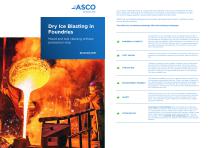
As in many industrial sectors, mould and tool cleaning is of utmost importance for foundries. Optimum cleaning of the moulds and core boxes is particularly important, as this not only increases quality, but also optimizes productivity and costs. ASCO has successfully developed an innovative cleaning process which is perfectly suited for the foundry industry. Dry Ice Blasting in Foundries Mould and tool cleaning without production stop The ASCO dry ice blasting technology offers the following advantages: POWERFUL & GENTLE The hardness of dry ice pellets can be compared to the hardness of chalk. As a result, the surface structure of the cleaning surface is not damaged or changed in any way. Dry ice blasting is a gentle yet effective cleaning method. Unlike steel brushes or scrapers, dry ice blasting does not damage materials. ASCO’s unique nozzle technology with sophisticated aerodynamic flow behavior ensures optimum blasting result. COST SAVING Downtime of the objects or machines to be cleaned, interruptions of production and expensive disposal of hazardous waste are eliminated. TIME SAVING Cleaning of machines, tools, moulds, conveyors, etc. can be performed during the ongoing production process. Since this cleaning technology is dry and non-abrasive, it can be applied directly onto the object to be cleaned. This way, downtime can be reduced to a minimum. Cooling or, conversely, heating of tools is not necessary, This saves valuable time. ENVIRONMENT FRIENDLY The pellets immediately change to a gaseous state on impact. Only the removed contamination remains. There is no need to dispose of the cleaning media. This reduces waste dramatically! No sewage - or cleaning and filtration of wastewater. No contamination by hazardous additives, chemicals etc. No remains of the cleaning media. Dry ice is basically non-toxic. Cleaning with dry ice is a dry and non-conductive cleaning process. By eliminating the use of sulvents and hazardous chemicals the dry ice cleaning technology is safe for people and environment. The equipment is light, mobile, low in maintenance, reliable and easy to operate. Advantages of combi-blasting: After prolonged dry ice blasting when removing coating in the mould, microparticles of the coating are compressed into the surface of the moulds, which leads to a smooth surface. On this smooth surface, the coating no longer holds, which makes abrasive cleaning of the mould necessary. This can be achieved with the ASCOJET 1708 Combi Blaster by supporting dry ice blasting at the push of a button with minimal use of abrasive additive.
Open the catalog to page 1
How is this blasting method used? The ASCO Dry Ice Blasting Technology offers the possibility of cleaning dismantled moulds in cabins or of performing the cleaning operation directly on the mounted hot moulds. Many gravity die casting foundries use the second option to avoid expensive production stops and to attain higher quality thanks to more frequent cleaning. The moulds are not damaged, because the blasting material is non-abrasive. In practice, cleaning is nowadays done more often to completely avoid aluminum residues on the moulds surface. For instance, manufacturers of high quality aluminum...
Open the catalog to page 2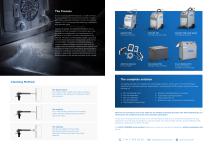
The Process Dry ice is produced from liquid CO2 . Inside an ASCO dry ice pelletizer, the liquid carbon dioxide is expanded under controlled conditions to form dry ice snow (approx. -79 °C) is pressed into pellets by a corresponding extruder plate. The dry ice pellets are filled into the ASCO dry ice blasting unit and conveyed to the blasting gun. Here the pelets are accelerated with compressed air to a speed of up to 300 m/s and hit the moulds to be cleaned. The impact of the pellets creates a punctual thermal shock and kinetic energy which removes the contamination. The pellets immediately change...
Open the catalog to page 3All ASCO CARBON DIOXIDE catalogs and technical brochures
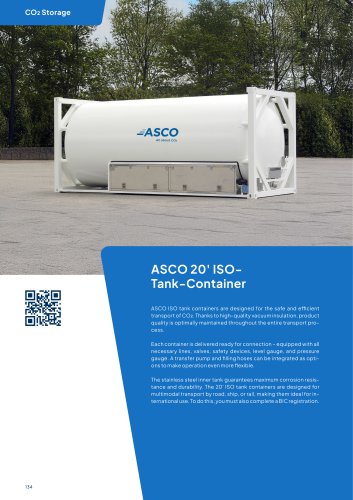 20' ISO-Tank Container
4 Pages
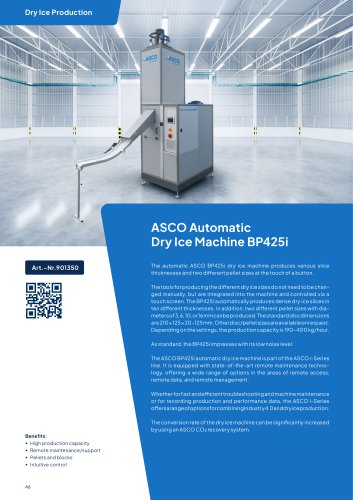 Dry Ice Machine BP425i
5 Pages
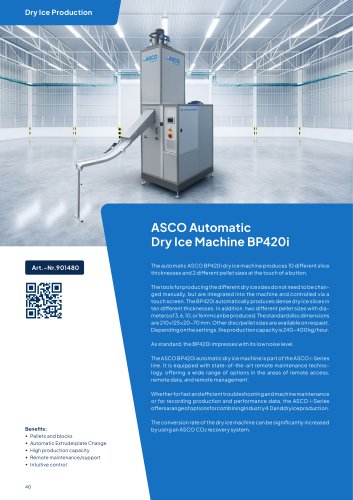 Dry Ice Machine BP420i
5 Pages
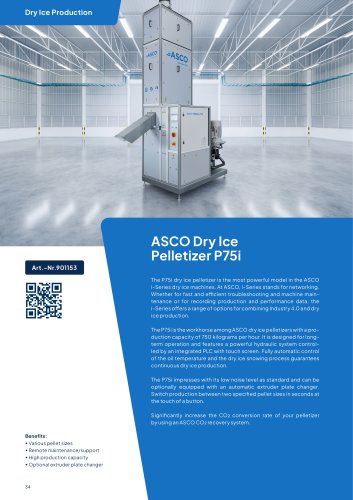 Dry Ice Pelletizer P75i
6 Pages
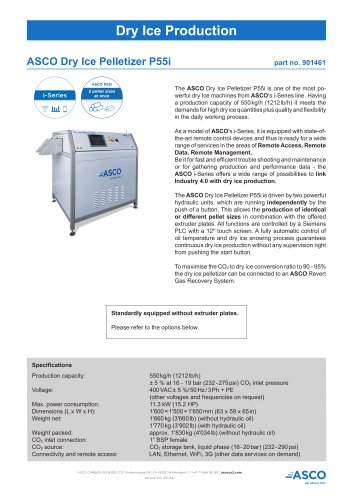 Dry Ice Pelletizer P55i
3 Pages
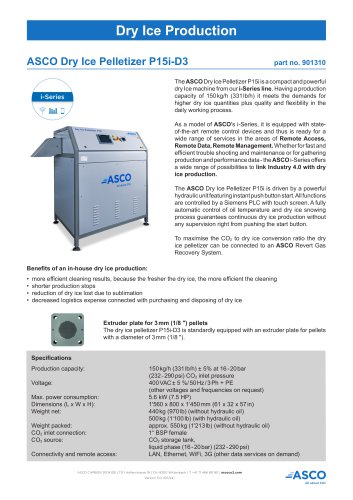 Dry Ice Pelletizer P15(i)
3 Pages
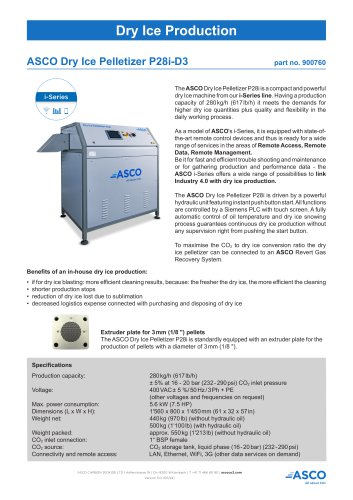 Dry Ice Pelletizer P28(i)
3 Pages
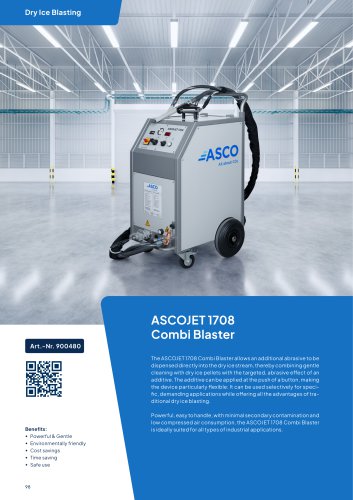 Dry Ice Blasting Unit 1708
8 Pages
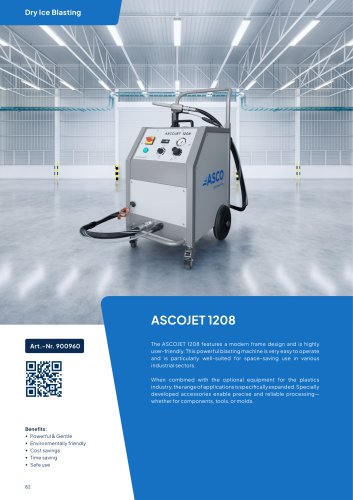 Dry Ice Blasting Unit 1208
7 Pages
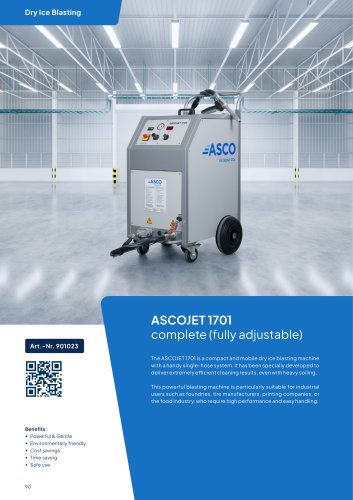 Dry Ice Blasting Unit 1701
8 Pages
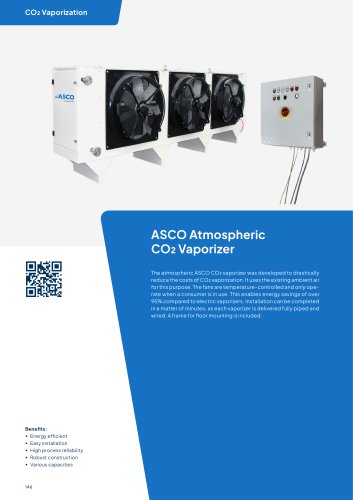 Atmospheric CO2 Vaporiser
8 Pages
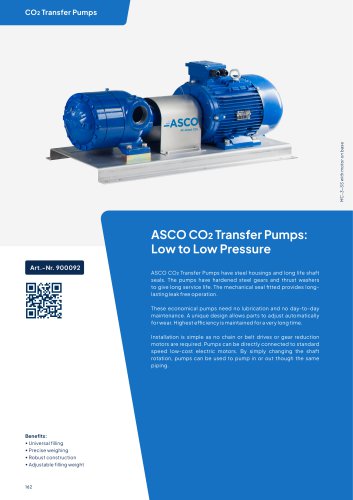 CO2 Transfer Pump
3 Pages
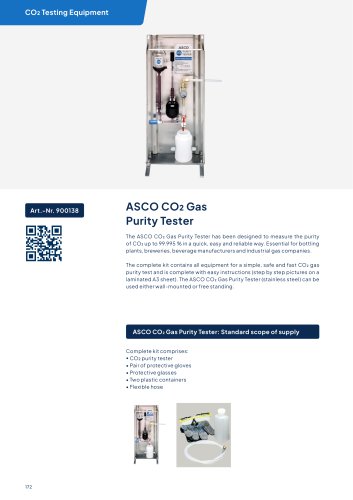 CO2 Gas Purity Tester
2 Pages
 CO2 Carbonation Tester
1 Page
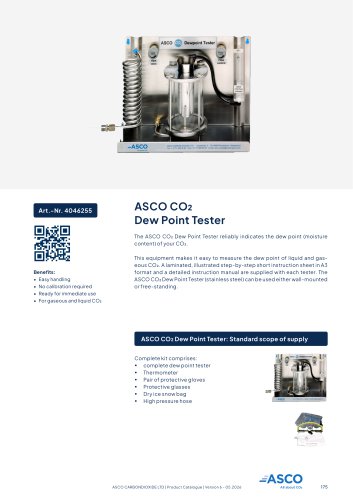 CO2 Dew Point Tester
1 Page
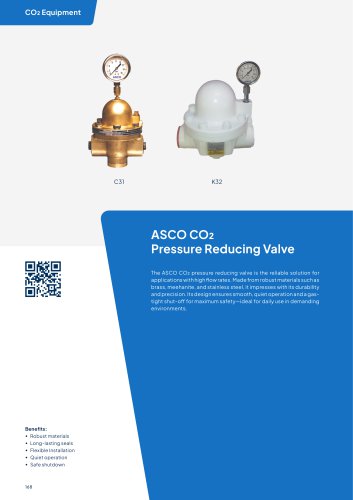 Pressure Reducing Valve
2 Pages
 CO2 Gas Detector
2 Pages
 Dry Ice Box AT126
1 Page
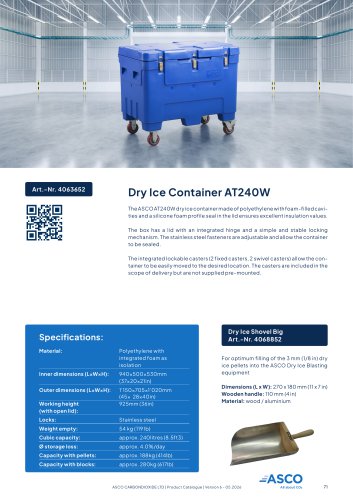 Dry Ice Container AT240W
1 Page
 Dry Ice Container AT440
1 Page
 CO2 Transfer Pumps
3 Pages
 Transportable CO2 Tank
2 Pages
 Dry Ice Reformer R70i
3 Pages
 Company Brochure
146 Pages
 Overview Dry Ice Production
3 Pages
 ASCO Carefree Rental Options
3 Pages
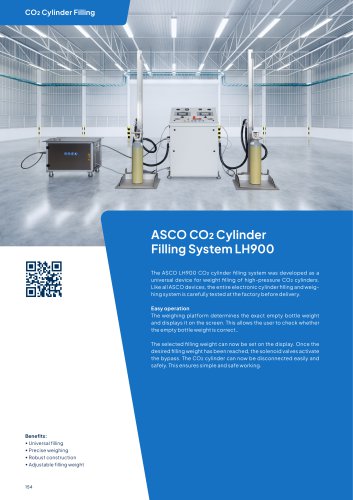
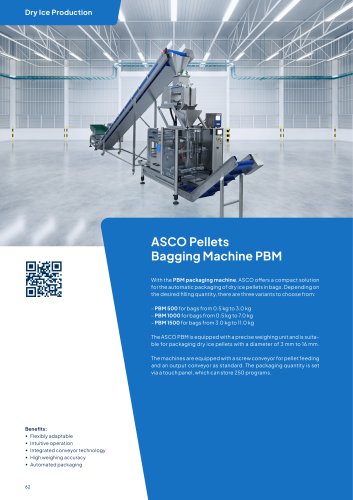



- Pump
- Industrial pump
- Valve
- Pump with electric motor
- Stationary pump
- Stainless valve
- Flowmeter
- Vessel
- Regulating valve
- Transfer pump
- Gas analyzer
- Storage vessel
- Packing machine
- Storage industrial bin
- Fully automatic filling machine
- Automatic packaging machine
- Gas flow monitor
- Metal tank
- Valve for industrial applications
- Transport industrial bin