
- Catalogs
- Ascential Technologies, Test & Measurement Systems
- Principles of dynamic balancing


Principles of dynamic balancing
Principles of dynamic balancing
Balancing is a technique used to correct unbalanced rotors, reducing noise and vibration, and improving machinery quality, safety, and lifespan. Unbalance results from uneven mass distribution around the rotation axis, often due to manufacturing imperfections.
1. Dynamic Unbalance: Involves axial and radial forces, corrected in two or more planes. Common in electric rotors, pumps, crankshafts, and turbines.
2. Static Unbalance: A pure radial force corrected in a single plane using the equation U=m*r.
3. Couple Unbalance: Results from opposite forces causing rocking or wobbling, corrected in two planes using U=m*r*d.
Unbalanced rotors can lead to reduced bearing life, increased noise and vibration, operating stress, power losses, and safety hazards such as overheating, fire risk, and rotor failure.
ISO 21940 defines acceptable residual unbalance in rotating machinery, ensuring safety, reliability, and quality consistency.
Balancing involves rotating the component to detect heavy spots using precision equipment. Corrections are made by removing or adding material to achieve balance.
Modern machines use automatic correction systems like welding, milling, and drilling to apply precise adjustments. Advanced machines can handle multiple corrections simultaneously, reducing cycle times.
Ascential Technologies specializes in diagnostics, inspection, and test processes across various industries, leveraging over 70 years of experience and a global presence to enhance innovation and safety.
Catalog excerpts
Technologies | Test & Measurement Systems Principles of dynamic balancing
Open the catalog to page 1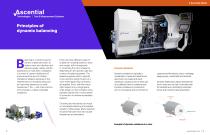
\\ Ascential eBook Principles of dynamic balancing alancing is a method used to correct unbalanced rotors to reduce noise and vibration and improve quality, safety and life expectancy of machinery. Unbalance is a result of uneven distribution of mass around the axis of rotation. Unbalance happens because of tiny imperfections in manufacturing such as machining tolerances or small clearances in fits — just a few microns off is enough to create noticeable unbalance. There are three different types of unbalance including dynamic, static and couple, with the approach to correcting the rotor unbalance...
Open the catalog to page 2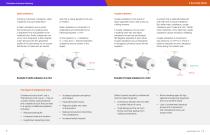
\\ Ascential eBook Priniciples of dynamic balancing Static unbalance Couple unbalance Contrary to dynamic unbalance, static unbalance is a pure radial force. axis that is nearly parallel to the axis of rotation. A static unbalance occurs when the inertial axis of a rotating mass is displaced from and parallel to the rotational axis. Static unbalances can occur more frequently in disk-shaped rotors because the thin geometric profile of the disk allows for an uneven distribution of mass with an inertial Static unbalance is corrected in a single plane and achieved by the following equation: U=m*r....
Open the catalog to page 3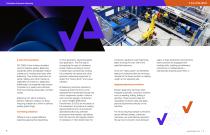
Priniciples of dynamic balancing \\ Ascential eBook A look at the standards ISO 21940 is the industry standard used for balance quality. Balancing standards define acceptable residual unbalance in rotating machinery after balancing. They ensure machines run safely, reliably and within tolerance, regardless of industry or application. Additionally, the standard helps ensure consistency in quality and customer trust by providing measurable, certified results. Balancing isn't about achieving "perfect" balance; instead, it's about reducing unbalance to within a defined quality grade range. Different...
Open the catalog to page 4
Technologies | Test & Measurement Contact us today to discuss how we can help tackle your toughest, most complex challenges and unlock the performance of your business. About Ascential Technologies Ascential Technologies solves the most challenging problems where the cost of failure is high. We design, develop, and automate complex diagnostics, inspection, and test processes across medical & life science, transportation, and test & measurement end markets. With 70+ years of experience, 2,300+ experts, and over 40 locations across the globe, Ascential Technologies leverages the power of science...
Open the catalog to page 5All Ascential Technologies, Test & Measurement Systems catalogs and technical brochures
 Hydrocarbon line accessories
8 Pages
 Ascential Care
3 Pages
 AECD & OBD Training Series
4 Pages
 Kion M
4 Pages
 Turbocharger Balancing Machines
12 Pages
 eRotor Balancer Machine Series
16 Pages
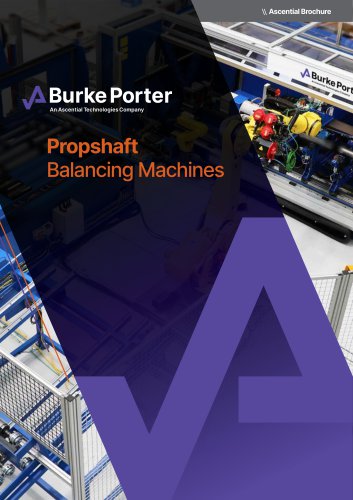 Propshaft Balancing Machines
16 Pages
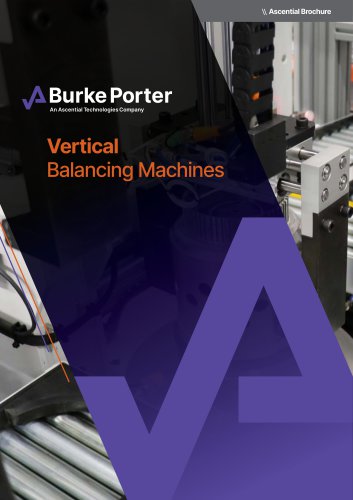 Vertical Balancing Machines
16 Pages
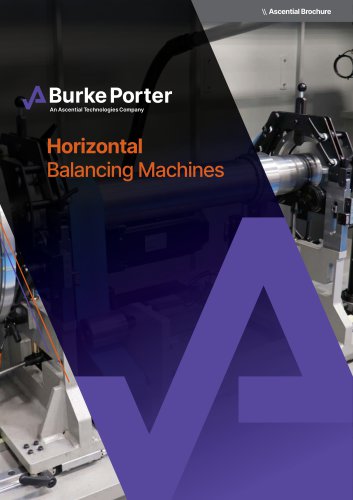 Horizontal Balancing Machines
16 Pages
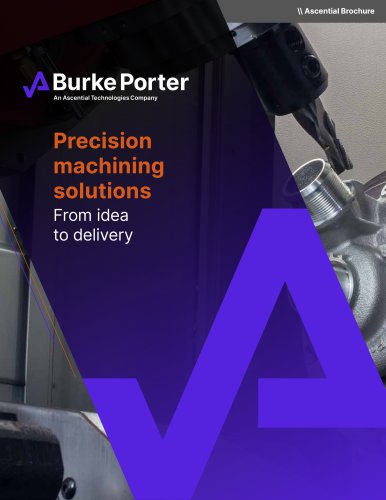 Precision machining solutions
8 Pages
 GLOBAL SUPPLY CHAIN REQUIREMENTS
18 Pages
 CMT-VSR
3 Pages
 CMT-VSR big
3 Pages
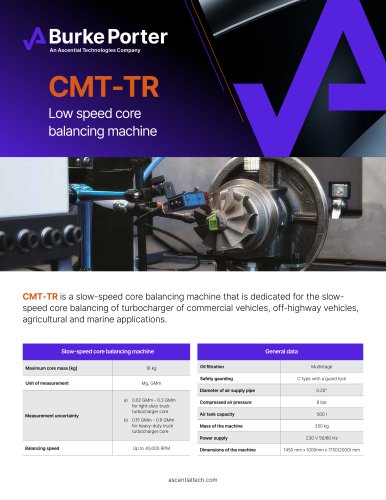 CMT-TR
2 Pages


- CIMAT balancing machine
- Automatic test kit
- Leak monitor
- CIMAT dynamic balancing machine
- CIMAT horizontal balancing machine
- Gas leak detector
- Rotor balancing machine
- Automatic balancer
- CIMAT vertical balancing machine
- Recuperator
- CIMAT high-accuracy balancing machine
- Compact test kit
- Two-plane balancing machine
- Fan balancing machine
- Universal balancing machine
- Compact balancing machine
- Static balancing machine
- Gauge for the automotive industry
- Manual balancing machine
- Shaft balancing machine
 鄂公网安备42018502009509号 -