
- Catalogs
- Ascential Technologies, Test & Measurement Systems
- The importance of ADAS calibration for collision prevention and road safety


The importance of ADAS calibration for collision prevention and road safety
The importance of ADAS calibration for collision prevention and road safety
Advanced Driver Assistance Systems (ADAS) are vital for enhancing vehicle safety by reducing crash rates. However, their effectiveness is highly dependent on precise calibration. This document examines the impact of ADAS on crash prevention, the consequences of improper calibration, and the necessity of recalibration after collisions.
Properly calibrated ADAS features like automatic emergency braking (AEB) and lane departure warning (LDW) significantly reduce crashes. For example, vehicles with forward collision warning (FCW) and AEB see about 50% fewer rear-end collisions, while LDW systems reduce single-vehicle and head-on crashes by 11%.
ADAS systems require precise sensor calibration. Misalignment can render these systems ineffective, leading to false warnings or failure to detect hazards. Common causes of miscalibration include collisions and routine maintenance like windshield replacements.
Recalibrating ADAS components after a collision is crucial. Many drivers report ADAS issues post-repair, especially after windshield replacements. Improper calibration can lead to a false sense of security, increasing the risk of accidents.
Repairers have a legal and ethical obligation to follow OEM calibration requirements. Skipping or improperly performing calibrations can compromise vehicle safety systems and expose repairers to liability.
Failing to calibrate ADAS after repairs can lead to safety risks and legal repercussions. Calibration is essential for returning a vehicle to a safe operating condition and should not be considered optional.
Unlike traditional safety systems, ADAS requires periodic recalibration due to sensor drift and environmental factors. Regular checks are recommended, especially for older vehicles.
Testing on a 2024 Nissan Altima showed that proper calibration significantly enhances ADAS performance. Poor calibration leads to system failures and increased collision risk.
ADAS calibration is gaining attention from regulators, insurers, and automakers. Proper calibration is essential to meet future federal safety mandates like FMVSS 127.
Insurance companies require proof of calibration to ensure safety systems function correctly. Automakers insist on recalibration after specific events and often require OEM parts to avoid issues.
The repair industry is investing in new equipment and training to meet calibration challenges. Proper ADAS repair is essential to avoid legal risks, and shops are increasingly performing in-house calibrations.
ADAS calibration is essential for maintaining vehicle safety. Skipping calibration can lead to dangerous failures, while proper calibration ensures ADAS functions as a protective measure on the road.
Catalog excerpts
\\ Ascential White Paper Test & Measurement Systems The importance of ADAS calibration for collision prevention and road safety An Ascential Technologies Brand ™ An Asrpntfal Terhnnlnnles Rranri
Open the catalog to page 1
\\ Ascential White Paper As ADAS technologies advance, proper calibration becomes essential for both safety and legal compliance ^Ascential Technologies | Test & Measurement Systems . minimum performance L-/—)"" J calibration accuracy have l// \ never been higher. The performance of Advanced Driver Assistance Systems (ADAS) is highly dependent on precise sensor calibration. As ADAS technology becomes increasingly standard in modern vehicles, maintaining system accuracy post-repair is no longer a best practice, it is a necessity for ensuring safety, functionality and regulatory compliance. This...
Open the catalog to page 2
The importance of ADAS calibration for collision prevention and road safety Introduction Advanced Driver Assistance Systems (ADAS) can dramatically improve vehicle safety but only if they are properly calibrated. Below, we explore how effective ADAS is at preventing crashes, what happens when ADAS sensors aren't calibrated correctly, why post-collision recalibration and routine checks are essential, and the broader industry implications. The evidence, including statistics, studies and real-world examples makes a compelling case that ADAS calibration must be a priority after repairs and as part...
Open the catalog to page 3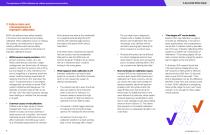
\\ Ascential White Paper The importance of ADAS calibration for collision prevention and road safety ADAS only delivers these safety benefits if its sensors and cameras are accurately calibrated. When calibration is poor or missing, the systems can malfunction or become entirely ineffective with serious safety consequences. Key points on the impact of improper calibration include: sADAS sensors require precision: ADAS sensors (cameras, radars, etc.) are finely tuned devices, and even a slight misalignment can throw them off. Industry experts note that if a sensor's aim is off by just one degree...
Open the catalog to page 4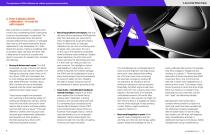
\\ Ascential White Paper The importance of ADAS calibration for collision prevention and road safety 3. Post-Collision ADAS calibration – A must for safe repairs After a vehicle is involved in a collision (even a minor one), recalibrating ADAS components is not just recommended, it is essential. The vehicle has absorbed forces that almost certainly shifted sensor positions or damaged their mounts, and repairs themselves (panel replacements, new windshields, etc.) often disturb the sensors. Failing to recalibrate after an accident repair can leave the driver with a false sense of security or a...
Open the catalog to page 5
\\ Ascential White Paper The importance of ADAS calibration for collision prevention and road safety onboard diagnostics and still dramatically impair performance.12 4. ADAS calibration as a routine maintenance requirement The John Eagle collision case: This case serves as a cautionary tale for the ADAS industry: a body shop deviated from OEM repair procedures bonding a roof instead of welding it, which lead to catastrophic structural failure in a crash and a $31.5 million jury verdict.16 The same principle applies to ADAS: when repairers skip or improperly perform calibrations, they compromise...
Open the catalog to page 6
The importance of ADAS calibration for collision prevention and road safety vehicles were 5+ years old, implying their systems were still functioning well.6 This suggests that catastrophic drift is not inevitable in the short term. However, not all degradation is immediate or obvious to the driver, and a car that's been through rough use may tell a different story than one gently driven on smooth roads. Given the stakes, many in the industry err on the side of caution, if there's any doubt, it's wise to verify sensor calibration periodically. This might be especially true if you notice the ADAS...
Open the catalog to page 7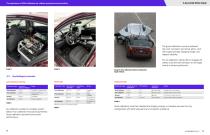
\\ Ascential White Paper The importance of ADAS calibration for collision prevention and road safety The good calibration scenario delivered the most consistent and timely alerts, with the longest average stopping margin and highest reliability. The no calibration vehicle did not engage the brakes at all and had full impact to the target vehicle in all tests performed. Image 1 Image 3: Non calibrated vehicle crashing into target vehicle. Lane departure warning Calibration type Avg. alert distance (Right) Calibration Type Avoidance rate Calibration type Good Calibration Consistent, symmetric alerts...
Open the catalog to page 8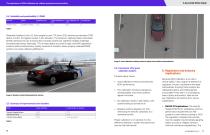
The importance of ADAS calibration for collision prevention and road safety \\ Ascential White Paper 5.4 Variability and predictability (-) PAEB 5.6 Conclusion: Why good calibration matters The data clearly shows: s Good calibration restores and enhances ADAS performance. s Poor calibration introduces dangerous unpredictability, even when systems appear functional. s No calibration results in silent failure, with systems failing to activate at all. s Baseline systems degrade over time, reinforcing the need for calibration as a maintenance item. Proper calibration is not optional. It is the difference...
Open the catalog to page 9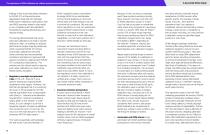
\\ Ascential White Paper The importance of ADAS calibration for collision prevention and road safety findings in this study have direct relevance to FMVSS 127, as the performance degradation observed with improper ADAS sensor calibration, particularly in CIB and PAEB scenarios where it could result in non-compliance with the standard's thresholds for braking effectiveness and reaction timing. The testing demonstrated that poorly executed calibrations can lead to system failures (no alert, no braking) or reduced performance (longer stopping distances), which would fail FMVSS 127 criteria. Conversely,...
Open the catalog to page 10
\\ Ascential White Paper The importance of ADAS calibration for collision prevention and road safety dealerships and certified collision centers to uphold these standards. To support shops, automakers provide training and sometimes build calibration facilities (for example, special alignment bays). As ADAS becomes ubiquitous, OEMs are also exploring more automated self-calibration (for example, some new systems can self-check alignment via software routines), but these are still in early stages. Until then, the OEM message is: "If you disturb it, you must calibrate it." They want their safety...
Open the catalog to page 11All Ascential Technologies, Test & Measurement Systems catalogs and technical brochures
 Hydrocarbon line accessories
8 Pages
 Ascential Care
3 Pages
 AECD & OBD Training Series
4 Pages
 Kion M
4 Pages
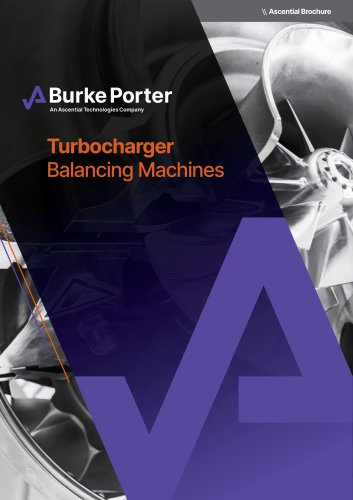 Turbocharger Balancing Machines
12 Pages
 eRotor Balancer Machine Series
16 Pages
 Propshaft Balancing Machines
16 Pages
 Vertical Balancing Machines
16 Pages
 Horizontal Balancing Machines
16 Pages
 Precision machining solutions
8 Pages
 GLOBAL SUPPLY CHAIN REQUIREMENTS
18 Pages
 CMT-VSR
3 Pages
 CMT-VSR big
3 Pages
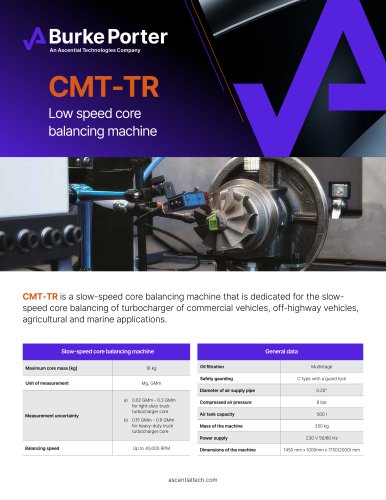 CMT-TR
2 Pages


- CIMAT balancing machine
- Automatic test kit
- Leak monitor
- CIMAT dynamic balancing machine
- CIMAT horizontal balancing machine
- Gas leak detector
- Rotor balancing machine
- Automatic balancer
- CIMAT vertical balancing machine
- Recuperator
- CIMAT high-accuracy balancing machine
- Compact test kit
- Two-plane balancing machine
- Fan balancing machine
- Universal balancing machine
- Compact balancing machine
- Static balancing machine
- Gauge for the automotive industry
- Manual balancing machine
- Shaft balancing machine
 鄂公网安备42018502009509号 -