
- Catalogs
- Ascential Technologies, Test & Measurement Systems
- EC or UT: that’s the question for roll inspection


EC or UT: that’s the question for roll inspection
EC or UT: that’s the question for roll inspection
The document emphasizes the importance of roll inspection in rolling mills to maintain roll quality, prevent defects, and minimize downtime. It introduces Eddy Current (EC) and Ultrasound (UT) as primary inspection methods, highlighting their capabilities and advantages.
Rolling mills face demands for longer campaigns and higher quality products. Roll quality is crucial as defects can lead to product imperfections and downtime. Regular inspection is necessary to maintain performance.
- Eddy Current (EC) Inspection: Uses an electrical coil to detect surface changes, identifying cracks and bruises through the analysis of eddy currents.
- Ultrasound Inspection: Uses sound waves to detect internal discontinuities, employing transducers and diagnostic units to calculate defect depth.
- Basic Principle: An electrical coil generates a magnetic field, creating eddy currents that indicate defects.
- Signal Processing: Demodulation separates crack and bruise signals using high-pass and low-pass filtering.
- Array Sensors: Multiple coils cover a wide area for efficient scanning, using different modes to enhance detection.
A case study shows a roll surface defect leading to product rejection due to limitations in previous EC technology.
Advanced roll inspection systems, like Ascential Technologies' EC array sensor, offer reliable detection of small cracks and allow for future updates to enhance performance.
The LRI system suppresses noise from material variations, improving crack detection. It uses reflection mode for clearer identification.
Normal Beam (NB) Sensors: Detect internal defects but have a 'dead zone' near the surface.
Surface Waves (SW): Inspect the roll surface and detect small cracks up to 5mm deep.
EC is sensitive to surface defects, while SW and UT are used for sub-surface inspection. Combining these methods ensures thorough defect detection.
The UTC sensor combines NB and SW technologies, increasing scan width and improving inspection efficiency.
Users should understand their requirements before investing in inspection units. Ascential Technologies offers over 30 configurations to meet diverse needs.
Ascential Technologies specializes in diagnostics and inspection across industries, focusing on innovation and safety with over 70 years of experience.
Catalog excerpts
Technologies | Test & Measurement Systems
Open the catalog to page 1
\\ Ascential White Paper In general, rolling mills are facing ever-increasing demands to improve its performance. Longer rolling campaigns, producing higher quality product and minimize mill downtime is where the focus lies. EC or UT: that’s the question for roll inspection Introduction In this paper we present the strength of each individual automated roll quality inspection method that’s available on the market. Based on clear, practical roll quality issues (which occurred for different roll users) and the technical background of the Eddy Current (EC) and Ultrasound technique, a clear understanding...
Open the catalog to page 2
\\ Ascential White Paper EC or UT: that’s the question for roll inspection Application 1 - Eddy currents Inspection area: Surface Most cracks and bruises initiate during the rolling process. The more aggressive or instable the rolling process is, the higher the chance of severe rolling accidents occurring, which eventually leads to defects at the surface of the roll. Automated inspection of this area can be done by means of generating ECs on the surface or by means of ultrasound surface waves. The latter one is described in ‘Application 3’ in this paper. Basic principle of inspection by means...
Open the catalog to page 3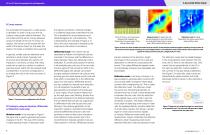
\\ Ascential \\ Ascential White eBook Paper EC or UT: that’s the question for roll inspection EC array sensors For automated roll inspection, a wide sensor is desirable. In order to fully scan the roll surface a helical path shall be followed. The roll rotates and the sensor moves sideways across the length of the roll. For every roll rotation, the sensor can be moved with the width of the sensor head. So, the wider the head is, the faster a complete roll is scanned. In general, smaller coils are relatively more sensitive to small cracks. Typically coils of around 4mm diameter are used for roll...
Open the catalog to page 4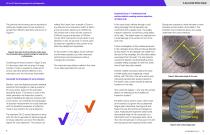
\\ Ascential White Paper EC or UT: that’s the question for roll inspection Industrial Case 1 - Undetected roll surface defect causing serious rejection of rolled strip This physical shortcoming can be resolved by setting up multiple pairs of coils oriented in at least four different directions and shown in Figure 6. Figure 6: Four pairs of coils in reflection mode, these four orientations give a smooth coverage for small cracks in all directions. Combining the theory shown in Figure 5 and 6, it becomes clear that an array of a large number of coils is required to create an EC sensor head that...
Open the catalog to page 5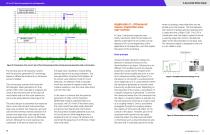
\\ Ascential White Paper EC or UT: that’s the question for roll inspection Previous generation eddy current system Application 2 – Ultrasound waves. Inspection area: sub-surface LRI eddy current system In Case 1, ultrasound inspection was briefly mentioned. With this technique roll defects underneath the roll surface can be detected. Prior to the explanation of this application at roll inspection, we’ll first explain the basics of this technique. when not pulsing, these reflections can be picked up by the receiver. The time between the moment of pulsing and the received echo is called the time...
Open the catalog to page 6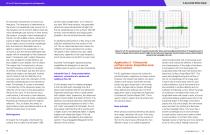
\\ Ascential White Paper EC or UT: that’s the question for roll inspection An important characteristic of sound is its frequency. The frequency is determined as the amount of wavelengths per second. So, if the frequency of the sound is higher, there are more wavelengths per second. In other words, the duration, or length of each wavelength is shorter. As with audible sounds, ultrasound waves of higher frequencies penetrate less into an object, due to its shorter wavelength. Also, the minimum detectable size of a defect is related to the wavelength. A rule of thumb is that the minimal detectable...
Open the catalog to page 7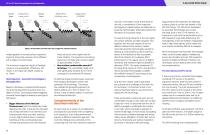
\\ Ascential White Paper EC or UT: that’s the question for roll inspection must be. To be able to scan all the areas of the rolls, a combination of the inspection techniques is needed. Below, we elaborate on Ascential Technologies’ philosophy behind the formation of its product range. Figure. 14 Schematic overview of the entry angles for ultrasound waves. widely applied for manual surface inspection. Figure 14 shows the overview of the different entry angles of sound waves. The maximum inspection depth of Rayleigh waves is one wavelength. Effectively, this results in an inspection depth usually...
Open the catalog to page 8
EC or UT: that's the question for roll inspection in the UTC sensor is identical to Ascential Technologies' existing SW sensor. That means the UTC sensor is able to detect axial and circumferential orientated defects with a depth range of 0-5mm. Best performing setup The UTC sensor can be applied in combination with the new EC sensor. With this configuration, roll shops will have state-of-the-art inspection technology to service rolls for the mill. To get the most out of both inspection techniques, each can have its own intelligent probe positioning system (IPPS) making independent scanning possible....
Open the catalog to page 9
.Ascential Technologies | Test & Measurement Systems Contact us today to discuss how we can help tackle your toughest, most complex challenges and unlock the performance of your business. About Ascential Technologies Ascential Technologies solves the most challenging problems where the cost of failure is high. We design, develop, and automate complex diagnostics, inspection, and test processes across medical & life science, transportation, and specialty industrial end markets. With 70+ years of experience, 2,300+ experts, and over 40 locations across the globe, Ascential Technologies leverages...
Open the catalog to page 10All Ascential Technologies, Test & Measurement Systems catalogs and technical brochures
 Hydrocarbon line accessories
8 Pages
 Ascential Care
3 Pages
 AECD & OBD Training Series
4 Pages
 Kion M
4 Pages
 Turbocharger Balancing Machines
12 Pages
 eRotor Balancer Machine Series
16 Pages
 Propshaft Balancing Machines
16 Pages
 Vertical Balancing Machines
16 Pages
 Horizontal Balancing Machines
16 Pages
 Precision machining solutions
8 Pages
 GLOBAL SUPPLY CHAIN REQUIREMENTS
18 Pages
 CMT-VSR
3 Pages
 CMT-VSR big
3 Pages
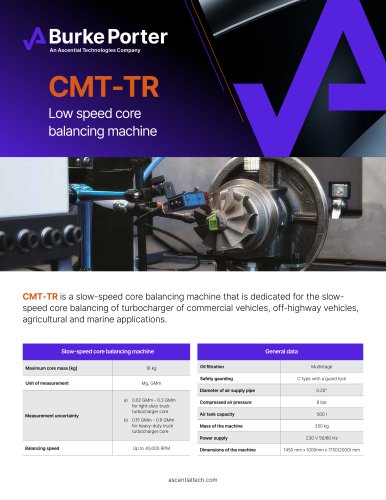 CMT-TR
2 Pages



- CIMAT balancing machine
- Automatic test kit
- Leak monitor
- CIMAT dynamic balancing machine
- CIMAT horizontal balancing machine
- Gas leak detector
- Rotor balancing machine
- Automatic balancer
- CIMAT vertical balancing machine
- Recuperator
- CIMAT high-accuracy balancing machine
- Compact test kit
- Two-plane balancing machine
- Fan balancing machine
- Universal balancing machine
- Compact balancing machine
- Static balancing machine
- Gauge for the automotive industry
- Manual balancing machine
- Shaft balancing machine
 鄂公网安备42018502009509号 -