

ASC P401A15

ASC P401A15
- Dynamic Ranges: ±50g, ±100g, ±500g
- Temperature Range: -55°C to +150°C
- Frequency Range: 0.5Hz to 15kHz
- Sensitivity: 100 mV/g (±50g), 50 mV/g (±100g), 10 mV/g (±500g)
- Shock Limit: 5000g
- Weight: 11 grams
- High temperature and frequency capabilities
- Hermetically sealed with isolated mounting surface
- Centre bolt for 360° cable orientation
- Miniature size and lightweight
- TEDS (Transducer Electronic Data Sheet) enabled
- High temperature testing
- Automotive and laboratory testing
- Gearbox vibration monitoring
- General purpose vibration and shock monitoring
- Health Usage & Monitoring Systems (HUMS)
- Excitation Voltage: 18 to 30 V DC
- Supply Current: 2 to 20 mA
- Output Impedance: <100 Ω
- Startup Time: 2 seconds
Catalog excerpts

High-temperature Piezoelectric Accelerometer ► Uniaxial ► IEPE (Integrated Electronic Piezoelectric) ► Stainless Steel Housing ► Voltage Output Dynamic Ranges ► High Temperature (+150°C) ► High Frequency (±1dB, 15kHz) ► Hermetically Sealed ► Isolated Mounting Surface ► Shear Design ► Centre bolt for 360° cable orientation ► Miniature size (11 grams) ► TEDS Piezoelectric IEPE Technology ASC's high-temperature centre bolt accelerometers are made of piezoelectric ceramics and are usable over a wide frequency range from 0.5Hz to 15kHz. The accelerometers are IEPE (lntegrated_Electronics PiezoElectric) sensors that produce an output voltage proportional to the input acceleration. The sensors feature a built-in preamplifier and a charge to voltage converter that transforms the high-impedance charge output from the piezoelectric ceramic (Lead Zirconate Titanate, PZT) into a low-impedance voltage output that is suitable to drive long cables. ASC's high-temperature IEPE sensors operate on a 2-20mA constant-current supply and use a two-wire coaxial cable for power input and signal output. Description Options ► Customised Cable Length ► DAkkS Calibration Applications ► High Temperature Testing ► Automotive Testing ► Laboratory Testing ► Gearbox Vibration Monitoring ► General Purpose Vibration & Shock Monitoring ► Test & Measurement Applications ► High Frequency Applications ► HUMS (Health Usage & Monitoring Systems) ASC's high-temperature IEPE uniaxial accelerometer, P401A15, is an analog voltage output sensor. Type P401A15 is designed for use in demanding high-temperature (150°C) vibration monitoring applications. The sensor is based on a piezoelectric annular shear design, which provides excellent immunity against base strain and temperature transients. ASC Type P401A15 features a stainless steel housing that is rugged, corrosion proof and chemical resistant. The sensor incorporates a welded hermetic contruction with the industry standard 10-32 UNF connector and can withstand shocks up to 5000g‘s. Type P401A15 has a through hole for centre bolt mounting, which permits 360° cable orientation. ASC Type P401A15 operates over a wide temperature range from -55°C to +150°C. MOUNTING HOLE FOR STANDARD #8 OR M4 SCREW- 2x, 0.027 [.69] SAFETY WIRE HOLES ■INSULATED MOUNTING SURFACE (HARD ANODIZED ALUMINUM) CENTER OF SEISMIC MASS- ■INSULATED MOUNTING SURFACE (HARD ANODIZED ALUMINUM) ASC GmbH ■ Advanced Sensors Calibration ■ LedererstraBe 10 ■ 85276 Pfaffenhofen ■ Germany ■ Tel. +49 (0) 8441 786 547 -0 ■
Open the catalog to page 1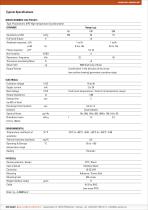
Typical Specifications Range (±g) MODEL NUMBER: ASC P401A15 Type: Piezoelectric IEPE High-temperature Accelerometer DYNAMIC Full Scale Output V Non-linearity %FSO Resonance Frequency kHz Shock limit ±g Output Polarity 5000 (half-sine, 0.3ms) Acceleration in the direction of the arrow (see outline drawing) generates a positive output 18 to 30 2 to 20 10±2 (room temperature) ; 10±4 (in full temperature range) <100 2 ELECTRICAL Excitation voltage V DC Supply current mA Bias Voltage V DC Output Impedance Q Startup time sec (to 90% of bias) Discharge Time Constant sec...
Open the catalog to page 2
FACTORY CALIBRATION (SUPPLIED WITH THE SENSOR) Range 50g 100g 500g CALIBRATION DIN ISO 17025 (ORDER SEPARATELY) 1Range 50g 100g 500g Frequency Response I: 0.5Hz to 100Hz I: 0.5Hz to 100Hz (Long-stroke shaker calibration) (Long-stroke shaker calibration) II: 10Hz to 10kHz II: 10Hz to 15kHz (High-frequency shaker calibration) (High-frequency shaker calibration) Sensor Type TEDS Range ASC Uniaxial IEPE High- 51 ±50g ACCESSORIES Cable Assembly for ASC Uniaxial IEPE Accelerometers KPU Cable for Uniaxial IEPE Accelerometer 10-32 UNF to BNC -55°C to +200°C ASC GmbH...
Open the catalog to page 3All ASC catalogs and technical brochures
 ASC 5421MF / ASC 5425MF
3 Pages
 ASC DiSens® MD
3 Pages
 ASC 4421MF / ASC 4425MF
3 Pages
 ASC 4321MF / ASC 4325MF
3 Pages
 ASC 4221MF
3 Pages
 ASC 4211LN
3 Pages
 ASC 4111LN
3 Pages
 ASC 3521MF
3 Pages
 ASC Angular Rate Sensors
3 Pages
 ASC Product Catalogue
52 Pages
 Honeywell_Mems_IMU_HG4930
2 Pages
 Honeywell IMU HG1120
2 Pages


Archived catalogs
 ASC 271 / ASC 273
3 Pages
 ASC 5521-MF / ASC 5525-MF
3 Pages
 ASC 5421-MF / ASC 5425-MF
3 Pages
 ASC 4421-MF / ASC 4425-MF
3 Pages
 ASC 4321-MF / ASC 4325-MF
3 Pages
 ASC IMU 7.X.Y
5 Pages
 ASC P203A11 / ASC P203A12
3 Pages
 ASC P101A25 / P101A15
3 Pages
 ASC 61C1
3 Pages
 ASC 4221
3 Pages
 ASC 3521
3 Pages
 ASC OS 115LN / OS 125MF
4 Pages
 ASC 5411LN / ASC 5415LN
3 Pages
 ASC 3511LN
3 Pages
 ASC 4421 / ASC 4425
3 Pages
 ASC 4321 / ASC 4325
3 Pages
 ASC 74C1
3 Pages
 ASC 4311LN / ASC 4315LN
3 Pages
 ASC 5721
3 Pages
 ASC OS 315LN
3 Pages
 ASC 5421/ ASC 5425
3 Pages
 ASC 5511LN/ ASC 5515LN
3 Pages
 ASC 5521/ ASC 5525
3 Pages
 ASC 66C1
3 Pages
 ASC 62C1
3 Pages
 ASC 4411LN / ASC 4415LN
3 Pages
 ASC 75C1
3 Pages
 ASC 76C1
3 Pages
 ASC OS 215LN
3 Pages
 ASC P311A15 / ASC P311A25
3 Pages


- Tilt sensor
- ASC 1-axis accelerometer
- Digital inclination sensor
- ASC 3-axis accelerometer
- ASC compact accelerometer
- MEMS inclination sensor
- ASC accelerometer with analog output
- High-precision tiltmeter
- IP67 inclination sensor
- ASC industrial accelerometer
- 1-axis tilt sensor
- ASC MEMS accelerometer
- ASC voltage output accelerometer
- ASC IP68 accelerometer
- ASC accelerometer with built-in electronics
- ASC rugged accelerometer
- High-sensitivity accelerometer