

ASC MEMS Capacitive Tilt Sensors

ASC MEMS Capacitive Tilt Sensors
Catalog excerpts

ASC MEMS Capacitive Tilt Sensors Uniaxial / Biaxial 4 / 8 Wire System Anodised Aluminium Housing Stainless Steel Housing Protection Class IP67 / IP68 Made in Germany ASC TS-91V1-090 (Uniaxial) Features Range: ±15°, ±90° DC Response High Resolution Low Temperature Coefficient of Bias Excellent Long-Term Bias Stability Wide Temperature Range High Shock Limit Tilt Sensors MEMS capacitive accelerometers measure both static and dynamic accelerations. Tilt is a static measurement where earth’s gravity is the acceleration being measured. The change in degrees of tilt corresponds to a change in acceleration due to a changing component of gravity that acts on the accelerometer. Low-g accelerometers with high sensitivity result in the highest degree of resolution of a tilt measurement. For a tilt from -90° to +90°, the ASC MEMS capacitive accelerometer experiences acceleration from -1g to +1g. The analog output from the tilt sensor (Vout) can be converted to the degree of tilt (Ø) using the following equation: Ø = arcsin ((Vout - Offset) / Sensitivity) Options Customised Cable Length Customised Connector 4-20mA Current Output Applications Crane Safety Systems Building Construction Machines Solar Array Tracking Systems Ship’s Navigation Posture Measurement Flap Bridge Monitoring Track Alignment & Maintenance Wheel Alignment Truck Chassis Levelling Machine Tool Angle Positioning ASC’s tilt sensors yield a nominal full scale output of ±2V for an acceleration of ±1g, which corresponds to a tilt of ±90°. The nominal bias or offset (output at 0g or 0°) is < ±10mV (< ±0.29°) and the output swing is from -2V to +2V with a linear response in the range < ±15°. Description ASC’s tilt sensors TS-9XVY, feature an analog voltage output and are available in two versions, uniaxial and biaxial. Biaxial tilt sensors contain two independent MEMS sensors oriented at 90° to each other to allow perpendicular tilt measurement. ASC’s tilt sensors feature either a light-weight anodized aluminium housing, which provides case isolation against ground loops or a robust stainless steel housing, which has an IP68 rating. The sensor sensitivity and bias is extremely stable over a wide temperature range from -40°C to +120°C. The sensors can be powered using a 6-36 VDC supply, where the output is independent of the supply. ASC’s tilt sensors can withstand shocks as 5000g and feature an aluminium housing (78g) or stainless steel housing (192g) with an integral cable. The sensors can be configured with a 4-20 mA current output as an option, by a temperature range from -20 to +70°C. Uniaxial (TS-91VY) All dimensions are in mm ASC GmbH · Advanced Sensors & Calibration · Ledererstraß
Open the catalog to page 1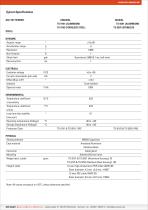
UNIAXIAL TS-91V1 (ALUMINIUM) TS-91V5 (STAINLESS STEEL) BIAXIAL TS-92V1 (ALUMINIUM) TS-92V5 (STAINLESS Typical Specifications ASC TILT SENSOR: STEEL) DYNAMIC Angular range ° ELECTRICAL Excitation voltage V DC +6 to +36 Current consumption (per axis) mA 2 Isolation Case Isolated Spectral noise °/VHz 0.001 ENVIRONMENTAL Temperature coefficient %/°C 0.03 of sensitivity Temperature coefficient °/°C 0.02 of bias Long-term bias stability ° 0.1 (one year) Operating temperature (Voltage) °C -40 to +120 Storage temperature (Voltage) °C -40 to +125 PHYSICAL Sensing element Case material Connector Mounting...
Open the catalog to page 2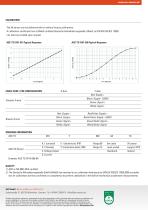
The tilt sensor can be delivered with or without factory calibrations. A calibration certificate from a DAkkS certified (Deutsche Akkreditierungsstelle, DAkkS, to DIN EN ISO/IEC 17025) can also be provided upon request. Y-Axis Red: Supply + Black: Supply - (GND) Green: Signal + White: Signal - Red: Supply + Red/Violet: Supply + Black: Supply - Black/Violet: Supply - (GND) Green: Signal + Green/Violet: Signal + White: Signal - White/Violet: Signal - X: 2 (biaxial) Y: 5 (stainless steel); IP68 V: Voltage Output C: Current 5V power supply 5 VDC (option) QUALITY 1) ASC is ISO 9001:2015 certified...
Open the catalog to page 3All ASC catalogs and technical brochures
 ASC 5421MF / ASC 5425MF
3 Pages
 ASC DiSens® MD
3 Pages
 ASC 4421MF / ASC 4425MF
3 Pages
 ASC 4321MF / ASC 4325MF
3 Pages
 ASC 4221MF
3 Pages
 ASC 4211LN
3 Pages
 ASC 4111LN
3 Pages
 ASC 3521MF
3 Pages
 ASC Angular Rate Sensors
3 Pages
 ASC Product Catalogue
52 Pages
 Honeywell_Mems_IMU_HG4930
2 Pages
 Honeywell IMU HG1120
2 Pages


Archived catalogs
 ASC 271 / ASC 273
3 Pages
 ASC 5521-MF / ASC 5525-MF
3 Pages
 ASC 5421-MF / ASC 5425-MF
3 Pages
 ASC 4421-MF / ASC 4425-MF
3 Pages
 ASC 4321-MF / ASC 4325-MF
3 Pages
 ASC IMU 7.X.Y
5 Pages
 ASC P203A11 / ASC P203A12
3 Pages
 ASC P101A25 / P101A15
3 Pages
 ASC P401A15
3 Pages
 ASC 61C1
3 Pages
 ASC 4221
3 Pages
 ASC 3521
3 Pages
 ASC OS 115LN / OS 125MF
4 Pages
 ASC 5411LN / ASC 5415LN
3 Pages
 ASC 3511LN
3 Pages
 ASC 4421 / ASC 4425
3 Pages
 ASC 4321 / ASC 4325
3 Pages
 ASC 74C1
3 Pages
 ASC 4311LN / ASC 4315LN
3 Pages
 ASC 5721
3 Pages
 ASC OS 315LN
3 Pages
 ASC 5421/ ASC 5425
3 Pages
 ASC 5511LN/ ASC 5515LN
3 Pages
 ASC 5521/ ASC 5525
3 Pages
 ASC 66C1
3 Pages
 ASC 62C1
3 Pages
 ASC 4411LN / ASC 4415LN
3 Pages
 ASC 75C1
3 Pages
 ASC 76C1
3 Pages
 ASC OS 215LN
3 Pages
 ASC P311A15 / ASC P311A25
3 Pages


- Piezoelectric accelerometer
- Tilt sensor
- Single-axis accelerometer
- IEPE accelerometer
- Digital inclination sensor
- Triaxial acceleration sensor
- Compact accelerometer
- MEMS inclination sensor
- Acceleration sensor with analog output
- High-precision tiltmeter
- IP67 inclination sensor
- Industrial accelerometer
- 1-axis tilt sensor
- MEMS accelerometer
- Voltage output accelerometer
- IP68 accelerometer
- Accelerometer with built-in electronics
- Rugged accelerometer
- High-sensitivity accelerometer