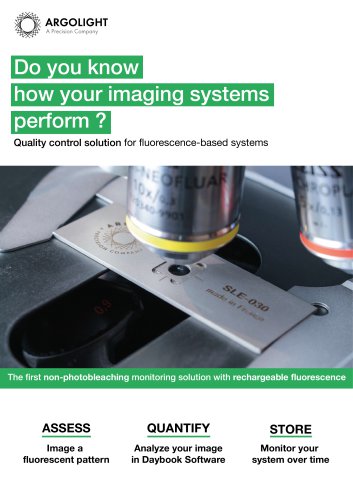
Argo-SIM Slide

Argo-SIM Slide
Argolight's Argo-SIM slides are designed for evaluating the performance of fluorescence-based imaging systems, particularly structured illumination microscopes and systems using deconvolution algorithms. The slides feature a special glass (ArgoGlass®) on a metal carrier with embedded fluorescent patterns, suitable for various contrast methods. These patterns are precisely positioned and stable under light exposure, with analysis facilitated by Argolight software.
Specifications
The patterns are located 170 ± 5 μm below the glass surface, emulating a microscope coverglass. The maximum positioning error is ± 110 nm in XY and Z directions, with a pattern thickness of 600 ± 200 nm FWHM. Patterns are excitable from 350 nm to 650 nm, with fluorescence efficiency decreasing towards the red spectrum. Under normal conditions, fluorescence intensity remains stable, with transient decreases under specific illumination that recover over time.
ArgoGlass® Description
ArgoGlass® is a specially produced glass ensuring homogeneity and purity, with a refractive index similar to microscope cover glasses.
Slide Compatibility
The slides are compatible with dry and oil immersion objectives, and with water immersion for exposures under five minutes.
Patterns Description
The slide contains 14 types of patterns, each with unique features:
- Pattern A: Concentric circles with radii from 10 μm to 120 μm.
- Pattern B: 2D matrix of 21 × 21 rings with landmarks and a central cross.
- Pattern C: 4 x 4 matrix of squares with varying fluorescence intensity.
- Pattern D: 2x16 matrix of rectangles with varying fluorescence intensity.
- Pattern E: Gradually spaced lines in four orientations.
- Pattern F: Matrix of crosses with varying spacing.
- Pattern G: Meridians of a sphere in different planes.
- Pattern H: Repositioning crosses spaced 500 μm apart.
- Pattern I: 3D crossing stairs with varying step sizes.
- Pattern J: Argolight logo with a surrounding frame.
- Pattern K: 3D matrix of rings in a defined volume.
- Pattern L: Matrix of rings on a background.
- Pattern M: Various geometrical figures.
- Pattern N: Grid with crosses in some squares.
Catalog excerpts

Spec sheet ARGOLIGHT ARGO-SIM slide for fluorescence imaging systems 02/2018 Introduction Argolight multidimensional slides are specifically designed for assessing and following the performances of fluorescence-based imaging systems. Argo-SIM slides are specifically designed for structured illumination microscopes, as well as any system exploiting deconvolution algorithms. The slides consist in a special glass piece (ArgoGlass®) set on a metal carrier. Different fluorescent patterns are embedded inside the glass. They also exhibit a contrast in bright and dark fields, DIC (Differential Interference Contrast) and phase contrast. The patterns are accurately positioned and stable to light illumination. The analysis of pattern images can be simplified using Argolight software solutions. Fluorescence properties Patterns are excitable from 350 nm to 650 nm. The emission is a broad continuum and the efficiency decreases as the excitation wavelength shifts towards the red. Fluorescence stability Under normal use (irradiances, either peak or average, no higher than 50 GW/cm2), the fluorescence spectrum for a given illumination setting is identical in shape and intensity to any similar part of the patterns. Under specific illumination configurations, the intensity of the patterns may decrease. However, this decrease is transient. The fluorescence intensity recovers to its initial value after some time. The recovery time depends on the irradiation conditions (power density, wavelength, pixel size, exposure time). This behaviour is reproducible. For a given intensity and exposure time, the rate of decrease and recovery time will always be the same. Read the full study at www.argolight.com. ArgoGlass® Description ArgoGlass® is a special glass produced at the Argolight facility to insure its homogeneity and purity. Its refractive index is similar to the one of microscope cover glasses. Imaging compatibility Objective compatibility The slides are compatible with dry and oil immersion objectives. The slides are compatible with water mmersion, but continuous exposure longer than five minutes should be avoided. Patterns inside the slide Patterns are positioned (170 ± 5) pm below the top glass surface, on a horizontal plane which flatness is within ± 5 mrad. This emulates the presence of a microscope coverglass, having a thickness of (170 ± 5) pm and a refractive index of (1.5255 ± 0.0015) at 546.1 nm. The maximum relative positioning error is ± 110 nm in XY and ± 110 nm in Z within each individual pattern. The thickness (in the Z direction) of these patterns is about (600 ± 200) nm FWHM (Full Width at Half Maximum). Patterns description can be found in the back of this spec sheet. Argolight - 2018 - [email protected] - www.argolight.com
Open the catalog to page 1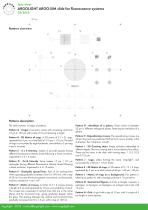
Spec sheet ARGOLIGHT ARGO-SIM slide for fluorescence systems 02/2018 Patterns overview Patterns description The slide contains 14 types of patterns. Pattern A - Target. Concentric circles with increasing radii from 10 μm to 120 μm with a step of 10 μm, featuring a target. Pattern B - 2D Matrix of rings. A 2D matrix of 21 × 21 rings, separated by 5 μm, on a total field of 110 μm × 110 μm. The field of rings is surrounded by eight landmarks, and exhibits a 3 μm long cross in its center. Pattern C - 4 x 4 Intensity. Sixteen 6 μm-wide squares having different fluorescence intensity levels following...
Open the catalog to page 2All Argolight catalogs and technical brochures
 Argo-LM
2 Pages
 ARGOLIGHT ARGO-HM
2 Pages
 ARGO-CHECK Resolution slide
2 Pages
 ARGOLIGHT ARGO-POWERHM
2 Pages
 Argo-LM Slide
2 Pages
 Argo-HM Slide
2 Pages