
- Catalogs
- Arcus Technology
- pmx-2ed-sa

- Products
- Catalogs
- News & Trends
- Exhibitions
pmx-2ed-sa
1 / 78 PagesView full catalog
pmx-2ed-sa
Product catalog summary
Introduction
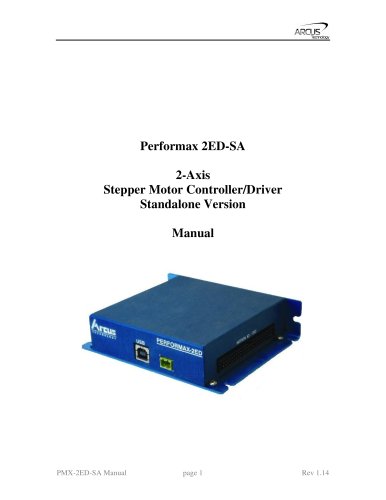
The PMX-2ED-SA is a sophisticated 2-axis stepper motor controller/driver designed for standalone operation. It supports USB communication and can execute standalone programs independently of a host.
The PMX-2ED-SA is a sophisticated 2-axis stepper motor controller/driver designed for standalone operation. It supports USB communication and can execute standalone programs independently of a host.
Features
- USB 2.0 communication
- Standalone programmability
- Maximum pulse output rate of 400K PPS
- Trapezoidal or s-curve acceleration
- On-the-fly speed change
- XY linear coordinated motion
- A/B/Z differential encoder inputs with a max frequency of 5 MHz
- StepNLoop closed loop control for position verification
- Opto-isolated I/O with 8 inputs and 8 outputs
- Various homing routines
- 2 x 10-bit analog inputs for joystick control
- Stepper driver with 12-24 VDC and 1.5 Amp max current setting
Electrical Specifications
- Power Requirement: +12 to +24 VDC, 1.5A peak current
- Operating Temperature: -20°C to +80°C
- Storage Temperature: -55°C to +150°C
- Pulse, Dir, Enable Outputs: Open-collector output, max sink voltage +24 VDC, max sink current 40 mA
- Digital Inputs: Opto-isolated inputs (NPN), voltage range +12V to +24VDC, max forward current 40 mA
- Digital Outputs: Opto-isolated outputs (NPN), max voltage +12V to +24VDC, max source current 90 mA
Dimensions
Detailed dimensions are provided in Figure 3.0.
Detailed dimensions are provided in Figure 3.0.
Pin Descriptions
- Controller Power: 2-pin connector for +12VDC to +24VDC input
- 4-Pin Connectors for X and Y-axis step motor phases
- Driver Power: Separate 2-pin connector for stepper driver power
- 50-Pin Control/Encoder IO: Includes encoder inputs, analog inputs, limit and home inputs, digital inputs/outputs
Getting Started
Instructions for typical setup and main control screen are provided.
Instructions for typical setup and main control screen are provided.
Motion Control Features
- Motion Profile and Pulse Speed
- On-The-Fly Speed and Target Position Change
- Homing and Jogging
- Motor Status and Position
- Polarity and Limits
- Digital and Analog Inputs/Outputs
- Joystick Control
Communication
Details on USB communication API functions and issues.
Details on USB communication API functions and issues.
Language Specifications
- ASCII Language Specification
- Standalone Language Specification
Example Standalone Programs
Includes single and multi-threaded examples.
Includes single and multi-threaded examples.
Appendix A: Speed Settings
Details on acceleration/deceleration range and positional move settings.
Details on acceleration/deceleration range and positional move settings.
Contacting Support
For technical support, contact [email protected] or your local distributor.
For technical support, contact [email protected] or your local distributor.
Connector and Interface Specifications
The document describes the PMX-2ED-SA interface circuit, including a 50-pin 0.1" connector from CW Industries (Part: C3AAG-5018M). Digital outputs are opto-isolated using Darlington transistors, capable of sinking up to 100mA at 24VDC. Digital inputs require a 12 to 24VDC opto-supply, and encoder inputs support both differential and single-ended connections. Analog inputs range from 0 to 5V with 10-bit resolution, supporting joystick control with a maximum source current of 10mA.
The document describes the PMX-2ED-SA interface circuit, including a 50-pin 0.1" connector from CW Industries (Part: C3AAG-5018M). Digital outputs are opto-isolated using Darlington transistors, capable of sinking up to 100mA at 24VDC. Digital inputs require a 12 to 24VDC opto-supply, and encoder inputs support both differential and single-ended connections. Analog inputs range from 0 to 5V with 10-bit resolution, supporting joystick control with a maximum source current of 10mA.
Driver Current and Microstep Settings
The PMX-2ED-SA includes two bipolar microstep drivers. Current settings are adjustable via jumper headers with preset options (1.2A, 1.0A, 0.7A, 0.5A) or custom settings using a resistor formula. Microstep settings are configured using SW1 and SW2 headers, offering 1/8, 1/4, 1/2, and full step options.
The PMX-2ED-SA includes two bipolar microstep drivers. Current settings are adjustable via jumper headers with preset options (1.2A, 1.0A, 0.7A, 0.5A) or custom settings using a resistor formula. Microstep settings are configured using SW1 and SW2 headers, offering 1/8, 1/4, 1/2, and full step options.
Control and Operation
The manual outlines PC-controlled and stand-alone operation setups. The main control screen provides status updates on pulse position, encoder position, speed, motor status, and StepNLoop status. Control features include setting global and individual speed parameters, target positions, and enabling driver power. On-the-fly speed and position changes are supported, with specific commands for each axis.
The manual outlines PC-controlled and stand-alone operation setups. The main control screen provides status updates on pulse position, encoder position, speed, motor status, and StepNLoop status. Control features include setting global and individual speed parameters, target positions, and enabling driver power. On-the-fly speed and position changes are supported, with specific commands for each axis.
Setup and Configuration
Setup options include polarity settings, boot configurations, homing parameters, joystick parameters, and StepNLoop parameters. Users can store settings to flash memory and download/upload configurations. The terminal allows command input and response viewing.
Setup options include polarity settings, boot configurations, homing parameters, joystick parameters, and StepNLoop parameters. Users can store settings to flash memory and download/upload configurations. The terminal allows command input and response viewing.
Programming and Compilation
The document details program file control, text programming, and compilation processes. Users can write, edit, compile, and download standalone programs. Program control features include running, stopping, pausing, and continuing programs, with status indicators for each state.
The document details program file control, text programming, and compilation processes. Users can write, edit, compile, and download standalone programs. Program control features include running, stopping, pausing, and continuing programs, with status indicators for each state.
Motion Control Features
The PMX-2ED-SA supports trapezoidal and S-curve velocity profiles, with commands for setting high/low speeds and acceleration/deceleration times. On-the-fly speed changes require specific command sequences, and motor status can be monitored via bit representation. Individual and linear interpolation moves are supported, with incremental and absolute modes available. Homing routines involve moving towards home or limit switches, with five different routines described.
The PMX-2ED-SA supports trapezoidal and S-curve velocity profiles, with commands for setting high/low speeds and acceleration/deceleration times. On-the-fly speed changes require specific command sequences, and motor status can be monitored via bit representation. Individual and linear interpolation moves are supported, with incremental and absolute modes available. Homing routines involve moving towards home or limit switches, with five different routines described.
Homing Routines:
- Home Input Only: The motor accelerates to high speed, resets position counter to zero upon home input trigger, decelerates, reverses to find the home switch, and stops after resetting the position counter again.
- Limit Only: The motor accelerates to high speed, stops upon limit trigger, reverses direction, and reaches zero position.
- Home and Z-index: The motor accelerates, decelerates upon home input trigger, searches for z-index pulse, and stops with position set to zero.
- Z-index Only: The motor starts at low speed, stops upon finding the z-index pulse, and sets position to zero.
Jogging and Stopping:
- Jogging allows continuous speed operation using specific commands.
- Motors can be stopped immediately or with deceleration using ABORT or STOP commands.
Motor and Encoder Position:
- Motor positions are read using PX/PY commands, and encoder positions using EX/EY commands.
- Setting positions manually is restricted if StepNLoop is enabled.
Polarity and Limits:
- Polarity settings can be adjusted using POLX/POLY commands.
- Limit switches stop the motor and set error states, which can be cleared or ignored with specific commands.
Digital and Enable Outputs:
- Digital inputs and outputs are controlled using DI and DO commands, with values referenced bit-wise.
- Enable outputs are controlled using EO commands, with initial states set via EOBOOT register.
Analog Inputs and Joystick Control:
- Two 10-bit analog inputs are available, with joystick control linked to these inputs.
- Joystick parameters include speed, limits, and tolerance settings, controlled via JV and JL variables.
StepNLoop Closed Loop Control:
- StepNLoop verifies position and monitors delta values, stopping the motor if errors exceed set ranges.
- Parameters include ratio, tolerance, error range, and correction attempts, controlled via SL commands.
Device Number and Standalone Program Specification:
- Device numbers are set using DN command and stored with STORE command.
- Standalone programs support multi-threading and error handling, with execution controlled via SR commands.
Storing to Flash
Table 6.11 outlines the parameters stored to flash memory, including device name, boot-up configurations, deceleration settings, home and limit correction amounts, polarity settings, S-curve enable, joystick settings, and standalone program parameters. Notably, variables V0-V31 reset to zero on boot-up.
Table 6.11 outlines the parameters stored to flash memory, including device name, boot-up configurations, deceleration settings, home and limit correction amounts, polarity settings, S-curve enable, joystick settings, and standalone program parameters. Notably, variables V0-V31 reset to zero on boot-up.
Communication
The PMX-2ED-SA supports USB 2.0 communication, utilizing Windows-compatible DLL API functions. Communication is efficient, with typical transaction times in milliseconds. Key functions include device enumeration, product string retrieval, communication handle management, timeout settings, and data transmission. Buffer flushing is recommended to resolve synchronization issues.
The PMX-2ED-SA supports USB 2.0 communication, utilizing Windows-compatible DLL API functions. Communication is efficient, with typical transaction times in milliseconds. Key functions include device enumeration, product string retrieval, communication handle management, timeout settings, and data transmission. Buffer flushing is recommended to resolve synchronization issues.
ASCII Language Specification
This section details the ASCII commands for device control, including motion commands (e.g., ABORT, ACC), input/output management (e.g., DI, DO), and configuration settings (e.g., DOBOOT, EDEC). Error codes are provided for troubleshooting command processing issues.
This section details the ASCII commands for device control, including motion commands (e.g., ABORT, ACC), input/output management (e.g., DI, DO), and configuration settings (e.g., DOBOOT, EDEC). Error codes are provided for troubleshooting command processing issues.
Standalone Language Specification
Commands for standalone programming are described, including motion control (e.g., ABORT, ABS), acceleration settings, and conditional logic. Comments are denoted with a semicolon (;).
Commands for standalone programming are described, including motion control (e.g., ABORT, ABS), acceleration settings, and conditional logic. Comments are denoted with a semicolon (;).
Overview: This document is a technical manual for the PMX-2ED-SA, detailing various commands and their syntax for controlling acceleration, deceleration, digital and analog inputs/outputs, and other functionalities.
1. Acceleration and Deceleration:
- ACC[axis]: Used to read or set individual acceleration values in milliseconds. Syntax includes reading and writing values directly or through variables.
- DEC[axis]: Similar to ACC, but for deceleration values.
2. Input/Output Controls:
- AI[1-2]: Reads analog input values ranging from 0-5000 mV.
- DI[1-8]: Reads digital input values. Performax 2ED has 8 digital inputs.
- DO[1-8]: Reads and writes digital output values. Performax 2ED has 8 digital outputs.
3. Motion Commands:
- JOG[axis]: Performs jogging using current speed and acceleration settings.
- HOME[axis][+ or -]: Performs homing using current speed and acceleration settings.
- HLHOME[axis][+ or -]: Performs low-speed homing.
4. Speed Settings:
- HSPD[axis]: Reads or sets high speed in pulses/second, with a range from 1 to 6,000,000.
- LSPD[axis]: Reads or sets low speed in pulses/second.
5. Conditional and Loop Commands:
- IF/ELSE/ELSEIF: Conditional checks for various arguments including numerical values, digital inputs/outputs, and motor status.
- WHILE/ENDWHILE: Looping structure for repeated execution based on conditions.
6. Joystick Control:
- JOYENA: Enables joystick feature for an axis.
- JOYHS[axis]: Sets high-speed settings for joystick control.
- JOYDEL[axis]: Sets maximum delta value for speed change in joystick control.
7. Program Control:
- PRG: Indicates the start of a program.
- END/ENDSUB: Marks the end of a program or subroutine.
- GOSUB: Calls a subroutine, with subroutine 31 reserved for error handling.
8. Additional Features:
- SCV[axis]: Enables or disables s-curve acceleration, affecting on-the-fly speed changes.
- SL[axis]: Enables StepNLoop control for an axis.
Conclusion: The manual provides comprehensive instructions for configuring and controlling the PMX-2ED-SA, with detailed syntax and examples for each command.
Overview: This document is a technical manual for the PMX-2ED-SA, detailing various commands and standalone programs for controlling motor movements. It includes specifications, syntax, examples, and operational guidelines for different commands and settings.
Key Sections:
1. Command Descriptions: The document provides detailed descriptions of commands such as SLY, SLS, SR, SSPD, SSPDM, STOP, STORE, SUB, TOC, V, WAIT, WHILE, X, Y, ZHOME, and ZOME. Each command includes syntax, usage examples, and notes on functionality.
2. Standalone Programs: Examples of standalone programs are provided, demonstrating single-thread and multi-thread operations. These programs illustrate tasks like moving motors to specific positions, using loops for repeated actions, and handling digital inputs and outputs.
3. Speed Settings: Appendix A outlines speed settings, including high-speed (HSPD) and low-speed (LSPD) values, speed windows, and acceleration/deceleration ranges. It provides formulas for calculating maximum acceleration based on speed settings.
4. Acceleration/Deceleration Range: The document explains how the controller calculates acceleration and deceleration for positional moves, including conditions for using acceleration values for ramp up and down, and when a triangle velocity profile is applied.
5. Contact Information: The document concludes with contact details for Arcus Technology, Inc.
Critical Information: The manual emphasizes the importance of understanding command syntax and operational parameters to effectively control motor movements. It also highlights the need to consider speed and acceleration settings to ensure optimal performance and avoid errors.
See more
All Arcus Technology catalogs and technical brochures
 ARCUS MOTION PRODUCT CATALOG
43 Pages
Archived catalogs
 pmx-4ex-sa
119 Pages
 pmx-4et-sa
108 Pages
 pmx-4cx-sa
60 Pages
 pmx-2ex-sa
79 Pages
 ace-sxe
88 Pages
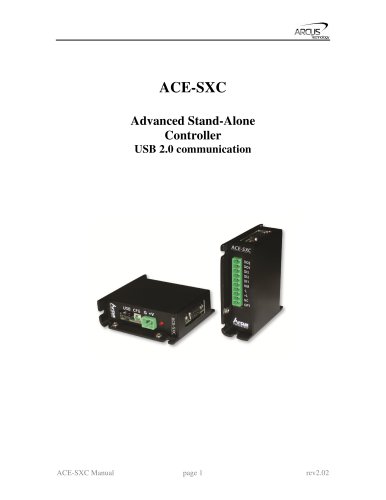 ace-sxc
66 Pages
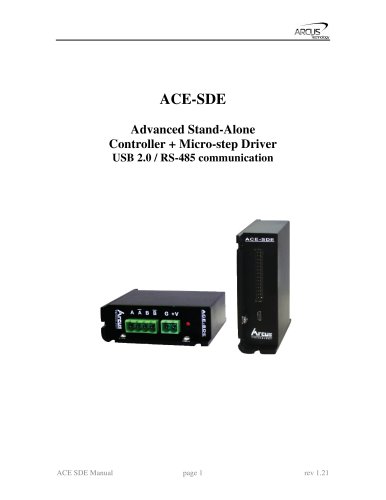 ace-sde
88 Pages
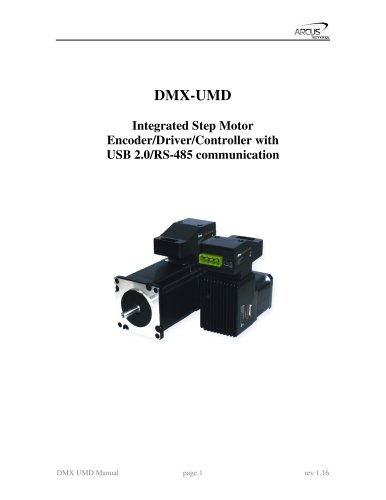 dmx-umd
87 Pages
 dmx-k-drv
32 Pages
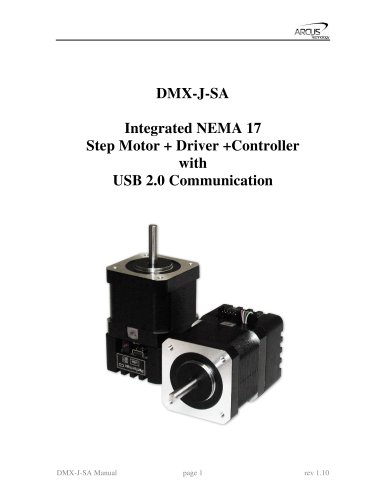 dmx-j-sa
58 Pages
 dmx-eth
78 Pages
 dmx-a2-drv
26 Pages
Related Searches
- Electromotor
- DC electromotor
- Multipole motor
- 24 V motor
- 2-pole motor
- Motor controller
- 48 V motor
- Stepper motor controller
- Integrated-drive motor
- Programmable motor controller
- Closed-loop motor controller
- Motor with integrated controller
- Single-axis motor controller
- Development kit
- Microstepping motor controller
- Multi-axis motor controller
- 2-axis motor controller
*Prices are pre-tax. They exclude delivery charges and customs duties and do not include additional charges for installation or activation options. Prices are indicative only and may vary by country, with changes to the cost of raw materials and exchange rates.
About DirectIndustry
DirectIndustry is a marketplace that offers B2B players a complete experience, from product sourcing to purchase. DirectIndustry is an entity of VirtualExpo Group.
Are you a buyer?
Are you a supplier?