
- Catalogs
- Arcus Technology
- dmx-eth

- Products
- Catalogs
- News & Trends
- Exhibitions
dmx-eth
1 / 78 PagesView full catalog
dmx-eth
Product catalog summary
Introduction
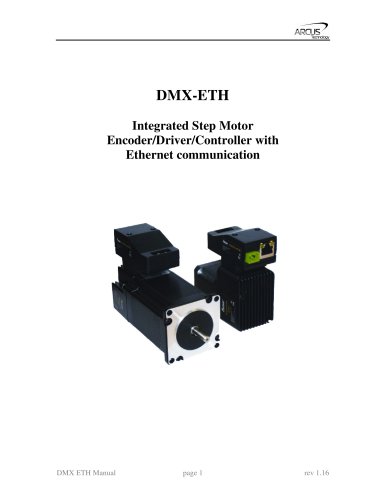
The DMX-ETH is an integrated step motor system with encoder, driver, and controller capabilities, designed for precise motion control applications. It features Ethernet communication and supports standalone program execution.
The DMX-ETH is an integrated step motor system with encoder, driver, and controller capabilities, designed for precise motion control applications. It features Ethernet communication and supports standalone program execution.
Specifications
- Electrical and Thermal Specifications: Requires +12 to +48 VDC, max current 3 A, operating temperature -20°C to +80°C, storage temperature -55°C to +150°C. Digital inputs/outputs are opto-isolated.
- Motor Specifications: Supports NEMA 17 and 23 motors with various electrical specifications.
Connections
Details on 4-pin and 14-pin connectors and the DMX-ETH interface circuit are provided.
Details on 4-pin and 14-pin connectors and the DMX-ETH interface circuit are provided.
Getting Started
Includes a Windows GUI for device configuration, testing, and debugging, allowing users to set IP, port numbers, and control motion parameters.
Includes a Windows GUI for device configuration, testing, and debugging, allowing users to set IP, port numbers, and control motion parameters.
Motion Control Overview
Describes motion profiles, speed changes, digital inputs/outputs, motor power, positional moves, homing procedures, and motor status monitoring.
Describes motion profiles, speed changes, digital inputs/outputs, motor power, positional moves, homing procedures, and motor status monitoring.
Ethernet Communication Protocol
Details socket settings and the ASCII protocol used for communication.
Details socket settings and the ASCII protocol used for communication.
Language Specifications
Outlines ASCII and standalone language specifications, including error codes and command syntax.
Outlines ASCII and standalone language specifications, including error codes and command syntax.
Additional Features
Includes micro-step driver configuration, over-temperature alarms, standalone programming, and communication time-out features.
Includes micro-step driver configuration, over-temperature alarms, standalone programming, and communication time-out features.
Control and Status
The GUI provides status information, including pulse and encoder counters, motion status, and StepNLoop status. Users can control target positions, speed, acceleration, and perform homing routines.
The GUI provides status information, including pulse and encoder counters, motion status, and StepNLoop status. Users can control target positions, speed, acceleration, and perform homing routines.
On-the-fly Speed Change
Allows speed changes during motion, requiring pre-configuration of the SSPDM parameter.
Allows speed changes during motion, requiring pre-configuration of the SSPDM parameter.
Standalone Program Management
Users can manage standalone programs through the GUI, with options to open, save, and create new programs.
Users can manage standalone programs through the GUI, with options to open, save, and create new programs.
Specifications and Parameters
Outlines error handling and correction parameters for motor control, including SLT (Tolerance range), SLE (Error range), and SLA (Max correction attempt).
Outlines error handling and correction parameters for motor control, including SLT (Tolerance range), SLE (Error range), and SLA (Max correction attempt).
IP Configuration
The DMX-ETH module's IP address can be set using the IP command, with default settings provided.
The DMX-ETH module's IP address can be set using the IP command, with default settings provided.
Driver Configuration
Configurable via software commands, including micro-stepping value, run current, idle current, and idle time.
Configurable via software commands, including micro-stepping value, run current, idle current, and idle time.
Over Temperature Alarm
Includes a temperature sensor that triggers an alarm if the temperature exceeds 75°C.
Includes a temperature sensor that triggers an alarm if the temperature exceeds 75°C.
Standalone Programming
Supports standalone programming with a memory size of 7650 assembly lines, allowing multi-threading.
Supports standalone programming with a memory size of 7650 assembly lines, allowing multi-threading.
Communication Protocol
Uses 10Mbps Ethernet ASCII communication over TCP/IP.
Uses 10Mbps Ethernet ASCII communication over TCP/IP.
Boot-up and Reset Procedures
Includes initial boot-up, hard reset detection, and connection detection procedures.
Includes initial boot-up, hard reset detection, and connection detection procedures.
Storing to Flash
Settings and programs are stored in flash memory, requiring a power cycle for changes to take effect.
Settings and programs are stored in flash memory, requiring a power cycle for changes to take effect.
Command Specifications
Comprehensive list of commands for motor functions, including syntax, descriptions, and examples.
Comprehensive list of commands for motor functions, including syntax, descriptions, and examples.
Error Codes
Table of error codes explaining possible error responses.
Table of error codes explaining possible error responses.
Standalone Language Specification
Describes syntax and usage of programming commands for standalone operations.
Describes syntax and usage of programming commands for standalone operations.
Critical Information
- Speed and Position Control: Commands like HSPD, LSPD, and PX are crucial for precise motor control.
- Error Handling: Commands such as ECLEARX and ECLEARSX ensure smooth operation.
- Conditional Logic: IF, ELSE, and ELSEIF statements allow complex decision-making.
- Subroutine Management: GOSUB and ENDSUB commands facilitate modular programming.
Conclusion
The DMX-ETH manual provides detailed instructions and examples for programming and controlling motor operations, essential for achieving desired motor performance and handling errors efficiently.
The DMX-ETH manual provides detailed instructions and examples for programming and controlling motor operations, essential for achieving desired motor performance and handling errors efficiently.
See more
All Arcus Technology catalogs and technical brochures
 ARCUS MOTION PRODUCT CATALOG
43 Pages
Archived catalogs
 pmx-4ex-sa
119 Pages
 pmx-4et-sa
108 Pages
 pmx-4cx-sa
60 Pages
 pmx-2ex-sa
79 Pages
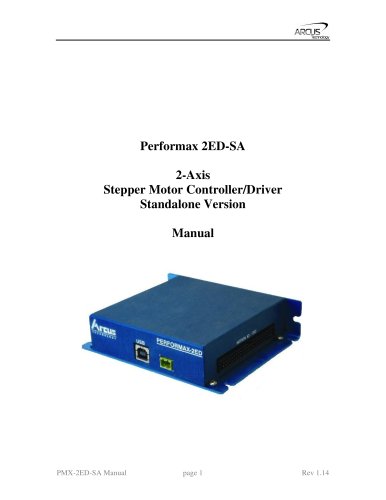 pmx-2ed-sa
78 Pages
 ace-sxe
88 Pages
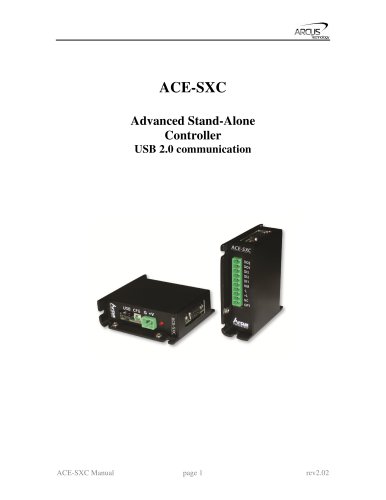 ace-sxc
66 Pages
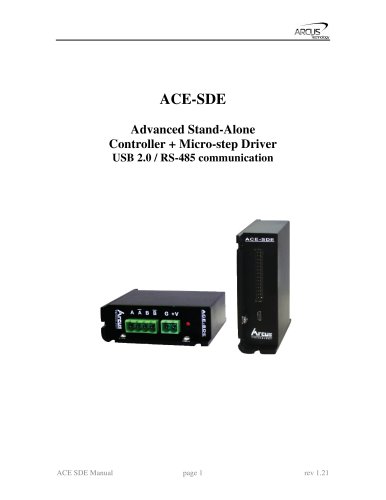 ace-sde
88 Pages
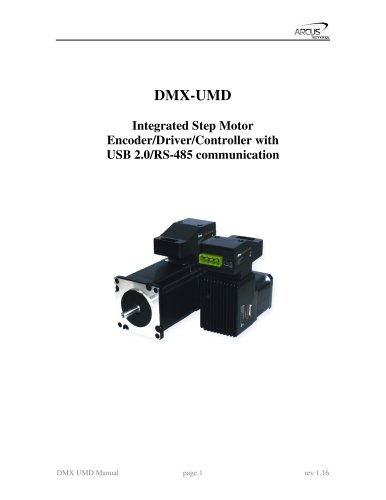 dmx-umd
87 Pages
 dmx-k-drv
32 Pages
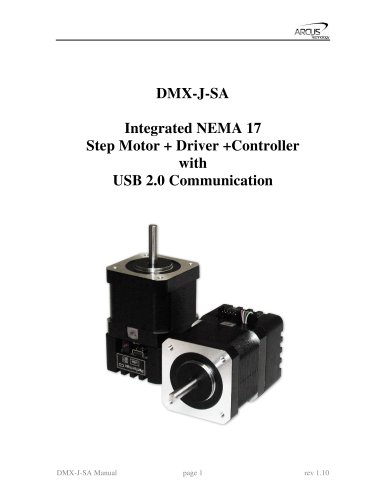 dmx-j-sa
58 Pages
 dmx-a2-drv
26 Pages
Related Searches
- Electromotor
- DC electromotor
- Multipole motor
- 24 V motor
- 2-pole motor
- Stepper motor
- Motor controller
- 48 V motor
- Stepper motor controller
- Integrated-drive motor
- Programmable motor controller
- Closed-loop motor controller
- Motor with integrated controller
- Single-axis motor controller
- Development kit
- Microstepping motor controller
- Multi-axis motor controller
- 2-axis motor controller
*Prices are pre-tax. They exclude delivery charges and customs duties and do not include additional charges for installation or activation options. Prices are indicative only and may vary by country, with changes to the cost of raw materials and exchange rates.
About DirectIndustry
DirectIndustry is a marketplace that offers B2B players a complete experience, from product sourcing to purchase. DirectIndustry is an entity of VirtualExpo Group.
Are you a buyer?
Are you a supplier?