
- Catalogs
- ARBOR Technology Corp.
- Gladius 10 Review

- Company
- Products
- Catalogs
- News & Trends
- Exhibitions
Gladius 10 Review

Gladius 10 Review
The ARBOR Gladius 10, introduced in 2015, is a rugged 10-inch Android tablet designed for enterprise and field applications. This document reviews its features and performance.
ARBOR's lineup includes the Gladius 5, 8, and 10 models, catering to enterprise and industrial needs. The Gladius 10 is larger and more robust than consumer tablets like the iPad Air 2.
The Gladius 10 features a 10.1-inch display with a 16:10 aspect ratio, is 0.9 inches thick, and weighs 2.3 pounds. It is powered by an octa-core MediaTek MT8392 processor, with 2GB RAM and 16GB storage, expandable via microSD.
The octa-core processor offers enhanced performance, scoring twice as high in benchmarks compared to the Gladius 8. It includes 2GB of RAM and 16GB of storage, expandable via a micro SDHC card slot.
Equipped with a 13MP rear camera and a 5MP front camera, the tablet has a 35.3 watt-hour Li-Ion battery, offering up to 8 hours of usage, charging via micro-USB.
The Gladius 10 has a magnesium frame and is well-sealed for environmental protection. It includes a barcode scanner and various sensors.
The 10.1-inch display has a resolution of 1280 x 800 pixels, adequate for most applications.
The high-resolution display offers wide viewing angles. The capacitive multi-touch screen requires finger touch and does not support glove use. Third-party capacitive pens can be used.
Runs on Android 4.4 "KitKat," with a Windows model available. This dual-platform approach caters to different market needs.
Android's large app ecosystem is advantageous, with solutions like Android AOSP and SureLock for app management in professional settings.
The 5MP front and 13MP rear cameras offer excellent image quality, with features like HDR and panorama.
IP65 rated for dust and water resistance, it withstands drops and harsh environments, using Corning Gorilla Glass 3 for screen protection.
Powered by a 1.7GHz octa-core processor, it offers good performance without a fan. The replaceable battery lasts a full work shift.
The ARBOR Gladius 10 is a versatile, rugged Android tablet suitable for enterprise and field applications, combining durability with a large, high-quality display and robust performance.
Designed for versatile field applications, the Gladius 10 features a robust build and functionalities for industrial and enterprise use.
IP65 rated for dust and water resistance, it survives drops from 4 feet and operates in temperatures from 14°F to 122°F.
Includes a 13MP rear camera, 5MP front camera, optional scanning capabilities, and supports Wi-Fi, Bluetooth, NFC, and GPS.
Equipped with a field-replaceable 9,300mAh battery, offering up to 8 hours of operation, with connectivity options including micro USB, mini-HDMI, and a headphone jack.
ARBOR Technology, established in 1993, specializes in embedded computing solutions and is ISO-certified.
Catalog excerpts

Technical White Paper The Review of Gladius 10, a Rugged, Affordable Multi-purpose octa-core Powered 10-inch Android Tablet for Numerous Enterprise and Field Applications
Open the catalog to page 1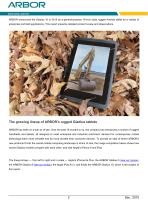
ARBOR announced the Gladius 10 in 2015 as a general-purpose 10-inch class rugged Android tablet for a variety of enterprise and field applications. This report presents detailed product review and observations. The growing lineup of ARBOR's rugged Gladius tablets ARBOR has been on a tear as of late. Over the past 18 months or so, the company has introduced a number of rugged handhelds and tablets, all designed to meet enterprise and industrial customers' demand for contemporary mobile technology that's more versatile and far more durable than...
Open the catalog to page 2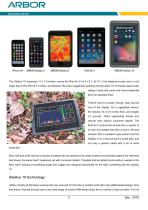
The Gladius 10 measures 11 x 7.5 inches, versus the iPad Air 2's 9.4 x 6.7. Its 10.1 inch diagonal screen size is a bit larger that of the iPad (9.7 inches), and between the extra ruggedness padding and the wider 16:10 display aspect ratio display it does look quite a bit more substantial than the standard iPad. There's more to a tablet, though, than just the size of the display. As a ruggedized device, the Gladius 10 is 0.9 inches thick, and weighs 2.3 pounds. That's significantly thicker and heavier than today's consumer tablets. The iPad Air 2 is sliver-thin at less than a quarter of an inch...
Open the catalog to page 3
Android members of its Gladius line of products, ARBOR has been going with Taiwanese semiconductor company MediaTek. Just like the smaller Gladius 5 and Gladius 8, the Gladius 10 uses an ARM Cortex A7 processor from MediaTek. However, whereas the Gladius 5 uses the 1.0GHz MTK6589 designed for smartphones, and the Gladius 8 the more tablet-oriented 1.3GHz MTK8382 — both quad-core designs built on contemporary 28nm process technology — the Gladius 10 ups the ante with an octa-core processor running at 1.7GHz, the MediaTek MT8392. What exactly does...
Open the catalog to page 4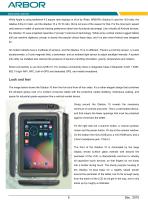
While Apple is using traditional 4:3 aspect ratio displays in all of its iPads, ARBOR's Gladius 5 uses the 16:9 ratio, the Gladius 8 the 4:3 ratio, and the Gladius 10 a 16:10 ratio. We're not sure of the reason for that. For the most part, aspect ratio seems a matter of personal viewing preference rather than functional advantage. Like virtually all Android devices, the Gladius 10 uses projected capacitive ("procap") multi-touch technology. While some vertical market rugged tablets still use resistive digitizers, procap is clearly the popular...
Open the catalog to page 5
Note that the three standard Android controls (Back, Home, MultiTask) are implemented entirely onscreen. That has its pros and cons. On the plus side, they will always be in the proper place no matter the orientation of the display. On the minus side, they eat up some screen space and you can't always see them. Design and construction of the Gladius 10 The more rugged tablets we review and analyze here at RuggedPCReview.com, the more we empathize with tablet designers. How many ways are there to create a product that consists of a rectangular...
Open the catalog to page 6
To separate the two halves the Gladius 10 consists of, there are eight Philips screws around the perimeter and 14 inside the battery compartment to be undone. The eight outer ones sits recessed inside the back cover and underneath little black rubber plugs. Once all screws are out, a plastic separater tool should be used to gently pry the two halves apart. The emphasis is on gently. You don't want to crush or break the snap-on retainer loops. Sealing between the two halves is done with an elaborate tongue-and-groove design and a very slender rubber...
Open the catalog to page 7
Reassembly requires some care. Just like plastic snaps often don't like to let go, they may need some special prodding to snap back in place. Here again it's a matter of finesse and patience rather than applying force. The barcode scan engine in our evaluation unit was an Opticon MDC-100 (see here) using CCD linear sensor technology and a red LED as a light source. It's a tiny module that supports a wide variety of 1D barcodes and postal codes. Note that the ARBOR Gladius 8 we evaluated a few months ago used the Opticon MDI-3100, a fixed-focus...
Open the catalog to page 8
as the Microsoft Surface 4 and Apple iPad Pro, both in the 12-13 inch class. In our opinion, 10.1 inches is plenty for Android, which so far has seen less of a differentiation between phone and tablet optimized apps. The screen's 1,280 x 800 pixel WXGA resolution is not tremendous in an era where much smaller smartphones routinely offer 1920 x 1080 pixel displays, and some even full 4k. As is, WXGA offers barely more pixels than ARBOR's own Gladius 5 has on its much smaller 5.5 inch screen (1280 x 720). So why did ARBOR use comparatively low 1,280...
Open the catalog to page 9
Android versus Windows The review Gladius 10 ARBOR sent us ran Android 4.4 "KitKat." But ARBOR also offers the very similarly sized Gladius G0975 that runs Microsoft Windows. With that, ARBOR follows the industry-wide trend of offering both of these major operating system platforms on similar and sometimes identical hardware. Why? There is no universal answer, and the reasons are different for tablets than they are for smaller handheld devices. Rugged industrial handhelds predate Android, and most of them ran Microsoft's Windows CE or Windows Mobile (now called Windows Embedded Handheld, or WEHH)....
Open the catalog to page 10
Additional Android contemplations The overall number of available apps for competing software platforms has gone beyond bragging rights to become a crucial marketing issue. How many apps are available? Are all of the important portals and social media sites supported? How easy is it to download apps? Apple, of course, has its massive and very user-friendly App Store. Android boasts the rapidly improving official Google Play store, and there is a number of third party alternatives such as the Amazon Appstore for Android, Slide ME, and several others. Frustratingly absent from the current app stores...
Open the catalog to page 11All ARBOR Technology Corp. catalogs and technical brochures
 IOT-800N
2 Pages
 EAGLE-8701
2 Pages
 ARES-6663
2 Pages
 ARES-5800_5803_5830
2 Pages
 ARES-530WT
2 Pages
 ARES-5300
2 Pages
 ARES-2367I
2 Pages
 ARES-1230-POS
2 Pages
 ARES-1230 Series
2 Pages
 ARES-1970
2 Pages
 ARES-1970-E
2 Pages
 ARES-1973C-4898
2 Pages
 ARES-1973H
2 Pages
 Gladius GT-500
2 Pages
 Gladius 10
2 Pages
 EmCORE-i2501
2 Pages
 EmQ-i2401
2 Pages
 PBQ-900L
2 Pages
 EmETXe-i250C
2 Pages
 ARTS-1450
2 Pages
 ARES-1231
2 Pages
 M1014
M10142 Pages
 Gladius 5
2 Pages
 M1922
M19222 Pages
 Gladius G0830 Product Review
12 Pages
 ARES-1230 Series whitepaper
9 Pages
 Gladius GT-500 Product Review
22 Pages
 IoT-800 Product Review
5 Pages
 IOT-500 Review
7 Pages
 ASLAN W722C Review
12 Pages
 IEC-3300 review
7 Pages
 Gladius 8 Review
24 Pages
 G0975 Review
17 Pages
 20150109_G5
23 Pages


