
- Catalogs
- ARBOR Technology Corp.
- 20150109_G5

- Company
- Products
- Catalogs
- News & Trends
- Exhibitions
20150109_G5

20150109_G5
The document is a technical white paper on the Gladius 5, a rugged 5.5-inch Android handheld device designed for IoT applications. Released by ARBOR Technology, it is positioned as a versatile tool for industrial and IoT applications.
The Gladius 5 functions as a mobile sensor device and IoT gateway, equipped with sensors like an ambient light sensor, accelerometer, gyroscope, barometer, and digital compass. It includes data collection tools such as an RFID/NFC reader and a barcode reader.
Designed to withstand harsh conditions, the Gladius 5 features IP65 sealing for dust and water resistance and a display protected by Corning Gorilla Glass 3. It is larger and more robust than typical consumer smartphones.
Powered by a 1.0GHz quad-core Cortex A7 MediaTek MTK6589 processor, it includes a PowerVR SGX544 graphics processor, 1GB of RAM, and 8GB of flash storage, expandable via a micro SDHC card slot. It features a 12.6mp documentation camera and supports wireless charging.
The device supports Bluetooth v4.0, WiFi, NFC, GPS, and mobile broadband. It features a capacitive multi-touch display and includes sensors crucial for IoT applications.
With a magnesium frame and PC+ABS housing, the device has a replaceable battery and dual SIM card slots, emphasizing durability and ease of maintenance.
The Gladius 5 features a sleek magnesium frame with a 5.5-inch IPS display, providing sharp visuals and wide viewing angles.
Supports capacitive multi-touch and runs on Android 4.2, reflecting Android's dominance in both consumer and industrial markets.
Supports a wide range of apps from Google Play and other stores, with solutions like Android AOSP or SureLock to restrict app access for industrial use.
Equipped with a 13-megapixel rear camera and a 2-megapixel front camera, supporting various settings and modes, including HDR and panorama.
Optional docking solutions include an in-vehicle mount and a desktop cradle, both featuring Qi wireless charging.
Capable of withstanding drops from five feet, making it more durable than typical consumer smartphones.
The document reviews the ARBOR Gladius 5, highlighting its durability, specifications, and potential use cases.
Features a 1.00GHz Quad-core Cortex A7 processor, 1GB RAM, and 8GB onboard storage with microSD expansion. It has a 5.5-inch XGA display with Gorilla Glass protection, dual SIM slots, and a replaceable battery.
Built with a magnesium frame and Corning Gorilla Glass 3, designed to operate in temperatures from 14 to 122 degrees Fahrenheit, and MIL-STD-810G tested for vibration resistance.
Includes NFC capabilities, a 13-megapixel rear camera, and optional dedicated scanners. Supports wireless charging and has various sensors for enhanced functionality.
Suitable for mobile point of sale, field service, transportation, public safety, and enterprise uses.
ARBOR Technology Corp., established in 1993, specializes in embedded computing products and services, focusing on high-quality industrial computing solutions.
Catalog excerpts

Technical White Paper The Anatomy of Gladius 5, a New 5.5” Rugged IoT Handheld Computer
Open the catalog to page 1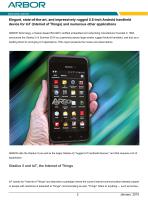
Elegant, state-of-the-art, and impressively rugged 5.5-inch Android handheld device for IoT (Internet of Things) and numerous other applications ARBOR Technology, a Taiwan-based ISO-9001 certified embedded and networking manufacturer founded in 1993, announced the Gladius 5 in Summer 2014 as a general-purpose large-screen rugged Android handheld, and also as a building block for emerging IoT applications. Tthis report presents the review and observations. ARBOR calls the Gladius 5 (as well as the larger Gladius 8) "rugged IoT handheld devices," and that requires a bit of explanation. Gladius...
Open the catalog to page 2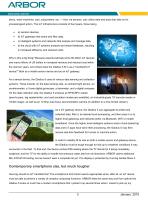
doors, wash machines, cars, subsystems, etc. — that, via sensors, can collect data and pass that data on for processingand action. The IoT infrastructure consists of four layers, those being • b) IoT gateways that share and filter data, c) intelligent systems and networks that analyze and manage data, d) the cloud with IoT systems analysis and instant feedback, resulting in increased efficiency and reduced costs. Why is this a big thing? Because experts estimate some 50 billion IoT devices and many trillions of US dollars in increased revenue...
Open the catalog to page 3
personal iPhone 6 Plus in its protective black rubber boot. The Gladius 5 is a bit larger yet than the big iPhone 6 Plus, but overall it looks just like what currently is considered a properly dimensioned phone. The picture to the right shows where the Gladius 5 fits in terms of size. The lineup shows — from left to right and in scale — Apple's by now tiny-looking iPhone 5, the standard iPhone 6, the big iPhone 6 Plus, and then ARBOR's compact IoT device. The Gladius 5 measures 6.9 x 3.3 inches, versus the iPhone 6 Plus's 6.2 x 3.1. Its 5.5 inch...
Open the catalog to page 4
PowerVR SGX544 graphics processor that's in charge of parallel graphics acceleration. The MTK6589 is a popular chip introduced in mid-2013 and being the heart of a long list of smartphones. It uses contemporary 28nm process technology and is competitive with its mostly QuadComm-based rivals. There's a gigabyte of LPDDR RAM and 8GB of Flash for storage. While 8GB doesn't look like much compared to the 16/64/128GB available in iPhones, it's more than adequate if the device can use expansion cards. So for the Gladius 5 it's the 8GB and what is in...
Open the catalog to page 5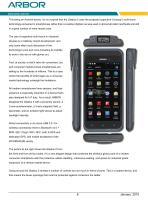
This being an Android device, it's no surprise that the Gladius 5 uses the projected capacitive ("procap") multi-touch technology pioneered in smartphones rather than a resistive digitizer as was used in almost all older handhelds and still in a good number of more recent ones. The use of capacitive multi-touch in industrial devices is a relatively recent development, and only came after much discussion of the technology's pros and cons (including its inability to work in the rain or with gloves on). Fact, of course, is that it rains for consumers,...
Open the catalog to page 6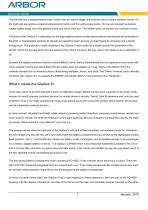
The left side has a programmable button (which can be used to trigger the scanner) and a volume up/down rocker. On the right side are another programmable/scanner button and the unit's power button. On top are, beneath protective hinged rubber plugs, the unit's earphone jack and micro-USB port. The bottom does not contain any controls or ports. The front of the Gladius 5 is dominated by the large display whose surface glass extends well beyond the perimeter of the LCD, a characteristic common to virtually all capacitive touch devices, so that...
Open the catalog to page 7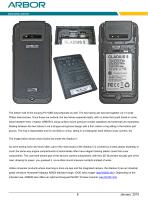
The bottom half of the housing PC+ABS polycarbonate as well. The two halves are secured together via 14 small Philips head screws. Once those are undone, the two halves separate easily, with no wires that could break or come loose between them. Instead, ARBOR is using surface mount pressure contact (speakers and antennae are examples). Sealing between the two halves is via a tongue-and-groove design with a thin rubber o-ring sitting in the bottom-part groove. The ring is replaceable and it's not likely to crimp, sitting in a rectangular track without crazy corners, etc. The image below shows...
Open the catalog to page 8
The image compilation below shows some of the interesting details of the ARBOR Gladius 5. On the left you can see a close-up of the intricate camera module, on the right an example of the surface-mount connector technology ARBOR seems fond of. The detail shows one of the Gladius 5 speakers with its surface contact arrangement that precludes wires. Overall, the Gladius 5 is a remarkably clean and well organized design. Particularly impressive is the elegant, functional magnesium frame with its custom-designed main and subsidiary boards that together form a compact, logical and very clean solution....
Open the catalog to page 9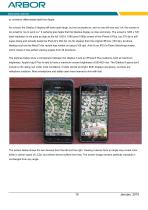
to somehow differentiate itself from Apple. As a result, the Gladius 5 display still looks quite large, but not unusually so, and no one will ever say "oh, this screen is too small for me to work on." It certainly also helps that the Gladius display is crisp and sharp. The screen's 1280 x 720 pixel resolution is not quite as high as the full 1920 x 1080 pixel 1080p screen of the iPhone 6 Plus, but 270 dpi is still super-sharp and actually beats the iPad Air's 264 dpi. It's far sharper than the original iPhone (163 dpi), let alone desktop such...
Open the catalog to page 10
Capacitive multi-touch works as everyone expects from a handheld these days — quickly and effortlessly. The touch controller ARBOR used is more sensitive than that in most earlier capacitive touch devices. That means it can work when wearing certain types of thin gloves. The device doesn't come with a stylus and ARBOR doesn't offer an optional capacitive pen. Any 3rd party capacitive pen will work, though those generic pens with their broad tips don't offer much more accuracy than the tip of a finger. It's not that important anyway as Android was specifically developed for capacitive multi-touch...
Open the catalog to page 11All ARBOR Technology Corp. catalogs and technical brochures
 IOT-800N
2 Pages
 EAGLE-8701
2 Pages
 ARES-6663
2 Pages
 ARES-5800_5803_5830
2 Pages
 ARES-530WT
2 Pages
 ARES-5300
2 Pages
 ARES-2367I
2 Pages
 ARES-1230-POS
2 Pages
 ARES-1230 Series
2 Pages
 ARES-1970
2 Pages
 ARES-1970-E
2 Pages
 ARES-1973C-4898
2 Pages
 ARES-1973H
2 Pages
 Gladius GT-500
2 Pages
 Gladius 10
2 Pages
 EmCORE-i2501
2 Pages
 EmQ-i2401
2 Pages
 PBQ-900L
2 Pages
 EmETXe-i250C
2 Pages
 ARTS-1450
2 Pages
 ARES-1231
2 Pages
 M1014
M10142 Pages
 Gladius 5
2 Pages
 M1922
M19222 Pages
 Gladius G0830 Product Review
12 Pages
 ARES-1230 Series whitepaper
9 Pages
 Gladius GT-500 Product Review
22 Pages
 IoT-800 Product Review
5 Pages
 IOT-500 Review
7 Pages
 Gladius 10 Review
20 Pages
 ASLAN W722C Review
12 Pages
 IEC-3300 review
7 Pages
 Gladius 8 Review
24 Pages
 G0975 Review
17 Pages


