

Minikit
Minikit
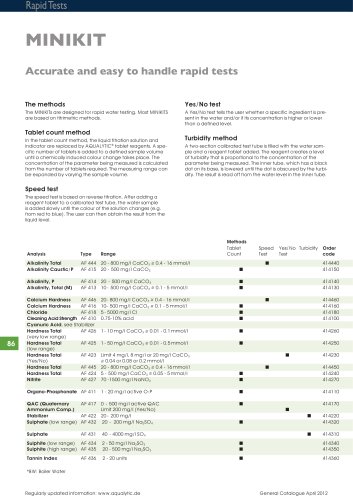
- Tablet Count Method: Utilizes AQUALYTIC® tablet reagents to induce a color change in a sample, allowing concentration calculation based on the number of tablets used.
- Speed Test: Involves reverse titration where a reagent tablet is added to a test tube, and the sample is added until a color change occurs, indicating the result.
- Yes/No Test: Determines the presence or concentration level of a specific ingredient in water.
- Turbidity Method: Measures turbidity created by a reagent tablet in a sample, with results read from a calibrated test tube.
- Alkalinity: Ranges from 10 to 800 mg/l CaCO3, with different kits for total, caustic, and P alkalinity.
- Calcium Hardness: Ranges from 10 to 800 mg/l CaCO3.
- Chloride: Ranges from 5 to 5000 mg/l Cl.
- Nitrite: Ranges from 70 to 1500 mg/l NaNO2.
- Sulphate and Sulphite: Various ranges for low and high concentrations.
Catalog excerpts

Rapid Tests Accurate and easy to handle rapid tests The MINIKITs are designed for rapid water testing. Most MINIKITS are based on titrimetric methods. Tablet count method In the tablet count method, the liquid titration solution and ndlcator are replaced by AQUALYTIC® tablet reagents. A spe- cific number of tablets Is added to a defined sample volume until a chemically Induced colour change takes place. The concentration of the parameter being measured is calculated from the number of tablets required. The measuring range can be expanded by varying the sample volume. Yes/No test A Yes/No test tells the user whether a specific Ingredient Is pre- sent in the water and/or If its concentration is higher or lower than a defined level. Turbidity method A two-section calibrated test tube Is filled with the water sam- ple and a reagent tablet added. The reagent creates a level of turbidity that Is proportional to the concentration of the parameter being measured. The inner tube, which has a black dot on Its base, is lowered until the dot is obscured by the turbi- dity. The result is read off from the water level In the inner tube. Speed test The speed test Is based on reverse titration. After adding a reagent tablet to a calibrated test tube, the water sample Is added slowly until the colour of the solution changes (e.g. from red to blue). The user can then obtain the result from the liquid level. Alkalinity Total Alkalinity Caustic/P Type Range Cleaning Acid Strength A F 410 Cyanuric Acid, see Stabilizer Hardness Total Hardness Total Hardness Total Hardness Total Ammonium Comp.) Sulphite (high range) AF435 Tannin Index Speed Yes/No Turbidity Order Test Test code Regularly updated Information: www.aqualytic.de General Catalogue April 2012
Open the catalog to page 1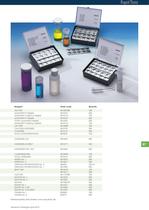
Rapid Tests Reagent Order code Quantity Material safety data sheets: www.aqualytlc.de General Catalogue April 2012
Open the catalog to page 2All AQUALYTIC catalogs and technical brochures
 General Catalogue
143 Pages
 Reagents
22 Pages
 Jar Tester
2 Pages
 checkit-comparator
12 Pages
 Powder Dispenser PD250
2 Pages
 COD Set-Ups COD VARIO
2 Pages
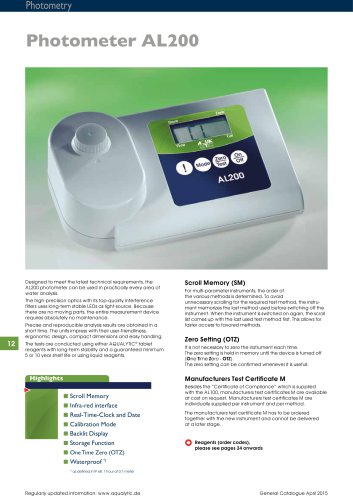 AL200
AL2004 Pages
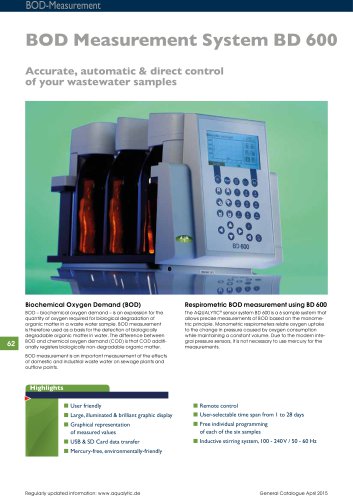 BD 600
4 Pages
 AL400 & AL410
4 Pages
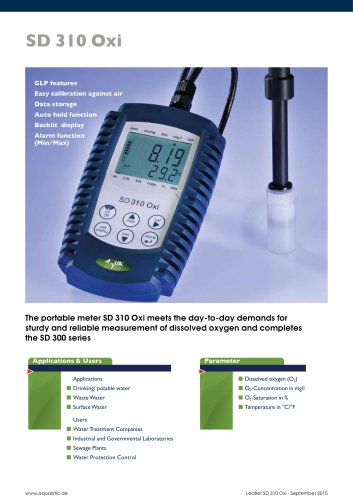 SD 310 Oxi
2 Pages
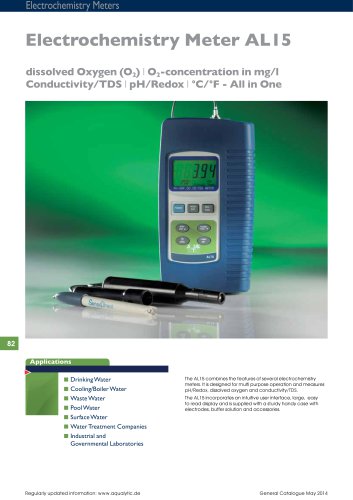 AL15
AL152 Pages
 Comparator 2000+
20 Pages
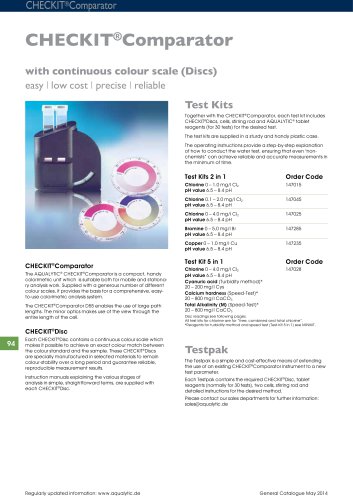 CHECKIT ® Comparator
12 Pages
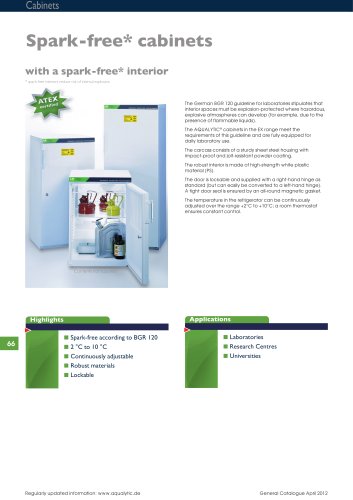 Laboratory Refrigerator
2 Pages
 Incubator
2 Pages
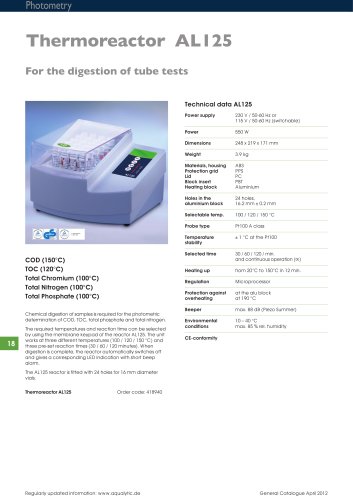 Thermoreactor AL125
1 Page
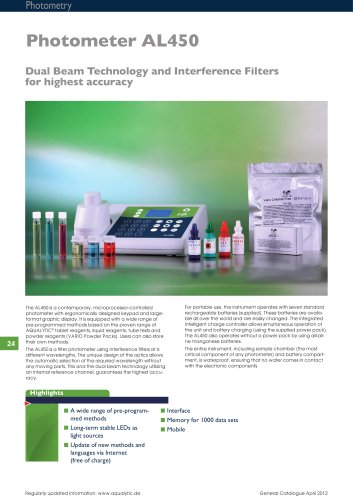 Photometer AL450 series
4 Pages
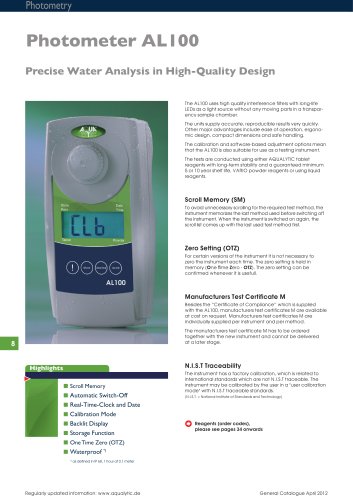 Photometer AL100
4 Pages
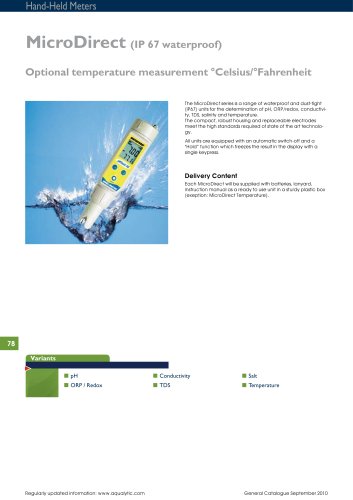 MicroDirect
2 Pages
 Hand-Held Meters AL10 Series
2 Pages
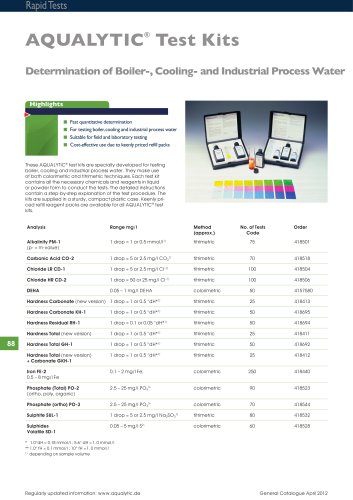 AQUALYTIC Test-Kits
2 Pages
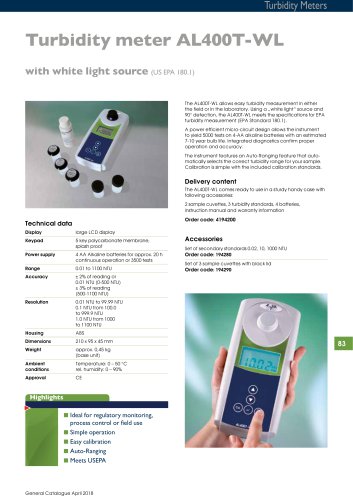

Archived catalogs
 General catalog
136 Pages
- Measuring device
- Concentration analyzer
- Liquids analyzer
- Benchtop analyser
- Incubator
- Water analyzer
- Laboratory analyzer
- Laboratory incubator
- Digital gauge
- Portable gauge
- Waterproof analyzer
- Industrial measuring module
- Spectrophotometer
- Solid dosing unit
- Temperature measuring module
- Natural convection incubator
- Automatic measuring module
- Compact measuring module
- Visible spectrophotometer
- Laboratory measuring instrument