
- Catalogs
- APSOparts®
- O-Rings basic catalogue


O-Rings basic catalogue

O-Rings basic catalogue
Material Specifications:
The document details various elastomers such as butyl, styrene-butadiene, polyester urethane, and natural rubber, with specific brands and manufacturers mentioned. It references international standards like ISO and ASTM for testing and material analysis.
Material Determination:
Material compositions are best determined in a lab, though costly. Thermal analysis (TGA) per ASTM E-1131 can identify material groups, while density offers a simpler method.
Resilience and Hardness:
Elastomer groups like NBR, FPM, and EPDM have distinct resilience properties. Hardness is measured in Shore A or IRHD, tested according to DIN standards.
Compression Set:
Measured by DIN 53517 or ASTM D395, it indicates an elastomer's permanent deformation after stress removal. Lower values suggest higher quality.
Special O-Ring Types:
PTFE-FEP covered O-Rings combine elastomer elasticity with PTFE-FEP chemical resistance. Virgin PTFE O-Rings require special housing due to non-elastic behavior. Metal O-Rings and C-Rings suit high-temperature and high-pressure applications.
Chemical Resistance:
Chemical resistance is crucial as substances can cause elastomers to swell, affecting performance. The document summarizes chemical resistance for various materials.
Specifications and Material Use:
Outlines material use in mineral oils and temperature ranges, specifying materials like NBR, FPM, HNBR, and PTFE.
Synthetic Lubricants:
Synthetic fluids, mainly phosphoric acid esters, are poorly compatible with standard sealing materials. Recommended materials include FPM, FFKM, and PTFE.
Difficultly Flammable Fluids:
These are categorized into three groups per VDMA standards, each with specific temperature ranges and suitable materials.
Biological Oils:
Overview of biological oils like HETG, HEEG, and HEPG, detailing composition, temperature range, and applications.
Elastomer O-Rings:
Discusses limits of elastomer O-Rings, emphasizing temperature behavior, fluid resistance, and mechanical properties.
Chemical Effects and Compatibility:
Insights into chemical effects on elastomers, including swelling and shrinkage due to fluid penetration.
Resistance to Water and Oils:
Most elastomers suit cold water, but EPDM, MVQ, and HNBR are preferred for hot water and steam.
Lubricating Greases Compatibility:
Explains lubricating greases' composition and compatibility with different elastomers.
Elastomer Swelling and Hardness: Swelling leads to deterioration of physical properties. Some fluids extract substances, causing shrinkage and increased hardness.
Resistance to Water and Steam: Most elastomers suit cold water. For hot water above 100°C, EPDM, MVQ, and HNBR are preferred.
Resistance to Oils: Elastomers are not inherently resistant to mineral oils. The aromatic content affects swelling.
Compatibility with Lubricating Greases: Greases consist of a base fluid and a thickener. Mineral oil-based greases require elastomers resistant to mineral oils.
Compatibility with Vegetable and Animal Oils: Elastomers resistant to mineral oils can be used with vegetable and animal oils.
Compatibility with Brake Fluids: Brake fluids are glycols and glycol ethers. EPDM materials are suitable due to limited swelling and good resistance to heat and aging.
Compatibility with Fuels: Fuels cause swelling in elastomers. NBR with high acrylonitrile content and FPM are used.
Compatibility with Solvents: Swelling is influenced by polar or non-polar groups.
Compatibility with Acids: Inorganic acids are aggressive. FPM materials are generally resistant.
Compatibility with Bases: FPM elastomers are attacked by inorganic bases. EPDM is suitable.
Specifications and Material Properties:
Elastomers like EPDM, CR, HNBR, FPM, MVQ, and FFKM are noted for resistance to weathering and aging.
Food Contact Compliance:
Silicone elastomers are preferred for food contact due to inertness.
Chemical Compatibility:
FPM elastomers resist most inorganic compounds but are vulnerable to bases.
Medical Use Suitability:
Medical applications use white silicone for general purposes.
Metal Contact and Corrosion:
Corrosion can occur due to free sulfur or hydrochloric acid from elastomers.
Contact with Plastics:
Elastomers can cause discoloration or softening of plastics.
Electrical Properties:
Elastomers are generally electrical insulators.
Limits of the Use of Elastomer O-Rings:
1. Use in Vacuum: Vacuum sealing is challenging due to elastomer permeability.
2. Resistance to Radioactivity: Exposure to atomic radiation reduces elastomer tightness.
3. Pressurisation: O-Rings can handle up to 2000 bar in static applications.
4. Elevated Temperatures: High temperatures cause elastomer aging.
5. Low Temperatures: Elastomers become harder and stiffer.
6. Thermal Expansion: Elastomers expand more than metals.
Specifications and Procedures:
1. TR10 Low-Temperature Guideline: The TR10 value is determined by extending an elastomer strip.
2. Compression Set: Measures permanent deformation after load release.
Material Properties and Recommendations:
1. Acrylonitrile Butadiene Elastomer (NBR): Known for resistance to mineral oils.
2. Fluoroelastomer (FPM): Offers high resistance to temperature and chemicals.
3. Silicone Elastomer (MVQ): Features a wide temperature range.
4. Ethylene Propylene Diene Elastomer (EPDM): Resistant to ozone and weathering.
5. Chloroprene Elastomer (CR): Good resistance to aging.
6. Hydrogenated Acrylonitrile Butadiene Elastomer (HNBR): Offers improved temperature and fluid resistance.
7. Fluorosilicone Elastomer (MFQ): Similar to silicone but with better resistance to fuels.
8. Perfluoroelastomer (FFKM): Combines chemical resistance of PTFE with elastic properties.
Approvals and Material Codes:
1. Food and Drug Administration (FDA) Approvals: For foodstuffs and drinking water applications.
2. DVGW Gas Approval: For gas sealing applications.
3. Oxygen Clearance Certificate (BAM): For oxygen applications.
4. ASTM Material Codes: Standardized codes for material identification.
Temperature Stability and Water Resistance Tests:
1. Temperature Stability: Conducted according to ASTM D746.
2. Water Resistance: Conducted according to ASTM D471.
Surface Treatments for O-Rings:
Various treatments like halogenation, molykoting, and PTFE spraying are discussed.
Surface Treatment of Metal O-Rings and C-Rings:
Coatings enhance sealing effects, especially for gas and vacuum seals.
Design Notes for O-Rings:
1. Introduction: O-Rings are used in static and dynamic applications.
2. Static Applications: O-Ring compression is higher in static conditions.
3. Compression: The mounted O-Ring must be deformed to initiate sealing.
4. Groove Profiles and Surface Finish: Groove volume should be larger than the O-Ring's cross-sectional area.
5. Axial Seals for Static Applications: Groove location and pressure direction are crucial.
6. Special Groove Profiles: Dovetail grooves hold the O-Ring firmly.
7. Material and Surface Considerations: O-Rings with a hardness of 70 to 90 IRHD/Shore A are standard.
8. Additional Considerations: Factors like pressure, material hardness, and lubrication are critical.
Design Notes for Radial Seals in Static Applications:
Discusses radial seals, groove location, and surface roughness specifications.
Special Applications: Vacuum Use:
Specific guidelines for O-Ring design and seating in vacuum applications.
Material Recommendations:
Standard materials for normal vacuums, FPM, CR, and FFKM for high vacuum.
Dynamic Applications:
Lower compression to minimize friction and wear.
Hydraulic Dynamic Applications:
Guidelines for groove dimensions and avoiding enclosed O-Rings.
Specifications and Design Notes:
Detailed specifications for O-Rings in various applications.
Compression and Groove Dimensions:
Guidelines for determining compression and groove depth.
Surface Finish:
Adherence to specified surface finishes is crucial.
Dynamic Pneumatic Applications:
Permissible compression range and calculation examples.
Special Applications:
Specifications for immersed mounting and rotary applications.
Tables and Diagrams:
Includes tables and diagrams for groove profiles and compression values.
Design Specifications and Notes:
Guidelines for O-Rings as drive belts in low-torque applications.
Limitations:
Avoid contact with liquids, minimum bending radius, and other limitations.
Surface Roughness:
Importance of surface roughness for durability and wear.
Compression and Force Requirements:
Table for groove depth and graph for compressive force.
Pressure Considerations:
High pressure in static applications, fluid pressure limits in dynamic applications.
Material and Surface Quality:
Importance of material and surface quality for effective sealing.
Design Notes and Specifications:
O-Ring damage under pressure, permissible clearance, and back-up rings.
Static and Dynamic Sealing Applications:
Design considerations for static and dynamic applications.
Material Hardness and Testing Methods:
Hardness testing methods and material resistance.
Lubrication and Viscosity:
Importance of lubrication in static and dynamic applications.
Viscosity-Temperature Characteristics: Importance of viscosity-temperature behavior in mineral oils.
Friction and Lubrication: Proper lubrication reduces friction and wear.
Stick-Slip Effect: Affects slow stroke movements, mitigated by high VI oils.
Wear and Tear: Common types of wear and measures to reduce it.
Running Speed and Contamination: Service limits for piston and rod speeds.
Back-up Rings: Prevent migration into sealing gaps.
Design Notes: Guidelines for designing grooves for back-up rings and O-Rings.
Specifications:
Specifications for PTFE O-Rings and design notes for metal O-Rings.
Surface Finish:
Surface roughness specifications for contact surfaces.
Accidental Damage and Limitations:
Common causes of O-Ring failure and prevention measures.
O-Ring Surface Cracking and Rapid Decompression: Causes and prevention of surface cracks and rapid decompression.
Manufacturing Tolerances and Standards: Tight dimensional tolerances and standards for O-Rings.
Quality Grades and Defect Limits: O-Rings categorized into Grade N and Grade S.
Storage Guidelines: Storage conditions for elastomer components.
Manufacturing Tolerances, Storage, and Standards:
Specifications and standards related to O-Rings.
DIN Standards:
Various DIN standards for O-Rings.
Aviation Standards:
DIN standards for aerospace equipment.
International Standards:
ISO standards for O-Rings.
British, French, Italian, and Swedish Standards:
Standards for O-Ring dimensions.
Extended Standards for Elastomer Components:
DIN standards for rubber products.
Testing and Quality Assurance:
DIN and ISO standards for testing elastomers.
Groove Dimensions and Applications:
Recommendations for groove dimensions.
O-Ring Specifications and Availability:
Variety of O-rings offered by Angst + Pfister.
Groove Dimensions for O-Rings:
Guide to groove dimensions.
O-Ring Groove Design:
Tables for determining groove dimensions.
Standards and Dimensions:
References to American/British standards for O-ring dimensions.
Static Applications:
Specifications for static applications.
Overview: Technical specifications and guidelines for O-Rings.
Specifications: Dimensions of O-Rings according to different standards.
Procedures and Recommendations: Advises against using O-Rings without mounting recommendations for dynamic applications.
Standards and Norms: References several standards and permissible tolerances.
Key Data from Tables: Extensive data on O-Ring dimensions.
Critical Information: Notes on O-Rings without specific mounting recommendations.
Catalog excerpts

Catalogo baseBasic catalogue >
Open the catalog to page 1
tr.row {} td.cell {} div.block {} div.paragraph {} .font0 { font:7.00pt "Arial", sans-serif; } .font1 { font:13.00pt "Arial", sans-serif; } Austria Czech Republic Italy Angst+Pfister Ges.m.b.H. :1/E Angst+Pfister spol. s.r.o. Veverf 111 CZ-616 00 Brno Phone +420 549 525 222 Fax +420 549 525 223 www.angst-pfister.com [email protected] Angst+Pfister S.p.A. Via Montefeltro 4 IT-20156 Milano Phone +39 02 30087.1 Fax +39 02 30087.100 www.angst-pfister.com [email protected] Floridsdorfer Hauptstrasse AT-1210 Wien Phone +43 (0) 1 258 46 01-0 Fax +43 (0) 1 258 46 01-98 www.angst-pfister.com [email protected]...
Open the catalog to page 2
Generalit sugli O-RingGeneral remarks on O-Rings 1 1 > Resistenza materialiResistance of materials 2 2 > Limiti dimpiego degli O-Ring in elastomeriLimits of the use of elastomer O-Rings 3 3 > Omologazioni e codice dei materialiApprovals and materials codes 4 4 > Trattamento superficialeSurface treatment 5 5 > Indicazioni costruttiveDesign notes 6 6 > Indicazioni di montaggio e danni accidentali Mounting instrucitons and accidental damage 7 7 > sugli O-Ringto the O-Rings Tolleranze di fabbricazione, magazzinaggio e normeManufacturing tolerances, storage and standards 8 8 > Dimensioni delle sediGroove...
Open the catalog to page 3
tr.row {} td.cell {} div.block {} div.paragraph {}
Open the catalog to page 4
Introduzione Introduction5 Generalit sugli Costruzione General remarks Design 6 O-Ring Funzionamento Function 6 Identificazione Identificazione degli O-Ring Identification of Identification of elastomer O-Rings 8elastomer O-Rings degli O-Ring in elastomero in elastomero Determinazione delle dimensioniDeterminazione del materiale Proprietࠠ di rimbalzo Test con lacetone Comportamento alla combustione Deformazione residua a compres-sione DVR (Compressione Set)Durezza Determination of dimensions 8 Determination of material 8 Resilience 9 Acetone test 10 Fire response 10 Compression set 11 Hardness...
Open the catalog to page 5
tr.row {} td.cell {} div.block {} div.paragraph {}
Open the catalog to page 6
Generalit sugli O-RingGeneral remarks on O-Rings5 1 > Le prime tenute con O-Ring hanno gi pi࠹ di 100 anni e sono stateregistrate nel 1882 come anelli di tenuta per vetro in un brevettoper rubinetti per acqua di Th. A. Edison. Altri brevetti con applica-zione di O-Ring sono stati rilasciati nellAmerica del nord nellҒanno1930. Il cammino trionfale dellO-Ring ha avuto inizio solo dopo lascoperta e lo sviluppo del caucciҹ sintetico verso lanno 1930.Lo sviluppo ininterrotto nel settore dei materiali, e specialmente lacreazione di nuovi gruppi di elastomeri, sostiene efficacemente icampi di applicazione...
Open the catalog to page 7
Generalit sugli O-RingGeneral remarks on O-Rings6 > Costruzione Design LࠒO-Ring un anello circolare senza fine a sezione circolare. Essoviene fabbricato con strette tolleranze e con elevata finitura super -ficiale e pu assicurare la tenuta radiale ed assiale. Le dimensionivengono contrassegnate dal diametro interno d An O-Ring is an endless ring with a circular cross-section. It is manu-factured to close tolerances, with an high surface finish and can provide an axial or radial seal. Its dimensions are quoted in termsof the inside diameter d > 1 e dal diametrodella corda d > 1 and the diameter...
Open the catalog to page 8
Generalit sugli O-RingGeneral remarks on O-Rings7 1 Quando gli O-Ring e le sedi di montaggio vengono definiti in baseai dati del nostro catalogo, si pu contare su una ಫtenuta tecnica, che pu۲ essere descritta come segue: Tenuta tra parti in riposo:con liquidi si puֲ contare su una tenuta senza perdite, con gas sihanno perdite per diffusione.Tenuta tra parti in movimento:con liquidi puֲ formarsi sulla superficie di scorrimento un film del fluido,che pu dar luogo a perdite di tenuta a lungo termine.Con gas si verifica una perdita in corrispondenza della super ficie discorrimento.La pratica dimostra...
Open the catalog to page 9
Designazione del materialeNome commercialeProduttoreDesignazione breve Material nameTrade nameManufacturerBrief descriptionISO 1629 ASTM D-1418 Elastomero acrilonitrile butadieneBuna N > Chemische Werke HlsNBRNBR Acrylonitrile butadiene elastomerEuroprene > Enichem Krynac > ή Polysar Ltd. Nipol N > Nippon Zeon Perbunan N > ή Bayer AG Elastomero fluoratoFluorel > 3M CompanyFPMFKM FluoroelastomerTecnoflon > ή Ausimont Viton > Du Pont Dow Elastomers Elastomero al siliconeElastosil > ή Wacker ChemieMVQVMQ Silicone elastomerRhodorsil > Rhδne Poulenc Silastic > Dow Corning Silopren > ή Bayer AG Elastomero...
Open the catalog to page 10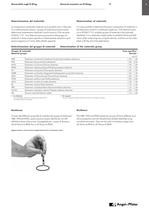
Gruppo di materialiPeso specifico Material groupsDenstiy g/cm > 3 NBRElastomero acrilonitrile butadiene/Acrylonitrile butadiene elastomer1,20 ⒖ 1,30 FPMElastomero fluorurato/Fluoroelastomer1,80 2,00 MVQElastomero al silicone/Silicone elastomer1,30 ֖ 1,40 EPDMElastomero etilene-propilene/Ethylene-propylene elastomer1,10 1,20 CRElastomero cloroprene/Chloroprene elastomer1,30 ֖ 1,50 HNBRElastomero acrilnotrile idrogenato/Hydrogenated acrylonitrile elastomer1,20 1,30 MFQElastomero al fluorosilicone/Fluorosilicone elastomer1,40 ֖ 1,50 FFKMElastomero perfluorurato/Perfluorelastomer1,90 2,00 ACMElastomero...
Open the catalog to page 11
ElastomeroComportamento alla combustioneTipo dei residuiProprietಠ caratteristiche ElastomerFire responseType of residuesCharacteristics NBRbrucia bene nella propria fiamma,֖fragili, leggermente untuosifiamma guizzante, briosama molto irregolarmente֖ burns well in its own flame,friable, very slightly greasy֖flickering, shooting flame but very unevenlyFPM/FFKMnon brucia nella propria fiamma֖solo limitatissimi residuiodore pungente molto forte, la cui intensit֠fumo chiaropuֲ essere paragonata, per esempio, aquella dellammoniacaҖdoes not burn in its own flameonly very slight residues֖very strong...
Open the catalog to page 12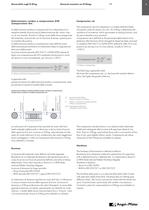
Generalit sugli O-RingGeneral remarks on O-Rings11 1 Deformazione residua a compressione DVR(Compressione Set) Compression set The compression set of an elastomer is a simple method of deter -mining the internal valuesૻ of a mix. An O-Ring is defined by theresilience of its material, which guarantees its sealing function, andthis test is therefore very practical.Compression set is defined as the permanent deformation of an La deformazione residua a compressione di un elastomero unsemplice metodo di prova per la determinazione dei valori inter-ni諻 di una miscela. Poich un O-Ring vive髻 della forza...
Open the catalog to page 13All APSOparts® catalogs and technical brochures
 APSOparts® brochure
8 Pages
 APSOPUR® Product datasheets
48 Pages
 Company brochure
20 Pages
 APSOvib® Buffers
28 Pages
 APSOvib® Gas Springs
8 Pages
 APSOseal® Molded Seals
8 Pages
 High Performance O-Rings
40 Pages
 HITEC® O-Rings
28 Pages
 APSOseal® Elastomer Profiles
8 Pages
 APSOseal® Rotary Seals
8 Pages
 APSOseal® O-Rings
8 Pages
 A+P X-Ring
24 Pages
 APSOseal® Flat Gaskets
8 Pages
 NORMATEC® O-Rings
12 Pages













- Piping
- Liquid filter
- Plastic hose
- Power transmission belt
- Neoprene® hose
- Filter cartridge
- Abrasion-resistant hose
- Single-component adhesive
- Plastic seal
- Flexible coupling
- Adhesive tape
- Shaft shaft coupling
- Industrial filter cartridge
- Smooth piping
- Metal adhesive
- Fine filter cartridge
- Rubber strip
- Filter housing
- Smooth hose
- Chemical product hose