
- Catalogs
- APLISENS S.A.
- Hydrostatic level probes SGE-25S and SGE-25C

- Company
- Products
- Catalogs
- News & Trends
- Exhibitions
Hydrostatic level probes SGE-25S and SGE-25C

Hydrostatic level probes SGE-25S and SGE-25C
The document provides technical specifications and operational guidelines for the Aplisens SGE-25S and SGE-25C hydrostatic level probes, designed for measuring waste liquid levels in various industrial settings.
Specifications
- Measurement Range: 2 to 20 meters of water (m H2O), with standard ranges of 2.5, 4, and 10 m H2O.
- Overpressure Limit: Up to 20 times the range without hysteresis.
- Accuracy: Varies from 0.5% to 1.5% Full Scale Output (FSO) depending on the range.
- Thermal Error: Zero error ranges from 0.2% to 0.6% per 10°C, and span error ranges from 0.2% to 0.4% per 10°C.
- Electrical Output: 4 to 20 mA two-wire transmission, with a special version offering 0 to 10 V three-wire transmission.
- Power Supply: 8 to 36 VDC, with variations for Ex and TR versions.
- Protection: IP-68 rated, with integrated overvoltage protection.
- Material: Casing and diaphragm made of SS316L, with optional Hastelloy C for the diaphragm.
Applications
The probes are suitable for measuring liquid levels in environments with contaminants or suspensions, such as intermediate pumping stations, fermentation chambers, and settling tanks.
Design and Operation
The probes operate based on the hydrostatic pressure principle, with a piezoresistant silicon sensor and an isolating diaphragm. The design minimizes sediment effects and allows for easy cleaning with water.
Installation and Use
- Probes can hang freely or lie on the tank bottom.
- Cable connections should be in non-hermetically sealed boxes to maintain atmospheric pressure.
- Recommended accessories include Aplisens SG cable hanger and PP junction box.
- For long signal lines, an additional Aplisens UZ-2 overvoltage protection circuit is advised.
- Probes should be installed in screening tubes in turbulent environments.
Technical Data
- Thermal Compensation Range: Standard 0 to 40°C, special version -10 to 70°C.
- Medium Temperature Range: -25 to 40°C standard, 0 to 75°C for ETFE and PTFE versions.
- Load Resistance: Up to 3k ohms for current output.
Ordering Information
Includes model codes, versions, certificates, output signals, cable types, and accessories.
Catalog excerpts
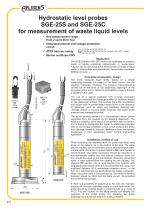
Hydrostatic level probes SGE-25S and SGE-25C for measurement of waste liquid levels ü Any measurement range from 2 up to 20 m H2O ü Integrated internal overvoltage protection circuit ü ATEX Intrinsic safety ü certificate DNV Marine II 1G Ex ia IIC T4/T5/T6 Ga II 1G Ex ia IIB T4/T5/T6 Ga (probes with PTFE cable) I M1 Ex ia I Ma Principles of operation, design The probe measures liquid levels, basing on a simple relationship between the height of the liquid column and the resulting hydrostatic pressure. The pressure measurement is carried out on the level of the separating diaphragm of the immersed probe and is related to atmospheric pressure through a capillary in the cable. Lifting handle The SGE-25S and SGE-25C probes are applicable to measure levels of liquids containing contaminants or suspensions. A typical use for this probe is the measurement of levels of liquid waste in intermediate pumping stations, fermentation chambers, settling tanks etc. Aplisens SG cable hanger The use of a special separator with a large uncovered diaphragm minimizes the metrological effect of sediment deposit on the diaphragm surface. This enables the probe long lifetime and proper work in contaminated media (even in the presence of abrasives, such as sand) and facilitates cleaning with delicate stream of running water (washing with water under pressure may damage the probe). The active sensing element is a piezoresistant silicon sensor separated from the medium by an isolating diaphragm. The electronic amplifier, which works in combination with the sensor, and is meant to standardize the signal, is additionally equipped with an overvoltage protection circuit, which protects the probe from damage caused by induced interference from atmospheric discharges or from associated heavy current engineering appliances. When lowered to the reference level, the probe may either hang freely on the cable or lie on the bottom of the tank. The cable with the capillary can be extended using a standard signal cable. For the cable connection a special Aplisens SG cable hanger is recommended. The cable connection should be situated in a Æ 25 non-hermetically sealed box (the internal pressure inside the box should be equal to the atmospheric pressure), preventing water or other contaminants from getting into the capillary. The Aplisens PP junction box is recommended For systems with long signal transmission lines, it is recommended the using of an additional Aplisens UZ-2 overvoltage protection circuit in the form of a wall-mounted box which allows the cables connection. When the probe cable is being wound up, the minimum winding diameter should be 30cm and the cable should be protected from mechanical damage. If there is a possibility of turbulence in the tank (for example, because of the mixer operating mixers or a turbulent inflow), the probe should be installed inside a screening tube (e.g. made of PVC). The line hooked on the lifting handle can simplify the operation of the probe pulling out. Cleaning the probe diaphragm by mechanical means is strictly prohi
Open the catalog to page 1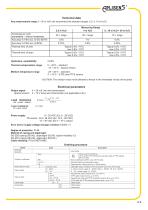
^plisenSTechnical data Any measurement range 2 - 20 m H2O (we recommend the standard ranges: 2,5, 4, 10 m H2O)
Open the catalog to page 2All APLISENS S.A. catalogs and technical brochures
 PRODUCT CATALOGUE 2026/2027
188 Pages

Archived catalogs
 2019-2020 PRODUCT CATALOGUE
176 Pages
 Product catalog 2017
166 Pages
 2022-2023 PRODUCT CATALOGUE
180 Pages
 PRODUCT OVERVIEW
6 Pages
 PRODUCT CATALOGUE 2016/2017
168 Pages
 APLISENS CATALOGUE 2015/2016
156 Pages
 Level transmitters
12 Pages
 APC-2000ALW
5 Pages


- Valve
- Manual valve
- Stainless valve
- Flowmeter
- DC power supply
- Ball valve
- AC/DC power supply
- Temperature probe
- Volume flow monitor
- Liquid flow monitor
- Measuring device
- APLISENS data-logger
- Resistance temperature sensor
- Lever valve
- APLISENS pressure transmitter
- Pressure gauge
- Level limit switch
- Calibration system
- APLISENS analog pressure transmitter