


- Company
- Products
- Catalogs
- News & Trends
- Exhibitions
EARTHING

EARTHING
A well-designed earthing system is essential for electrical installations to ensure safety and functionality. The main objectives include limiting touch voltage for personal safety, providing a low impedance path to protect equipment, minimizing electromagnetic noise, and establishing a reference voltage for system equipotentialization.
Key factors in designing an earthing system include regular resistance measurement, soil humidity, use of earthing enhancing compounds, and awareness of buried installations. Special electrodes are recommended for low-conductivity soils to achieve suitable earth resistance.
For effective lightning protection, each down-conductor must have an earthing system capable of dispersing lightning current. Standards specify that the resistance of the Lightning Protection System (LPS) earthing should be below 10 Ω. Configurations like triangle or 'goose foot' are effective for current dispersion.
Various international standards govern earthing systems, including RBT2002 in Spain, BS 7430 in Great Britain, NF C 15-100 in France, DIN VDE 0100 in Germany, and UL 467 in the USA.
Aplicaciones Tecnológicas manufactures earthing materials compliant with standards. Specifications for electrodes include dimensions and materials like copperbond steel, galvanized steel, and electrolytic copper.
Dynamic electrodes like APLIROD® contribute ions to the ground, improving performance in low-conductivity soils. Installation involves specific procedures for placing and connecting electrodes, using compounds like APLIFILL to enhance conductivity.
Graphite electrodes are suitable due to their high conductivity and resistance to chemical agents. Installation involves mixing graphite and clay-like powders with water to ensure good contact with the ground.
Copperbond earth rods are coated with 254 μm of copper to ensure durability and compliance with regulations like BS 7430 and UL 467.
The document references international standards such as IEC 62305-3 for lightning protection and EN 50164 (IEC 62561-2) for components of lightning protection systems. These standards ensure the safety and effectiveness of earthing systems.
The document details various types of earth rods and accessories, including copperbond, solid copper, stainless steel, and galvanized steel rods. Each type is specified with dimensions, material, and weight. For example, copperbond rods are extendable to improve earth resistance, and solid copper rods are suitable for corrosive environments.
- Earth rods should be buried at least 50 cm deep.
- Multiple conductors spread out are preferred over a single long conductor.
- Earth rods should be placed in a triangle or line, spaced at least as far apart as their buried depth.
- Conductors connecting earth rods should be buried at least 50 cm deep.
- Use ground enhancing products like CONDUCTIVER PLUS to lower earth resistance.
Accessories for earth rods include driving studs, couplings, and clamps made from materials like stainless steel and gunmetal. Ground enhancing products such as CONDUCTIVER PLUS and APLICEM are used to improve soil conductivity and reduce resistance.
- CONDUCTIVER PLUS: A non-corrosive gel that improves soil conductivity by forming a long-lasting conductive material deposit.
- APLICEM: A ground enhancing cement that increases the conductive surface of the electrode, reducing earthing resistance and preventing corrosion.
Detailed procedures for installing earth rods and applying ground enhancing products are provided. For example, APLICEM is mixed with water and used to fill boreholes or trenches around electrodes to improve grounding effectiveness.
All products and procedures comply with relevant international standards such as IEC 62305, IEC 62561, UNE 21186, and NF C 17-102, ensuring safety and reliability in earthing systems.
This document provides detailed specifications and applications for various earthing system components, including earth electrodes, bonding bars, earth bars, and clamps. It complies with international standards such as IEC 62305, IEC 62561, UNE 21186, and NF C 17-102.
The document lists various products with their dimensions, material composition, and weight. For example, the AT-050F bonding bar is made of tin-plated copper and weighs 200g, while the AT-051F can connect up to 7 copper cables and is made of copper, weighing 1.50kg.
The document outlines the installation and application procedures for different components. For instance, the AT-020H and AT-021J bonding bars allow disconnection of the lightning protection system's down-conductor for earth resistance measurement.
All components comply with relevant standards, ensuring safety and reliability in earthing systems. Specific products like the AT-050K spark gap are designed to prevent corrosion by isolating earth connections under normal conditions and connecting them during a discharge.
The document suggests using specific clamps and bars for different applications, such as the AT-080J for connecting copper tape to earth rods. It also highlights the importance of using appropriate materials like gunmetal and stainless steel for durability and performance.
The tables provide a comprehensive list of products with their specifications, including dimensions, conductor range, material, and weight. For example, the AT-053J insulator is made of polyester and weighs 0.12kg, while the AT-150J 4-way earth bar is made of copper and weighs 1.40kg.
The document emphasizes the importance of complying with international standards and using the correct components to ensure effective earthing and lightning protection systems. It also highlights the need for proper installation to avoid issues like resistive earth couplings and corrosion.
Catalog excerpts
> Importance of a suitable earthing system > Specific considerations for lightning protection > Enhanced electrodes for low-conductivity soils > Earth electrodes, ground enhancing products and earth pits
Open the catalog to page 2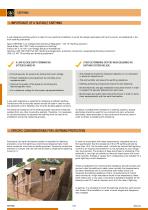
> IMPORTANCE OF A SUITABLE EARTHING A well designed earthing system is basic for any electrical installation to avoid the danger associated with fault currents, as established in the main earthing standards: Spain: RBT2002 “Low Voltage Electrotechnical Regulation”. ITC-18 “Earthing systems”. Great Britain: BS 7430 “Code of practice for Earthing”. France: NF C 15-100 “Low Voltage Electrical Installations”. Germany: DIN VDE 0100 Part 540 “Earthing arrangements, protective conductors, equipotential bonding conductors” USA: UL 467 “Grounding and bonding equipment”. A LOW VOLTAGE EARTH TERMINATION...
Open the catalog to page 3
APLICACIONES TECNOLOGICAS > REGULATIONS All the earthing materials manufactured by Aplicaciones Tecnologicas comply with the earthing and lightning protection standards. The minimum dimensions specified in these standards are the following: > EARTHING RBT ITC-18. Technical Guide for implementing Technical Instruction 18 (earthing systems) of the Spanish Low Voltage Electrotechnical Regulations. > LIGHTNING PROTECTION EARTHING IEC 62305 / EN 62305 / IEC 62561 (EN 50164 before). Protection against lightning. (*) The minimum thickness of the copper coating the copperbond steel earth rods, as recommended...
Open the catalog to page 4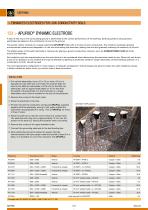
133 > APLIROD® DYNAMIC ELECTRODE A lack of free ions in the surrounding ground is detrimental to the correct performance of the earthing. Earthing systems using dynamic electrodes are based on the contribution of ions to the ground. The system mainly consists of a copper electrode (APLIROD®) filled with a mixture of ionic compounds. The moisture condenser absorbs environmental moisture and dissipates it in the soil surrounding the electrode, adding free ions and gradually lowering the resistivity of the soil. The effectiveness of this earth electrode is improved by placing a ground conductivity...
Open the catalog to page 5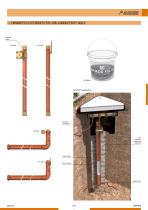
> ENHANCED ELECTRODES FOR LOW-CONDUCTIVITY SOILS Breather holes APLIROD® (application) Moisture condenser Low resistivity compound APLIFILL Leach holes Ionic mixture Leach holes
Open the catalog to page 6
134 > GRAPHITE ELECTRODE The fact that graphite exhibits high electrical and thermal conductivity and is unassailable and inert to chemical agents (apart from oxygen at a high temperature), makes it a very suitable element for building an earth electrode. The materials used as filling (graphite powder and thin claylike powder) ensure contact between the electrode and the ground thanks to its capacity to penetrate even cracks in rocks. 1.5 x 1.5 x 2 meter hole Machinery needed: > Backhoe INSTALLATION The reference AT-070H consists of a rigid graphite core surrounded by a layer of graphite powder...
Open the catalog to page 7
APLICACIONES TECNOLOGICAS > EARTH ELECTRODES, GROUND ENHANCING PRODUCTS AND EARTH PITS INSTALLATION The electrodes should be placed at a depth of at least 50 cm. It is preferable to use several conductors conveniently spread out rather than one very long conductor. In the case of an earthing system made up of various interconnected electrodes, it is recommended that: > The buried earth rods must be placed in a triangle or line and spaced out at a distance of at least that of their buried depth. > The buried earth rods are connected by an identical or compatible conductor to the one used for the...
Open the catalog to page 8
136 > SOLID COPPER EARTH RODS Solid copper rods enable long-lasting earthing in ground with high corrosion levels. Threaded electrodes with the correct accessories enable the length to be increased, thus achieving a better earth resistance. Stainless steel earth rods enable long-lasting earthing in ground with high corrosion levels. Threaded electrodes with the correct accessories enable the length to be increased, thus achieving a better earth resistance.
Open the catalog to page 9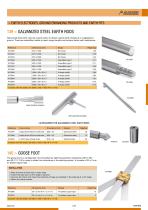
APLICACIONES TECNOLOGICAS > EARTH ELECTRODES, GROUND ENHANCING PRODUCTS AND EARTH PITS
Open the catalog to page 10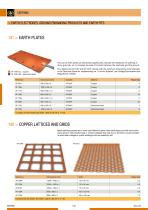
141 > EARTH PLATES The use of earth plates as electrodes significantly reduces the resistance of earthing in stony grounds, as it increases the area of contact between the electrode and the ground. The references AT-116H and AT-122H comply with the minimum dimensions recommended in the Technical Guide for implementing no. 18 of the Spanish Low Voltage Electrotechnical Regulations of 2002. Mesh earthing systems are a more cost-effective option than earth plates and still work well in stony ground, reducing the step or contact voltages that may occur. AT-070J is recommended to avoid step voltages...
Open the catalog to page 11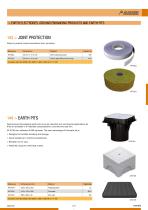
APLICACIONES TECNOLOGICAS > EARTH ELECTRODES, GROUND ENHANCING PRODUCTS AND EARTH PITS Strips to protect buried connections from corrosion. 144 > EARTH PITS Aplicaciones Tecnologicas earth pits cover all industrial and commercial applications as they are available in 3 materials: polypropylene, concrete and cast iron. AT-010H can withstand 5,000 kg loads. The main advantage of this earth pit is: > Designed to facilitate handling and storage. > Good resistance to chemical substances. > Resistant to UV rays. > Attached using two individual screws
Open the catalog to page 12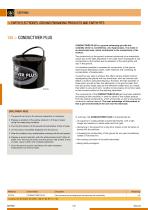
CONDUCTIVER PLUS is a ground enhancing gel with low solubility which is, nonetheless, very hygroscopic. It is made of an electrolyte base, which contributes to the conductivity of the mixture. The conductivity of the ground is almost exclusively of an electrolytic nature due to the salts dispersed in the water which impregnate it and concentrate on the surface due to adhesion of the sand grains and clay in the ground. It is therefore possible to increase the conductivity of the ground, improving its absorption power, water retention and increasing its concentration of soluble salts. It would...
Open the catalog to page 13
APLICACIONES TECNOLOGICAS > EARTH ELECTRODES, GROUND ENHANCING PRODUCTS AND EARTH PITS In high resistivity soils it is necessary to use a specific material to obtain a suitable grounding resistance. APLICEM ground enhancing cement improves grounding effectiveness around any type of earthing rod. This product is very useful in industries that require a low grounding resistance such as computer installations, radio frequency facilities and substations etc. APLICEM increases the conductive surface of the earth electrode, reducing the earthing resistance of the loose electrode. Additionally, resistance...
Open the catalog to page 14All Aplicaciones Tecnológicas, S.A. catalogs and technical brochures
 DAT CONTROLER® PLUS
3 Pages
 Surge Protection Guide
3 Pages
 Company profile
9 Pages
 IGA TEST T
1 Page
 IGA TEST SUB series
1 Page
 ATPLUG SERIES
2 Pages
 ATLAN 12/8/4 CAT6
2 Pages
 RF SPD TESTER
1 Page
 ATFONO RJ45
2 Pages
 ATSUB-4P-NR TT
2 Pages
 ATSUB-P
5 Pages
 ATSUB-D M
2 Pages
 ATSUB-R
5 Pages
 ROD TO CABLE COUPLING
1 Page
 ROD TO TAPE COUPLING
1 Page
 ROD BRACKETS
1 Page
 FLAT SADDLE
1 Page
 AIR ROD BASE
1 Page
 RIDGE SADDLE
1 Page
 ATSHOCK
2 Pages
 full catalogue
438 Pages
 Lightning rods and accesories
78 Pages


Archived catalogs

- Electrical cable
- Copper electrical cable
- Surge protector
- Clamping device
- Multi-strand cable
- Multi-wire electrical cable
- DIN rail lightning arrester
- Portable tester
- Class II surge protector
- Solderless terminal
- IEC electrical cable
- PVC-sheathed cable
- PVC-sheathed electrical cable
- Power supply lightning arrester
- Low-voltage lightning arrester
- Clamping device
- Class II surge arrester
- Single-conductor cable
- Solid electrical cable