
- Catalogs
- API Metrology
- LADAR vs. Laser Radar

LADAR vs. Laser Radar
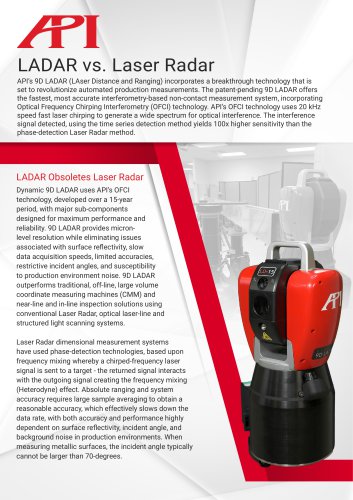
LADAR vs. Laser Radar
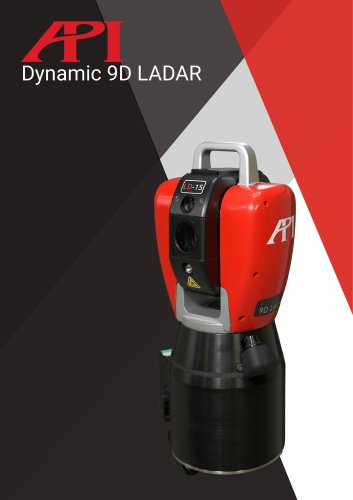
Dynamic 9D LADAR, developed by API over 15 years, offers micron-level resolution and addresses issues like surface reflectivity and slow data acquisition. It surpasses traditional CMM and Laser Radar systems in performance and reliability.
The 9D LADAR uses Optical Frequency Chirping Interferometry (OFCI), providing 100x higher sensitivity than phase-detection Laser Radar. It operates at 20 kHz, offering fast and accurate non-contact measurements.
9D LADAR offers significant improvements over conventional systems, including:
- Data Rate: 20,000 pts/sec vs. 500-1,000 pts/sec
- Scanning Speed: 0.2 sec/cm2 vs. 1 sec/cm2
- Accuracy: Linear 20 µm + 2 µm/m (2σ) vs. 20 µm + 5 µm/m
- Beam Spot Size: 32 µm or smaller vs. sub-mm
- Insensitive to target reflectivity and capable of measuring translucent objects
- Wider incident angle tolerance: ≤ 85-degree vs. ≤ 45-degree
9D LADAR is suitable for automotive applications, providing high-speed raster scanning for surface geometry and dimensional data. It can be installed in-line or near-line, enhancing production pace and productivity.
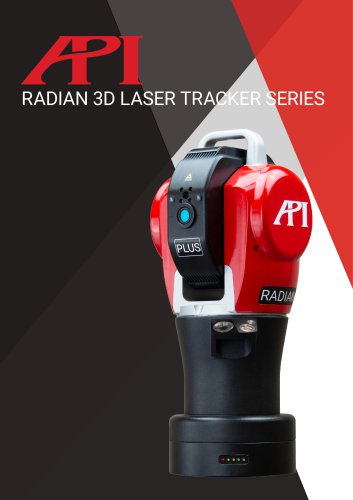
API's 9D LADAR offers dynamic tracking of robot positioning with its 6DoF Radian Laser Tracker, allowing accurate real-time positioning and unlimited calibrated robot poses, reducing non-productive calibration times.
Catalog excerpts
LADAR vs. Laser Radar API’s 9D LADAR (LAser Distance and Ranging) incorporates a breakthrough technology that is set to revolutionize automated production measurements. The patent-pending 9D LADAR offers the fastest, most accurate interferometry-based non-contact measurement system, incorporating Optical Frequency Chirping Interferometry (OFCI) technology. API’s OFCI technology uses 20 kHz speed fast laser chirping to generate a wide spectrum for optical interference. The interference signal detected, using the time series detection method yields 100x higher sensitivity than the phase-detection Laser Radar method. LADAR Obsoletes Laser Radar Dynamic 9D LADAR uses API’s OFCI technology, developed over a 15-year period, with major sub-components designed for maximum performance and reliability. 9D LADAR provides micronlevel resolution while eliminating issues associated with surface reflectivity, slow data acquisition speeds, limited accuracies, restrictive incident angles, and susceptibility to production environment noise. 9D LADAR outperforms traditional, off-line, large volume coordinate measuring machines (CMM) and near-line and in-line inspection solutions using conventional Laser Radar, optical laser-line and structured light scanning systems. Laser Radar dimensional measurement systems have used phase-detection technologies, based upon frequency mixing whereby a chirped-frequency laser signal is sent to a target - the returned signal interacts with the outgoing signal creating the frequency mixing (Heterodyne) effect. Absolute ranging and system accuracy requires large sample averaging to obtain a reasonable accuracy, which effectively slows down the data rate, with both accuracy and performance highly dependent on surface reflectivity, incident angle, and background noise in production environments. When measuring metallic surfaces, the incident angle typically cannot be larger than 70-degre
Open the catalog to page 1
Non-contact Laser Radar technology has proven its ability to measure automotive parts including full 'Body-in-White', as a replacement for CMM measurements adjacent to production lines providing both external and internal measurements of vehicle body regions. 9D LADAR precision automated high-speed 'raster' scanning provides both surface geometry point cloud data collection as well as 'gap and flush' dimensional data. Laser Radar systems, although offering advantages over CMM measurements, remained too slow to pace production thereby providing an audit only measuring function. The enhanced speed...
Open the catalog to page 2All API Metrology catalogs and technical brochures
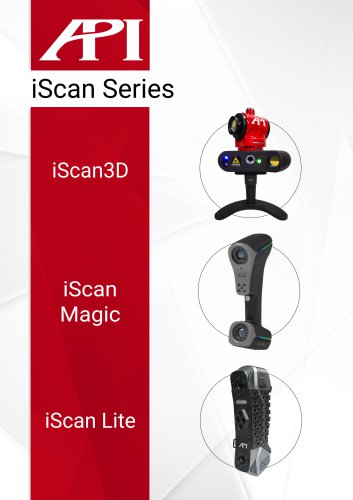 iSCAN Seires
12 Pages
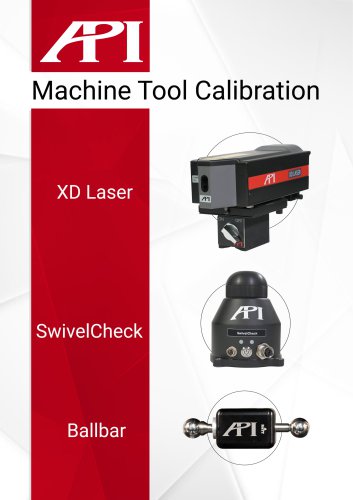 MACHINE TOOL CALIBRATION
12 Pages
 Dynamic 9D LADAR
7 Pages
- Measuring machine
- Calibration system
- Inspection system
- Automatic inspection system
- Precision calibration equipment
- 3D scanning system
- High-precision measurement system
- Solid-state laser
- Measuring system for industrial applications
- Laser scanner
- Touch probe
- Inspection scanner
- Visible laser
- Non-contact measurement system
- Measurement touch probe
- High-resolution scanner
- Continuous wave laser
- Dimensional measurement system
- Optical inspection system
- High-speed scanner