
- Catalogs
- API - Automated Precision Europe GmbH
- Turbine manufacturing at Siemens with API Laser Tracker Systems


- Products
- Catalogs
- News & Trends
- Exhibitions
Turbine manufacturing at Siemens with API Laser Tracker Systems

Turbine manufacturing at Siemens with API Laser Tracker Systems
Turbine Manufacturing with API Technology
The press release discusses the use of API Omnitrac Laser Tracker technology at Siemens AG in Mülheim an der Ruhr, Germany, specifically for the final assembly of turbines for the Olkiluoto nuclear power station in Finland. The turbines require precise alignment of blades to ensure optimal efficiency and safety, with measurements needing to be accurate to tenths of a millimeter.
Efficiency and Measurement Accuracy
The API Omnitrac Laser Tracker was chosen for its accuracy, ease of use, and portability, weighing only 8.5 kg. It allows for precise measurements of turbine blades, which are crucial for maintaining efficiency by minimizing the gap between blades and housing. The system's accuracy is at least 1/10 mm, which is essential for the task.
Custom-made Measurement Software
Siemens employs specialized software developed in collaboration with API to facilitate turbine measurements. This software is user-friendly, allowing even untrained employees to perform measurements after a brief introduction. The software guides users through the measurement process, reducing errors and improving efficiency.
Collaboration and Results
API provided both hardware and software solutions, which influenced Siemens' decision to adopt their technology. The Laser Tracker has been in use since February 2006, and its measurements have been consistently accurate. The system is versatile, suitable for various measurement tasks beyond turbine blades.
Wide Range of Applications
The Laser Tracker is not limited to blade measurement; it can also measure axial distances and diameters in housings. Its compact size and wide swiveling range make it suitable for measuring large objects from a distance. Siemens is considering further collaboration with API, including the potential purchase of additional API products.
About Automated Precision Inc. (API)
Founded in 1987, API specializes in modern measurement and sensor systems, including Laser Trackers and interferometers. Their products are used across various industries, including aerospace and automotive. API's European branch is located in the Netherlands, with marketing and sales based in Mannheim, Germany.
Catalog excerpts

Olkiluoto 1 and 2 nuclear power stations. The third power station should go live in 2009 and will net a city with 1.6 million inhabitants. Olkiluoto, the worlds largest and most modern nuclear power station, with an output of 1.600 Mwatts, relies on German Technology. During the final assembly of turbine manufacturing at Siemens blades are installed to the rotor and measured in the housing. This is a balancing act between optimal efficiency and necessary safety margins between blades and housings concerning just tenths of a millimetre. Better efficiency with the employment of Laser Trackers The steam turbine which is more than 12 m long and has a diameter of 6.7 meters is currently waiting for the final cross section before distribution to Olkiluoto 3 nuclear power station in Finland. The free standing blades of the low pressure turbines are aligned to tenths of a millimetre, despite their mass and weight. 쒓The deciding factor for these blades is their distance to the housing, describes Stefan Hoeyng, Plant Engineer for final assembly of steam turbines at Siemens AG Power Generation. The gap between turbines and housings must be kept as small as possible, as the larger the distance, the more steam will pass through and this lowers the efficiency. Turbine blades are not allowed under any circumstances to come in to contact with the housing as this causes damage. During the final assembly large disks are shrunk and inserted into the bladeԴs groove on the rotar. Olkiluotos low-pressure turbine has a blade weight of about 320 kg. When the rotor is bladed, it is loaded in the force shelter with excess rotation speed to obtain an appearance of compression. Subsequently, the free standing blades are measured. ԓThe more exact a measurement system is, the smaller the tolerances for the distance between the blades are which improves efficiency, explains Stefan Hoeyng. An accuracy of at least 1/10 mm was therefore the requirement for the new measurement system. After some tests, Siemens decided on the API Omnitrac, thanks to its ease of use and lightweight portability of just 8,5 kg. If the housings are to be measured in the final assem- bly, the Laser Tracker must reach heights of 3-5 meters and a lightweight system is a lot easier to handle in such tasks. It is planned that the Laser Tracker will be additionally used on construction sites, for example when mea- surement revisions in the power station housings are required. > Press Release from Automated Precision Deutschland GmbH, O6,7, 68161 Mannheim, Germany Contact: Kay Wessin, Marketing, Tel.: +49 621 170 289 0, [email protected] size="-1">
Open the catalog to page 1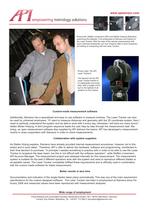
Picture left: Steffen Linnemann (API) and Stefan Hoeyng (Siemens) examining the software. Five employees at Siemens are trained on the Laser Tracker. With the help of the special measurement soft- ware untrained employees can now measure after a short fundamen- tal briefing on measuring with the Laser Tracker. Picture right: The API Laser Tracker3. The decision for the API Laser Tracker thanks to it`s lightweight and porta- bility. With a weight of 8,5 kg it is the lightest of all systems on the market. Custom-made measurement software Additionally, Siemens has a specialized and easy to use software...
Open the catalog to page 2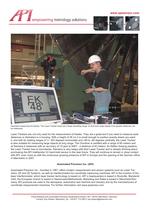
Automated Precision Inc. (API) Automated Precision Inc., founded in 1987, offers modern measurement and sensor systems such as Laser Tra-ckers, 2D and 3D Systems, as well as interferometers for coordinate measuring machines. API is the inventor of the laser interferometer, which laser tracker technology is based on. APIs headquarters is based in Rockville, Maryland/ USA, the European branch is based in Heerenveen/Netherlands, Marketing and Sales is based in Mannheim/Ger- many. API products are used in the aerospace, automotive and machine tool industry and by the manufacturers of coordinate measurement...
Open the catalog to page 3All API - Automated Precision Europe GmbH catalogs and technical brochures
 iLTx brochure
5 Pages
 DYNAMIC 9D LADAR
12 Pages
 iScan3D
2 Pages
 API Metrology Services
6 Pages
 API RapidScan 2
2 Pages
 Machine Tool Calibration
3 Pages
 API Active Target
1 Page
 API SmartTrack Sensor
1 Page
 Robotic Measurement Software
2 Pages


Archived catalogs
 API vProbe
1 Page
 Swivelcheck Datasheet
1 Page
 SPINDLE ANALYZER
1 Page
 BALLBAR
1 Page
 Autocollimator Datasheet
1 Page
 Laser Rail Tech Sheet
1 Page


- Measuring machine
- Calibration system
- Inspection system
- Position transducer
- Portable calibrator
- Automatic inspection system
- Optical measurement system
- Precision calibration equipment
- No-contact position sensor
- 3D scanning system
- Touch probe
- Measurement scanner
- Laser scanner
- Inspection scanner
- Measurement touch probe
- Non-contact measurement system
- Laser measuring machine
- Angular position sensor
- Dimensional measurement system