
- Catalogs
- API - Automated Precision Europe GmbH
- Laser-based Metrology in Fusion Plasma Physics


- Products
- Catalogs
- News & Trends
- Exhibitions
Laser-based Metrology in Fusion Plasma Physics

Laser-based Metrology in Fusion Plasma Physics
The document discusses the critical role of laser-based 3D metrology in the field of fusion plasma physics, particularly in the construction and setup of the Wendelstein 7-X fusion experiment at the Max Planck Institute in Greifswald. This experiment is based on the Stellarator principle and aims to demonstrate the feasibility of nuclear fusion for power generation.
Specifications and Challenges
The Wendelstein 7-X features a complex design with irregular, three-dimensional coils, requiring precise 3D measurement technology for its construction. The plasma vessel, resembling a twisted bicycle inner tube, must maintain its shape to contain plasma at extremely high temperatures without contact with the vessel walls.
Measurement Techniques
Initially, photogrammetry was used to measure the vessel's interior, but compact laser trackers have now been introduced, offering more accurate and time-efficient measurements. These trackers can be positioned inside the vessel through narrow openings, providing a detailed As-Built model for further design and installation.
Mobility and Efficiency
The compactness of modern laser trackers allows for easy repositioning without the need for cranes, reducing downtime and improving efficiency. This mobility is crucial for tasks such as aligning ports that connect the plasma vessel to external systems.
Reference Systems
Accurate measurements require a global reference system, established using targets on the experiment hall's walls. The laser trackers must see multiple targets from each position, a challenge due to the complex setup.
Advancements and Future Prospects
The document highlights the progress in the assembly of the Wendelstein 7-X and the potential of laser trackers to replace older measurement systems. The ultimate goal is to prove the Stellarator's suitability for a fusion power plant, contributing to sustainable energy solutions.
Conclusion
The completion of the Wendelstein 7-X is imminent, with expectations to demonstrate optimized plasma confinement and continuous operation by 2015. This project represents a significant step towards harnessing nuclear fusion as a viable energy source, addressing the depletion of fossil fuels and the decline of traditional nuclear energy.
About the Max Planck Institute for Plasma Physics
The institute conducts extensive research on fusion power principles, operating major experiments like the ASDEX Upgrade and Wendelstein 7-X. It employs around 1,100 staff and is a leading center for fusion research in Europe.
Catalog excerpts

Laser-based Metrology in Fusion Plasma Physics Automated Precision Europe GmbH Im Breitspiel 17 69126 Heidelberg Tel: +49 (0) 6221 729 805 0 Fax: +49 (0) 6221 729 805 23
Open the catalog to page 1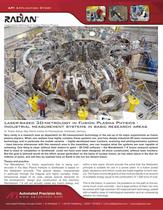
API Application Story TM Laser-based Metrology in Fusion Plasma Physics Picture: Max-Planck-Institut für Plasmaphysik, Dietmar Gust Laser-based 3D-metrology in Fusion Plasma Physics Industrial measurement systems in basic research areas Dr. Torsten Bräuer, Max-Planck-Institut für Plasmaphysik, Greifswald, Germany Very rarely is a research area as dependent on 3D-measurement technology in the set-up of its major experiments as fusion plasma physics. When one realises how highly complex these systems are, and how deeply industrial 3D laser measurement technology, and in particular the mobile variants...
Open the catalog to page 2
API Application Story TM Laser-based Metrology in Fusion Plasma Physics Symmetries: negative! The plasma vessel, which is surrounded by hot plasma at up to 100 million degrees, is reminiscent of a twisted, half-deflated bicycle inner tube of approx. 11 m at the large diameter and approx 1,5 m at the small diameter. The highly complex, threedimensional contour of the plasma vessel orientates itself to the geometry of the toroidal magnetic field generated on the Wendelstein 7-X. The field lines, which are comparable to the bars of the cage of a wild animal, form a cage that makes it impossible...
Open the catalog to page 3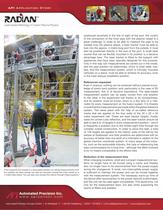
API Application Story TM Laser-based Metrology in Fusion Plasma Physics positioned anywhere in the line of sight of the port, the control of the connection of the inner pipe with the plasma vessel is a great challenge. In order to be able to measure the pipe to be welded onto the plasma vessel, a laser tracker must be able to look into the approx. 2-metre-long port from the outside. It must also be positioned directly in the axis of the port. A small laser tracker that can be flexibly mounted in its position is a decisive advantage here. The laser tracker is fitted to the support with appliances...
Open the catalog to page 4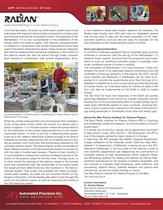
API Application Story TM Laser-based Metrology in Fusion Plasma Physics In the last few years, the build-up of the fusion system has moved well ahead with regard to the principal components, and the outer shell has become almost completely closed. The assembly of the Wendelstein 7-X is now concentrated on the installation of the fittings within the plasma vessel. Until recently, photogrammetric systems in combination with jointed measurement arms were used in the interior of the plasma vessel. Today, however, it appears that that the measurement during the installation in the interior of the...
Open the catalog to page 5All API - Automated Precision Europe GmbH catalogs and technical brochures
 iLTx brochure
5 Pages
 DYNAMIC 9D LADAR
12 Pages
 iScan3D
2 Pages
 API Metrology Services
6 Pages
 API RapidScan 2
2 Pages
 Machine Tool Calibration
3 Pages
 API Active Target
1 Page
 API SmartTrack Sensor
1 Page
 Robotic Measurement Software
2 Pages


Archived catalogs
 API vProbe
1 Page
 Swivelcheck Datasheet
1 Page
 SPINDLE ANALYZER
1 Page
 BALLBAR
1 Page
 Autocollimator Datasheet
1 Page
 Laser Rail Tech Sheet
1 Page


- Measuring machine
- Calibration system
- Inspection system
- Position transducer
- Portable calibrator
- Automatic inspection system
- Optical measurement system
- Precision calibration equipment
- No-contact position sensor
- 3D scanning system
- Touch probe
- Measurement scanner
- Laser scanner
- Inspection scanner
- Measurement touch probe
- Non-contact measurement system
- Coordinate measuring machine
- Laser measuring machine
- Angular position sensor
- Dimensional measurement system