
- Catalogs
- API - Automated Precision Europe GmbH
- 3D Measurements in confined spaces


- Products
- Catalogs
- News & Trends
- Exhibitions
3D Measurements in confined spaces

3D Measurements in confined spaces
This document discusses the challenges and solutions for conducting precise 3D measurements in confined spaces, particularly in manufacturing sectors like aerospace and automotive. It highlights the limitations of traditional stationary 3D-CMM machines and introduces laser trackers as a mobile alternative.
Specifications and Advantages of Laser Trackers
Laser trackers are portable 3D measurement systems that can be used directly at manufacturing sites. They are capable of measuring large structures up to 80 meters long and can operate in space-restricted environments. The API Radian laser tracker, for instance, features an integrated camera for documenting measurements and can handle multiple targets simultaneously, offering significant time savings.
Applications in Manufacturing
Laser trackers simplify complex manufacturing processes by allowing precise measurements to be taken directly from CAD systems. This capability is particularly beneficial in industries like aerospace, where components such as aircraft fuselages require precise alignment and positioning. The Radian's design allows it to measure steep angles and operate in confined spaces, making it suitable for use in vacuum chambers and sterile environments.
Installation and Operational Considerations
The placement of laser trackers is crucial for optimal performance. They can be mounted at various heights or directly on machinery to ensure accurate measurements. The API Radian's lightweight design and large measuring angle make it versatile for different environments, including bottling plants and turbine housings.
Benefits in Maintenance and Calibration
Portable laser trackers offer significant advantages for on-site maintenance and calibration of fully built systems. They reduce the need for disassembly and transportation, providing substantial cost and time savings. The API Radian's compact size allows it to be easily transported and set up, facilitating quick and accurate measurements.
Conclusion
Laser trackers have become essential tools in modern 3D measurement technology, offering precise, efficient, and cost-effective solutions for measuring complex components in confined spaces. Their use has led to innovations in production processes across various industries.
Contact Information
For further inquiries, contact Rainer Lott at Automated Precision Europe GmbH via email at [email protected] or phone at 06221/729 805 0.
Catalog excerpts
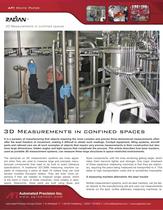
3D Measurements in confined spaces 3D MEASUREMENTS IN CONFINED SPACES It is a paradox of manufacturing that objects requiring the most complex and precise three-dimensional measurements often offer the least freedom of movement, making it difficult to obtain such readings. Cockpit equipment, filling systems, aircraft parts and railroad cars are all such examples of objects that require very precise measurements in their construction but also have large dimensions, hidden angles and tight spaces that complicate the process. This article describes how laser trackers, used as portable 3D measurement systems, can measure these large structures in space-restricted environments. The demands on 3D measurement systems are most appar- ent when they are used to measure large and precisely manu- factured components that need to be built to exact tolerance specifications. A traditional 3D-CMM measuring machine ca- pable of measuring a piece at least 10 meters long can cost several hundred thousand dollars. They are even more ex- pensive if they are needed to measure longer pieces, which is the trend in many of these industries, most notably in aero- space. Meanwhile, these parts are built using fewer and fewer components, with the ones remaining getting larger, which helps them become lighter and stronger. One major drawback of these expensive measuring machines is that they are station- ary, requiring the piece being measured be transported to it. This leads to high transportation costs and is sometimes impossible. A measuring machine alternative: the laser tracker Mobile measurement systems, such as laser trackers, can be tak- en directly to the manufacturing site and carry out measurements directly on the spot. Unlike stationary measuring machines, la- Automated Precision Europe GmbH | Im Breitspiel 17 | 69126 Heidelberg | 06221 729 805 0 | [email protected] | www.apisensor.com
Open the catalog to page 1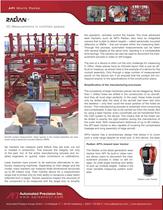
3D Measurements in confined spaces Aircraft cockpit measurement. Open spaces in the cockpit assembly are mea- sured using a spherical mounted reflector (SMR). ser trackers can measure parts before they are even cut out or molded in production. This ensures the integrity not only of the part, but of the entire manufacturing process and en- ables engineers to quickly make corrections or calibrations. Laser trackers have proven to be welcome alternatives to sta- tionary measuring machines. Depending on their design and the model, many trackers can measure three-dimensional structures up to 80 meters...
Open the catalog to page 2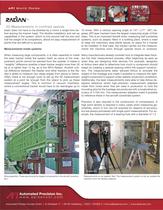
WHITE PAPER 3D Measurements in confined spaces beam does not have to be diverted by a mirror a single time be- fore leaving the tracker head. The flexible installation and set-up capabilities in the system, which is only around half the size and half the weight of its competitors, allows for easy measurement of points that are difficult to access. Measurements inside systems 10 times. With a vertical opening angle of 137° (+77° -60°) de- grees, API laser trackers have the largest measuring angle of their class. This is an important benefit when measuring self-contained systems, such as aseptic...
Open the catalog to page 3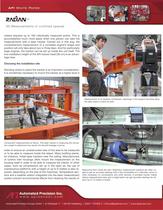
API White Paper TM 3D Measurements in confined spaces meters requires up to 160 individually measured points. This is accomplished much more easily when one person can take the measurements with a laser tracker. Carried out in this way, the comprehensive measurement of a complete engine’s shape and position will only take about two or three days. And for particularly large engines, the tracker can be set up inside the unit itself. The low installation height of the API tracker head (36 cm) is an advantage here. Choosing the installation site Deciding where to place the tracker is an important...
Open the catalog to page 4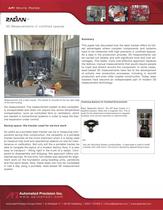
3D Measurements in confined spaces Measurements with a laser tracker. The tracker is mounted at the top right edge the measurement. The measurement system is also complete- ly encapsulated and does not require any active temperature compensation, such as controlled fans or ventilators, which are needed in conventional systems in order to keep the ther- mal expansion under control. Saving space: the tracker used for service work As useful as a portable laser tracker can be in measuring com- ponents during their construction, the versatility of a portable tracker becomes all the more important...
Open the catalog to page 5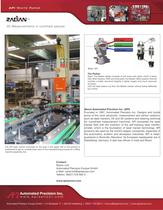
API White Paper TM 3D Measurements in confined spaces IFM Laser Achse ADM Laser Bilder: API The Radian Right: The Radian design consists of just three main parts, which is fewer than other trackers. With just three parts, the Radian offers superior thermal controls, a better structural integrity, a lighter weight, and much improved accuracy. Left: the laser beams out from the Radian tracker without being deflected by a mirror. About Automated Precision Inc. (API) Founded in 1987, Automated Precision Inc. Designs and builds some of the most advanced measurement and sensor systems, such as laser...
Open the catalog to page 6All API - Automated Precision Europe GmbH catalogs and technical brochures
 iLTx brochure
5 Pages
 DYNAMIC 9D LADAR
12 Pages
 iScan3D
2 Pages
 API Metrology Services
6 Pages
 API RapidScan 2
2 Pages
 Machine Tool Calibration
3 Pages
 API Active Target
1 Page
 API SmartTrack Sensor
1 Page
 Robotic Measurement Software
2 Pages


Archived catalogs
 API vProbe
1 Page
 Swivelcheck Datasheet
1 Page
 SPINDLE ANALYZER
1 Page
 BALLBAR
1 Page
 Autocollimator Datasheet
1 Page
 Laser Rail Tech Sheet
1 Page


- Measuring machine
- Calibration system
- Inspection system
- Position transducer
- Portable calibrator
- Automatic inspection system
- Optical measurement system
- Precision calibration equipment
- No-contact position sensor
- 3D scanning system
- Touch probe
- Measurement scanner
- Laser scanner
- Inspection scanner
- Measurement touch probe
- Non-contact measurement system
- Coordinate measuring machine
- Laser measuring machine
- Angular position sensor
- Dimensional measurement system