

Vipel® Corrosion Guide
1 / 32 PagesView full catalog
Vipel® Corrosion Guide
Product catalog summary
Introduction
AOC corrosion resistant resins are tailored for the fiber-reinforced polymer (FRP) composite industry, focusing on environments where corrosion resistance is crucial. This guide aids fabricators in choosing suitable resins for components exposed to corrosive conditions, based on comprehensive laboratory and field testing.
AOC corrosion resistant resins are tailored for the fiber-reinforced polymer (FRP) composite industry, focusing on environments where corrosion resistance is crucial. This guide aids fabricators in choosing suitable resins for components exposed to corrosive conditions, based on comprehensive laboratory and field testing.
Resin System Selection
Selection depends on chemical service, environment, user specifications, and fabricator recommendations. Users may choose resin systems based on experience or manufacturer advice. Fabricators should verify the source and suitability of equivalent systems. Essential information includes chemical names, concentrations, specific gravity, pH, temperature ranges, pressure conditions, and exposure duration.
Selection depends on chemical service, environment, user specifications, and fabricator recommendations. Users may choose resin systems based on experience or manufacturer advice. Fabricators should verify the source and suitability of equivalent systems. Essential information includes chemical names, concentrations, specific gravity, pH, temperature ranges, pressure conditions, and exposure duration.
Resin Selection
Resins are chosen from the Corrosion Resistance Resins Guide based on provided data. Temperature data indicates the highest acceptable service temperature, with short exposure to higher temperatures permissible if the heat distortion temperature is not exceeded. Resistance is determined according to ASTM C581 and ASME/ANSI RTP-1 standards.
Resins are chosen from the Corrosion Resistance Resins Guide based on provided data. Temperature data indicates the highest acceptable service temperature, with short exposure to higher temperatures permissible if the heat distortion temperature is not exceeded. Resistance is determined according to ASTM C581 and ASME/ANSI RTP-1 standards.
Notes and Recommendations
Specific applications may require different veil materials, cure systems, or post-curing. Users should follow notes next to chemical listings for specific recommendations. For unlisted applications, contact AOC's Corrosion Product Leader.
Specific applications may require different veil materials, cure systems, or post-curing. Users should follow notes next to chemical listings for specific recommendations. For unlisted applications, contact AOC's Corrosion Product Leader.
Chemical Listings
The guide includes a comprehensive list of chemicals with recommended maximum continuous exposure temperatures. Notes indicate specific requirements such as synthetic veils, double veils, or specific curing systems for enhanced service life. Some resins are suitable for FDA/USDA applications.
The guide includes a comprehensive list of chemicals with recommended maximum continuous exposure temperatures. Notes indicate specific requirements such as synthetic veils, double veils, or specific curing systems for enhanced service life. Some resins are suitable for FDA/USDA applications.
Temperature Conversions
Fahrenheit to Centigrade conversions are provided for reference, with room temperature assumed to be 77°F.
Fahrenheit to Centigrade conversions are provided for reference, with room temperature assumed to be 77°F.
Overview
This document provides detailed information on various chemical plating solutions and other chemical compounds, focusing on their concentrations and recommended maximum continuous exposure temperatures in degrees Fahrenheit. It includes specific notes on handling and recommended materials for improved service life.
This document provides detailed information on various chemical plating solutions and other chemical compounds, focusing on their concentrations and recommended maximum continuous exposure temperatures in degrees Fahrenheit. It includes specific notes on handling and recommended materials for improved service life.
Plating Solutions
- Cadmium Plating Solution: Contains 3.2% Cadmium oxide, 10% Sodium cyanide, and 1.2% Sodium hydroxide.
- Chrome Plating Solution: Composed of 18.5% Chromic acid, 0.6% Sodium fluorosilicate, and 0.01% Sodium sulphate.
- Gold Plating Solution: Includes 22.8% Potassium ferrocyanide, 0.2% Potassium gold cyanide, and 0.8% Sodium cyanide.
- Lead Plating Solution: Contains 8% Lead, 0.8% Fluoboric acid, and 0.4% Boric acid.
- Nickel Plating Solution: Two formulations are provided, one with 11.3% Nickel sulphate, 1.4% Nickel chloride, and 1.1% Boric acid, and another with 43.7% Nickel sulphate, 3.5% Ammonium chloride, and 3.5% Boric acid.
- Tin Plating Solution: Composed of 18.3% Stannous fluoborate, 7.4% Metallic tin, 9.1% Fluoboric acid, 2.3% Boric acid, and 0.1% Naphtol.
- Zinc Plating Solution: Contains 49% Zinc fluoborate, 4.4% Ammonium chloride, and 5.9% Ammonium fluoborate.
Other Chemicals
- Polyethylene Glycol: Recommended maximum temperature is 210°F.
- Potassium Compounds: Various compounds such as Potassium Aluminum Sulphate, Potassium Bromate, and Potassium Chloride have specific temperature recommendations, generally around 210°F.
- Sodium Compounds: Includes Sodium Acetate, Sodium Bicarbonate, Sodium Chloride, and others, with maximum temperatures typically around 210°F.
Notes and Recommendations
- Various veils and curing systems are recommended for improved service life, such as synthetic veils, carbon veils, and BPO/DMA or BPO/DEA curing systems.
- Post-curing is recommended for certain chemicals to enhance service life.
- Specific products like Vipel® F764 or Vipel® F774 are recommended over others for certain applications.
- Some chemicals are suitable for FDA/USDA applications, including F010, F007, F015, F701, F764, F774, and F737.
Temperature Conversions
The document provides Fahrenheit to Centigrade conversions for various temperatures, with room temperature assumed to be 77°F.
The document provides Fahrenheit to Centigrade conversions for various temperatures, with room temperature assumed to be 77°F.
See more
All AOC catalogs and technical brochures
 AOC Crosslink, Volume 18
12 Pages
 AOC Crosslink, Volume 19
12 Pages
 Chroma-Tek Specialty Dispersions
13 Pages
 AOC Resins Capabilities
8 Pages
 Vibrin® Gel Coats
10 Pages
 Resin Technology for CIPP
6 Pages
 EcoTek® Sustainable Resins
4 Pages
 Vipel® Resins for CIPP
8 Pages
 CIPP RESINS
4 Pages
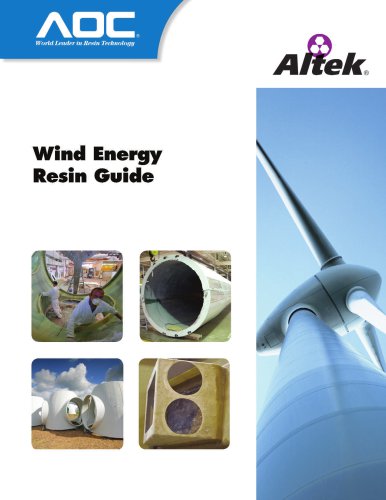 wind energy
6 Pages
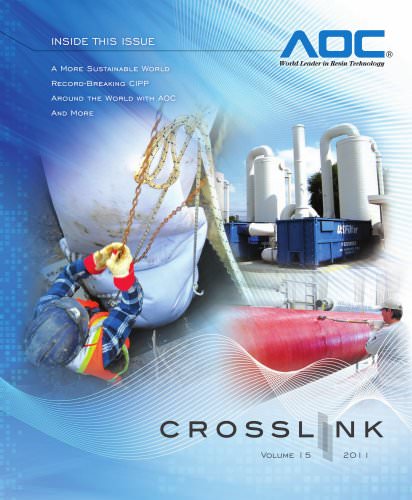 AOC Crosslink
16 Pages
 Vipel® Guide to Fabricating
40 Pages
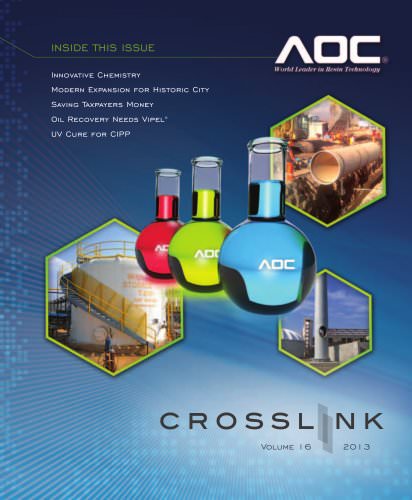 AOC Crosslink, Volume 16
16 Pages
 Atryl® Closed Mold Resins
4 Pages
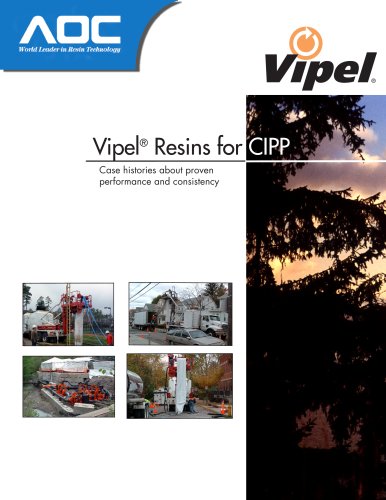 Vipel® Resins for CIPP
8 Pages
 Vipel® Vinyl Ester Brochure
6 Pages
 Vibrin® Brochure
4 Pages
 Hydropel® Brochure
4 Pages
 AOC Capabilities Brochure
8 Pages





Archived catalogs

*Prices are pre-tax. They exclude delivery charges and customs duties and do not include additional charges for installation or activation options. Prices are indicative only and may vary by country, with changes to the cost of raw materials and exchange rates.
About DirectIndustry
DirectIndustry is a marketplace that offers B2B players a complete experience, from product sourcing to purchase. DirectIndustry is an entity of VirtualExpo Group.
Are you a buyer?
Are you a supplier?