Corrosion Resistant Composites

Corrosion Resistant Composites
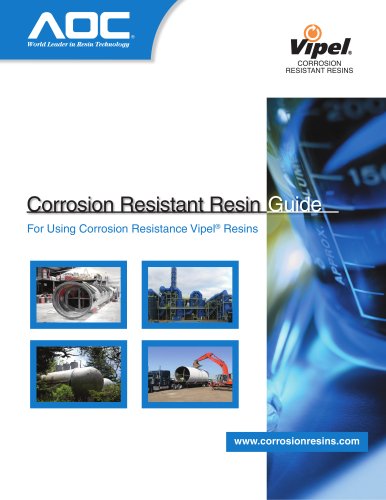
Composites like unsaturated polyester and vinyl ester resin are effective in reducing corrosion and chemical attacks, making them ideal for infrastructure applications. They are used in environments with damp soil, acids, oxidizing agents, and gases, providing long service life in applications such as scrubbers and underground storage tanks.
Resin Technologies
Corrosion-resistant resins, including bisphenol-A epoxy vinyl esters and chlorendic polyesters, have been developed since the 1960s. AOC LLC has improved these technologies to endure harsher environments.
Applications
- Chemical-Resistant Applications: Used in water treatment, food processing, and power generation, these composites resist moisture, corrosive attacks, and high temperatures.
- Water Treatment: A facility in California uses composite towers for solvent removal, showcasing durability and corrosion resistance.
- Food Processing: A composite rinse tank at Abbott Laboratories in Arizona meets FDA standards, offering corrosion resistance and reducing contamination risks.
- Underground Storage Tanks: Composite tanks have replaced steel tanks due to superior performance and soil corrosion resistance, with over 95% of new installations in North America being composite-based.
Infrastructure
Composites are used in civil and marine infrastructure for their mechanical properties and corrosion resistance, reducing maintenance costs. Applications include bridge decks, utility poles, and wind turbine blades.
Short-Span Bridges
Composite bridges offer quicker installation and reduced maintenance, with successful applications in rural areas where traditional construction is challenging.
Specifications
The Russell County bridge meets AASHTO standards, capable of carrying an HS20 or 20 US ton load. It measures 7.1 meters in length and 8.2 meters in width, utilizing a composite construction with a sine wave cross-section core sandwiched between two flat panels for structural efficiency.
Procedures
The bridge components were manufactured by hand laying resin-impregnated fiberglass materials in an open mold. The sinusoidal core uses chopped strand mat, while the flat panels use a combination of chopped strand mat and bidirectional fabrics. The wear surface is made of polymer concrete, offering superior elongation, impact, and abrasion resistance.
Materials and Standards
Three different AOC resins were used for the core, face panels, and polymer concrete. The bridge design has been replicated in various vehicular and pedestrian bridges across North America and Europe.
Conclusions and Recommendations
The use of composites in infrastructure, particularly for corrosion-resistant applications, is expected to grow significantly in the Asia Pacific region. This growth is driven by the need to prevent economic losses from leaking hydrocarbons and to protect the environment. The longevity and durability of composite materials make them ideal for bridge structures and decks.
Additional Information
The paper was presented at the RP Asia 2005 conference by Stephen Olle. Contact information for Ben R. Bogner of AOC, LLC is provided for further inquiries.
Catalog excerpts

November 2005 the voice of the composites industry worldwide C Corrosion resistantcomposites Corrosion resistantcomposites > Flue gas desulphurisation composites handle power station emissions Flue gas desulphurisation composites handle power station emissions Cover picture ֩ Photodisc Green www.reinforcedplastics.com size="-2">
Open the catalog to page 1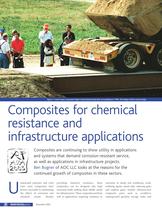
Figure 7. A short-span composite bridge is load tested shortly after its installation in 1994. The bridge is still in service today. nsaturated polyester and vinylester resin composites have proven successful in minimising the effects ofcorrosion and chemical attack.Besidesproviding chemical resistance,thesecomposites can be designed take highstructural loads making them ideally suitedfor infrastructure.These composites perform well in applications requiring resistance tocorrosion in damp soil conditions,acids,oxidising agents,metal salts,reducing gasesand sulphur gases.Quality infrastructurecomposite...
Open the catalog to page 2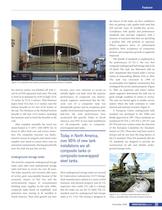
Figure 3. A composite rinse tank for processing nutritional products is installed. the interior surface was finished offwith C-veil in an FDA-approved vinyl ester.The tank is 10.03 m in diameter by 16.85 m high (32 ft, 10 inches by 55 ft,4 inches).Wall thickness tapers from 53.6 mm (2.11 inches) near the bottom knuckle to 9.9 mm (0.39 inches) at the top.The thickness at the finished bottom knuckle is 108 mm (4.25 inches),including the laminate used to bond the knuckle to the wall.After complete assembly,the vessel wassteam-heated at 71-82C (160-180аF) for 16hours to effect final cure and extract...
Open the catalog to page 5All AOC catalogs and technical brochures
 AOC Crosslink, Volume 18
12 Pages
 AOC Crosslink, Volume 19
12 Pages
 Chroma-Tek Specialty Dispersions
13 Pages
 AOC Resins Capabilities
8 Pages
 Vibrin® Gel Coats
10 Pages
 Resin Technology for CIPP
6 Pages
 EcoTek® Sustainable Resins
4 Pages
 Vipel® Resins for CIPP
8 Pages
 CIPP RESINS
4 Pages
 wind energy
6 Pages
 AOC Crosslink
16 Pages
 Vipel® Guide to Fabricating
40 Pages
 Vipel® Corrosion Guide
32 Pages
 AOC Crosslink, Volume 16
16 Pages
 Atryl® Closed Mold Resins
4 Pages
 Vipel® Resins for CIPP
8 Pages
 Vipel® Vinyl Ester Brochure
6 Pages
 Vibrin® Brochure
4 Pages
 Hydropel® Brochure
4 Pages
 AOC Capabilities Brochure
8 Pages