


Hybrid Electric Powertrain

Hybrid Electric Powertrain
The document discusses the challenges and solutions in designing hybrid electric powertrains, emphasizing the role of engineering simulation in expediting development. ANSYS simulation software is highlighted as a tool for virtual prototyping and testing, allowing engineers to evaluate designs under various conditions before physical prototyping.
Specifications and Procedures
The electric powertrain requires an integrated simulation platform to accurately simulate components and their interactions. This involves evaluating multiple physics such as structural mechanics, fluid dynamics, and thermal physics. The document outlines the need for converting detailed component models into reduced-order models for system-level optimization.
Battery Optimization
Batteries are crucial for providing primary drive power and must meet high standards of reliability and durability. Thermal management is a priority to prevent overheating, which affects efficiency and lifespan. ANSYS CFD solvers are used for analyzing cooling flows and heat transfer. Simplorer technology aids in evaluating control algorithms for battery safety under various conditions.
Power Electronics and Electric Motors
Power electronics require efficient cooling and control logic optimization. Electric traction motors need optimized magnetic design, thermal management, and vibration reduction. System integration is essential for optimizing motor and control systems together.
EMI/EMC Considerations
Upfront EMI/EMC analysis is crucial to reduce the need for extensive testing. ANSYS software supports this by simulating electromagnetic interactions at various levels.
Conclusion
The document underscores the importance of simulation in developing hybrid electric powertrains, highlighting ANSYS software's capabilities in optimizing battery performance, power electronics, and motor systems. It emphasizes the need for comprehensive simulation to ensure safety, efficiency, and reliability in electric vehicle components.
Catalog excerpts
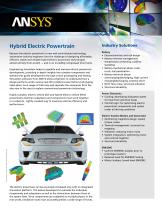
Hybrid Electric Powertrain Because the electric powertrain is new and revolutionary technology, automotive industry engineers face the challenge of designing affordable, efficient, stable and reliable hybrid electric powertrain technologies almost entirely from scratch — and in an incredibly compressed time frame. Engineering simulation helps to expedite and improve electric powertrain development, providing in-depth insights into complex components and systems that guide development through virtual prototyping and testing. Simulation software from ANSYS allows engineers to understand how a design performs under various real-life conditions even before prototyping takes place. Such usage of CAE may well separate the visionaries from the also-rans in the race to replace conventional powertrain technology. Highly complex, electric vehicle (EV) and hybrid-electric vehicle (HEV) powertrains and their subsystems and components must work together in a coherent , tightly coupled way to maximize vehicle efficiency and performance. Industry Solutions Battery • Electrochemistry and cell design • Battery thermal management: temperature uniformity, cold/hot start/stop • Battery mechanical abuse: crash, crush, nail penetration • Battery electrical abuse: overcharging/discharging, high current charging/discharging, external short • NVH: flow noise, structural vibration • Structural durability Power Electronics • Cooling: developing dissipation paths for heat from electrical losses • Control logic: for optimizing electric powertrain components and system under all driving conditions Electric Traction Motors and Generators • Optimizing magnetics design: speed, torque, losses • Thermal management: accurate loss mapping • Vibration: reducing motor noise • System integration: optimizing motor and controls together • Structural durability Generator image courtesy Kato Engineering. EMI/EMC • Upfront EMI/EMC analysis prior to prototype creation • Reduced need for EMI/EMC testing • Motor, busbars, board-level EMI/EMC The electric powertrain can be accurately simulated only with an integrated simulation platform. This allows developers to evaluate the individual components and subsystems as well as the interactions between them at the system level. Since components are subjected to multiple physics in the real world, simulation tools must accurately
Open the catalog to page 1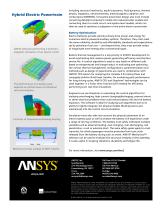
Hybrid Electric Powertrain including structural mechanics, explicit dynamics, fluid dynamics, thermal physics, magnetics, electrochemistry, electromagnetic radiation and conductance (EMI/EMC). Innovative powertrain design also must include converting detailed component models into reduced-order models and connecting them to create circuit- and system-level models, which can then be used to optimize a subsystem or the entire electric powertrain. Battery Optimization ANSYS software performing 3-D electromagnetic simulation of an electric motor The performance of a battery pack depends on performance...
Open the catalog to page 2All ANSYS catalogs and technical brochures
 Explicit Dynamics
8 Pages
 Ansys SpaceClaim Direct
2 Pages
 Ansys SCADE Display
5 Pages
 Ansys SCADE Test
4 Pages
 ANSYS Twin Builder
1 Page
 ANSYS VRXPERIENCE
4 Pages
 ANSYS® Simplorer® 17
5 Pages
 ANSYS FENSAP-ICE TURBO
8 Pages
 ANSYS FENSAP-ICE
4 Pages
 ANSYS Forte
4 Pages
 ANSYS Model Fuel Library
2 Pages
 Chemkin-Pro
6 Pages
 Polyflow
8 Pages
 ANSYS® SCADE LifeCycle® 17.0
2 Pages
 ANSYS® SCADE Suite® 17.0
7 Pages
 ANSYS Maxwell
2 Pages
 ANSYS DesignXplorer
8 Pages
 Meshing Solutions
4 Pages
 ANSYS Q3D Extractor
2 Pages
 ansys-icepak-brochure
8 Pages

Archived catalogs
 SCADE System ® R16
5 Pages
 ANSYS Structural
2 Pages
 High-Performance Computing
8 Pages
 ANSYS SpaceClaim
2 Pages
 ANSYS SIwave
2 Pages
 ANSYS® SCADE System® 17.0
6 Pages
 turbomachinery
4 Pages
 ANSYS AIM
2 Pages
 ANSYS SpaceClaim
2 Pages
 Discovery
2 Pages
 ANSYS AIM
2 Pages
 ANSYS HFSS
2 Pages
 EMIT
EMIT5 Pages
 Fluid Dynamics
8 Pages
 ANSYS 17.0 Capabilities
19 Pages
 Electromagnetics
12 Pages
 ANSYS Meshing Solutions
4 Pages
 Ansys brochure
12 Pages
 SIwave
12 Pages
 Q3D Extractor
8 Pages
 Fatigue Products
8 Pages
 Icepak
8 Pages
 TGrid
TGrid4 Pages
 ANSYS Workbench Platform
4 Pages
 SCADE LifeCycle
3 Pages
 SCADE Suite
5 Pages
 SCADE System
3 Pages
 ANSYS Simplorer
8 Pages
 Systems & Multiphysics Solutions
12 Pages
 ANSYS Mechanical Products
12 Pages
 ANSYS Vista TF
2 Pages
 ANSYS AQWA
4 Pages
 ansys-fluent-brochure
12 Pages
 ansys-maxwell-brochure
8 Pages
 ansys-hfss-brochure
12 Pages
 ansys-cfx-brochure
4 Pages
 ANSYS Composite PrepPost
2 Pages
 ANSYS ASAS
4 Pages
 FLUENT® for CATIA® V5
4 Pages
 SCADE Display
4 Pages
 ANSYS® SCADE Display® 17.0
6 Pages
 ANSYS® SCADE Test™ 17.0
4 Pages


- ANSYS management software
- ANSYS automation software
- ANSYS analysis software
- ANSYS process software
- Real-time software
- ANSYS CAD software
- Cloud-based software
- ANSYS control software
- ANSYS design software
- Monitoring software solution
- ANSYS industrial software
- ANSYS 3D software
- Measurement software
- Interface software
- ANSYS visualization software
- ANSYS quality software
- Programming software solution
- ANSYS automated software
- ANSYS development software