


ANSUL N-101
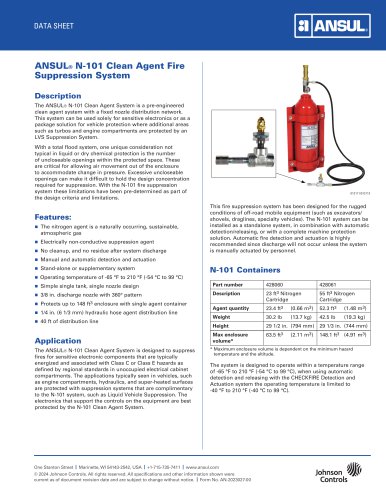
ANSUL N-101
- Uses nitrogen, a naturally occurring, sustainable gas.
- Electrically non-conductive and leaves no residue post-discharge.
- Operates manually or automatically, with a temperature range of -65 °F to 210 °F (-54 °C to 99 °C).
- Simple design with a single tank and nozzle, protecting up to 148 ft³ with a single container.
- Containers: Available in two sizes (23 ft³ and 55 ft³), filled with nitrogen at 2,015 psi at 70 °F.
- Nozzles: Designed for a 360° discharge pattern, available in sizes corresponding to the cartridge size.
- Brackets: Made of heavy gauge steel to support the cartridges.
- Detection and Releasing: Can be automated with CHECKFIRE systems or manually actuated.
Catalog excerpts
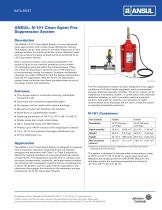
DATA SHEET The ANSUL® N-101 Clean Agent System is a pre-engineered clean agent system with a fixed nozzle distribution network. This system can be used solely for sensitive electronics or as a package solution for vehicle protection where additional areas such as turbos and engine compartments are protected by an LVS Suppression System. With a total flood system, one unique consideration not typical in liquid or dry chemical protection is the number of uncloseable openings within the protected space. These are critical for allowing air movement out of the enclosure to accommodate change in pressure. Excessive uncloseable openings can make it difficult to hold the design concentration required for suppression. With the N-101 fire suppression system these limitations have been pre-determined as part of the design criteria and limitations. ■ The nitrogen agent is a naturally occurring, sustainable, atmospheric gas ■ Electrically non-conductive suppression agent ■ No cleanup, and no residue after system discharge ■ Manual and automatic detection and actuation ■ Stand-alone or supplementary system ■ Simple single tank, single nozzle design ■ 3/8 in. discharge nozzle with 360° pattern ■ Protects up to 148 ft3 enclosure with single agent container ■ 1/4 in. (6 1/3 mm) hydraulic hose agent distribution line The ANSUL® N-101 Clean Agent System is designed to suppress fires for sensitive electronic components that are typically energized and associated with Class C or Class E hazards as defined by regional standards in unoccupied electrical cabinet compartments. The applications typically seen in vehicles, such as engine compartments, hydraulics, and super-heated surfaces are protected with suppression systems that are complimentary to the N-101 system, such as Liquid Vehicle Suppression. The electronics that support the controls on the equipment are best protected by the N-101 Clean Agent System. This fire suppression system has been designed for the rugged conditions of off-road mobile equipment (such as excavators/ shovels, draglines, specialty vehicles). The N-101 system can be installed as a standalone system, in combination with automatic detection/releasing, or with a complete machine protection solution. Automatic fire detection and actuation is highly recommended since discharge will not occur unless the system is manually actuated by personnel. * Maximum enclosure volume is dependent on the minimum hazard temperature and the altitude. The system is designed to operate within a temperature range of -65 °F to 210 °F (-54 °C to 99 °C), when using automatic detection and releasing with the CHECKFIRE Detection and Actuation system the operating temperature is limited to -40 °F to 210 °F (-40 °C to 99 °C). Johnson vjjt Controls One Stanton Street | Marinette, WI 54143-2542, USA | +1-715-735-7411 | www.ansul.com © 2024 Johnson Controls. All rights reserved. All specifications and other information shown were current as of document revision date and are subject to change without notice. | Form No. A
Open the catalog to page 1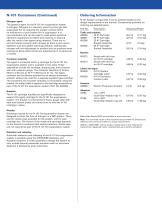
Shipping Weight N-101 Containers (Continued)Nitrogen agent The gaseous agent for the N-101 fire suppression system is nitrogen. Nitrogen is a naturally occurring inert gas that suppresses fire by reducing the oxygen content within an enclosure to a point where fire is suppressed. It is non-conductive and can be used in areas where sensitive electronic equipment is present and requires no cleanup after the result of the agent being released. There are no environmental concerns with nitrogen as there is zero ozone depletion and zero global warming potential. Additionally, nitrogen will not decompose...
Open the catalog to page 2All ANSUL catalogs and technical brochures
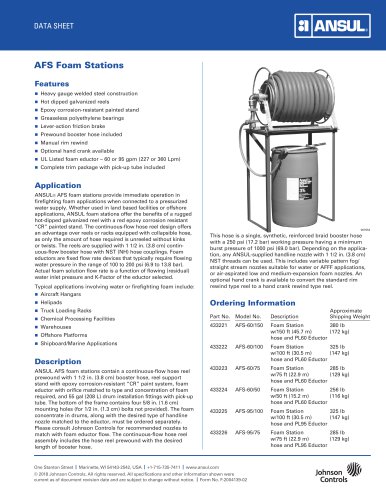 AFS Foam Stations
2 Pages
 SAPPHIRE® Acoustic Nozzles
2 Pages


Archived catalogs
 ANSUL® Capabilities Brochure
16 Pages
 Inert Gas System 300
4 Pages
 Archives and Museums
2 Pages
 Control Rooms
2 Pages
 Firefighting Foam Catalog
20 Pages


- Storage vessel
- Metal tank
- Spray tip
- Vertical tank
- Horizontal tank container
- Water tank
- Pressure tank
- Absorbent
- Smoke detector
- Feeding tank
- NPT nozzle
- ANSUL extinguisher
- Fire protection atomizing nozzle
- Automatic control panel
- ANSUL portable extinguisher
- BSP nozzle
- 360° nozzle
- Hydrocarbon absorbent
- ANSUL fire extinguishing system