
- Catalogs
- Angelo Quidacciolu Costruzioni Meccaniche
- PLANTS FOR THE COMPREHENSIVE SORTING OF RECYCLABLE MATERIALS

- Company
- Products
- Catalogs
- News & Trends
- Exhibitions
PLANTS FOR THE COMPREHENSIVE SORTING OF RECYCLABLE MATERIALS
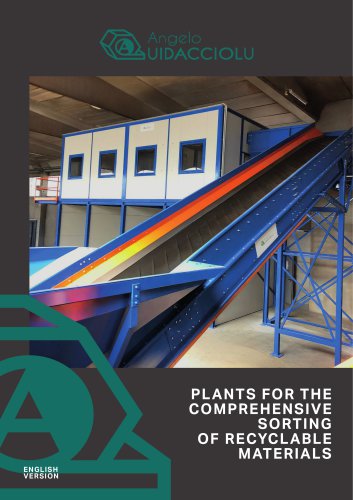
PLANTS FOR THE COMPREHENSIVE SORTING OF RECYCLABLE MATERIALS
The document outlines the company's commitment to environmental sustainability through advanced sorting plants that maximize resource recovery and support the transition to a circular economy. The focus is on collaboration and action to reduce pollution and enhance recycling efficiency.
The company emphasizes the importance of collective efforts to preserve the environment. It highlights the need for improved recycling policies and technological solutions to manage waste more efficiently, with sorting being a crucial step in effective recycling.
Quidacciolu Costruzioni Meccaniche specializes in designing and producing conveyor belts and automated recycling plants. The plants are adaptable, interconnected, and energy-efficient, offering turnkey solutions with comprehensive support from design to operation.
These plants are designed to treat unsorted municipal waste, maximizing recyclable material recovery and reducing landfill waste. Key components include shredders, trommel screens, and separators. The process involves controlled feeding, pre-treatment, screening, and sorting by weight and shape, with metal removal systems enhancing efficiency.
CSS plants manage waste for secondary solid fuel production, optimizing sorting and storage operations. They feature components like bag openers, trommel screens, and optical sorting systems. The process ensures efficient flow management and high sorting efficiency, with customization based on input material characteristics.
These plants recover and recycle industrial waste, transforming it into reusable materials. The process includes controlled feeding, pre-treatment, and sorting by physical and compositional characteristics. The plants are customizable to handle various materials, ensuring high purity and reduced waste.
Designed for recovering polymers from plastic packaging, these plants use mechanical and optical sorting systems to produce high-purity fractions. The process involves controlled feeding, pre-sorting, and separation by particle size and polymer characteristics, ensuring efficient recycling.
These plants focus on recovering materials from paper and cardboard waste, using components like infeed hoppers and sorting systems to optimize recycling processes.
These plants are equipped with components like metering drums, overbelt magnets, and near-infrared technology to sort materials into fractions such as cardboard boxes and mixed paper. The benefits include high-quality cellulose recovery, reduced impurities, and operational efficiency. The process involves controlled feeding, size separation, and manual sorting to ensure purity and quality.
Designed to recover glass and metals, these plants use vibrating feeders, eddy current separators, and overbelt magnets. The process ensures high efficiency in separating glass and non-ferrous metals, reducing impurities, and optimizing processing flows. The plants are customizable to handle variable contamination levels and ensure high purity levels.
These plants focus on transforming organic waste into high-quality compost through controlled biological processes. Key components include trommel screens and conveyors. The process involves pre-treatment to remove impurities, followed by controlled composting to stabilize the material. Benefits include reduced waste volume, emissions control, and contribution to the circular economy.
RDF plants convert sorted waste into secondary solid fuel using shredders, aeraulic separators, and eddy current separators. The process includes pre-treatment, shredding, and separation to produce fuel with controlled characteristics. The plants are designed for operational continuity and energy recovery, aligning with circular economy principles.
These plants handle heterogeneous materials from urban and industrial sites. Components like shredders, trommel screens, and ballistic separators enable the recovery of metals, wood, and plastics. The robust design ensures reliability under demanding conditions, with a focus on reducing disposal volumes and improving recovery efficiency.
These plants process electronic waste to recover materials like ABS, PS, and precious metals. The process involves shredding, magnetic separation, and densimetric tables to ensure efficient recovery. The plants are designed to handle complex materials and ensure high performance and stability.
All plants are custom-designed based on input material characteristics, processing volumes, and quality requirements. The modular configuration allows for flexibility and future expansion, with a focus on optimizing plant layout and integrating suitable technologies for long-term reliability and efficiency.
These plants are designed to process complex waste from end-of-life electrical and electronic equipment. They integrate mechanical and advanced separation systems to recover valuable materials like metals and plastics, ensuring high efficiency and quality. The modular configuration allows adaptation to different types of WEEE and production capacities.
These plants focus on processing end-of-life photovoltaic modules to recover materials such as glass, metals, and plastics. The process involves controlled feeding, pre-treatment, crushing, and separation systems to ensure high material recovery and quality.
Designed for the recovery of ferrous and non-ferrous metals from various waste streams, these plants use advanced separation technologies to produce high-purity metal fractions. The modular design allows adaptation to different feed types and production capacities.
These plants process wood material from post-consumer and industrial waste, producing clean wood fractions for reuse in industrial processes. The process includes shredding, screening, and magnetic separation to improve the quality of the recovered wood.
Mobile plants are designed for on-site processing in temporary settings, offering high operational flexibility. They integrate modular technologies for sorting and separation, reducing logistics costs and material handling times.
These plants process mixed waste streams from separate collection schemes, enabling the simultaneous separation of various materials like plastics, metals, and paper. The modular configuration ensures operational flexibility and process continuity.
- Efficient recovery of valuable materials
- High precision in separation processes
- Reduction in environmental impact
- Operational continuity and reliability
- Compliance with environmental and safety regulations
The document describes a waste sorting process that uses magnetic drums for ferrous metals and eddy current systems for non-ferrous metals. Advanced configurations may include optical sorting systems (NIR) for automatic identification and separation of materials, especially plastics.
Key machinery includes feeding hoppers, rotary screens, ECS separators, conveyors, magnetic separators, magnetic drums, air separators, bag openers, ballistic separators, and NIR optical sorting systems. The infrastructure is supported by steel construction with walkways and electrical engineering.
The process results in the separation of ferrous metals, non-ferrous metals, paper and cardboard, plastic, and recyclable light waste.
The system offers high flexibility in handling mixed waste streams, efficient separation of materials, improved quality of recovered fractions, optimized recycling processes, reduced waste volumes, and reliable operational continuity.
Sorting plants are custom-designed based on input material composition, processing volumes, and recovery targets. The modular configuration allows adaptation to specific operational needs, ensuring high performance and quality of recovered fractions. The design focuses on optimizing material flow and ensuring operational stability, with ease of management and potential for future expansion.
The document provides contact details for the offices and production headquarters, including phone number and email.
Catalog excerpts
PL ANTS FOR THE COMPREHENSIVE SORTING OF RECYCL ABLE MATERIALS E NGLISH VE RSION
Open the catalog to page 1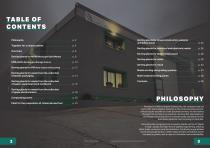
TAB LE OF C ONTE NTS __________________________________________ Together for a cleaner planet_________________________ Overview ___________________________________________ Sorting plants for MSW (Municipal Solid Waste) _________ CSS plants (Sorting and Storage Centre)__________________ Sorting plants for PIR (Post-Industrial Recycling) __________ Philosophy Sorting plants for waste from the collection of plastic packaging Sorting plants for waste from the collection of paper, paperboard and cardboard _______________________________ Composting plants __________________________________ Plant for...
Open the catalog to page 2
TOG ETH E R FOR A C LE AN E R PL AN ET A global environmental problem An expression that calls for collaboration and action to preserve the environment and reduce pollution, emphasising the importance of a collective commitment to environmental sustainability. In order to reverse this trend, which will see plastic pollution increase more and more over the next 30 years, and drastically reduce environmental impact, it is essential to strengthen recycling policies and promote technological solutions that support more efficient waste management. One of the key steps in this process is sorting: the...
Open the catalog to page 3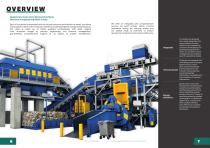
Each of our plants is developed with the utmost precision and attention to detail, according to the specific needs of the customer, whether a private individual or a large industrial group. Our team is made up of highly qualified professionals with skills ranging from structural design to process engineering and financial management, guaranteeing comprehensive support at all stages of project development. We offer an integrated and comprehensive service: we build turnkey plants, provide assistance during the start-up phase and are always ready to intervene to ensure operational continuity and...
Open the catalog to page 4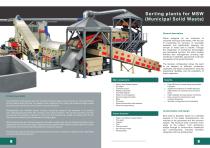
S or t ing pl a n t s for M SW (M u n icipa l S ol id Wa s te) General description Plants designed for the treatment of unsorted municipal solid waste, with the aim of maximising the recovery of recyclable materials and significantly reducing the amount of waste sent to landfill. Through the integration of mechanical technologies and automated systems, the plant enables efficient flow management, ensuring high standards of reliability, operational continuity and quality of the sorted fractions. The modular configuration allows the plant to be adapted to different production capacities and waste...
Open the catalog to page 5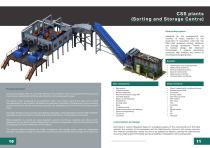
C S S pl a n t s (S or t ing a n d S torage C e n t re) General description Designed for the management and recovery of waste intended for the production of secondary solid fuel, the CSS plant optimises sorting, treatment and storage operations. Thanks to its modular design and advanced technologies, it ensures operational continuity, high reliability and control of incoming and outgoing flows. Benefits Process operation The process begins with the controlled feeding of the material, which is distributed evenly along the line to ensure operational continuity and efficiency in the subsequent stages....
Open the catalog to page 6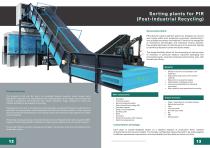
S or t ing pl a n t s for PI R (Pos t- I n d u s t ri a l Recycling) General description PIR industrial waste treatment plants are designed to recover and recycle waste from production processes, transforming it into reusable secondary raw materials. Thanks to the integration of mechanical technologies and advanced sorting systems, they enable high levels of material purity to be achieved, helping to optimise production cycles and reduce waste. The design flexibility allows for the processing of various types of materials, in particular plastics, industrial packaging and processing waste, ensuring...
Open the catalog to page 7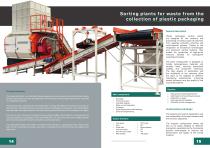
S or t ing pl a n t s for wa s te from t he collec t ion of p l a s t ic pack ag i ng General description Plastic packaging sorting plants are designed for the recovery and processing of various types of polymers from separate collection schemes and multi-material streams. Thanks to the integration of mechanical technologies and advanced sorting systems, they enable the production of high-purity fractions suitable for subsequent recycling processes. The plant configuration is designed to handle heterogeneous materials and variable flows, ensuring operational stability and production continuity....
Open the catalog to page 8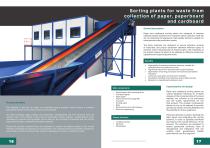
S or t ing pl a n t s for wa s te from collec t ion of pa pe r, pa pe rboa rd a n d c a rd boa rd General description Paper and cardboard sorting plants are designed to process cellulose-based materials from separate waste collection, with the aim of producing homogeneous, high-quality fractions suitable for reintroduction into production cycles. The plant solutions are designed to ensure effective removal of impurities and proper separation between different types of material, even in the presence of mixed streams. The modularity of the system allows the plant to be adapted to different production...
Open the catalog to page 9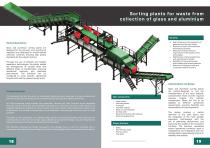
General description Glass and aluminium sorting plants are designed for the recovery and recycling of materials from dedicated or mixed-material collection schemes, ensuring high quality standards for the output fractions. Through the use of efficient and reliable separation technologies, the plants enable the management of variable flows and different levels of contamination, ensuring operational continuity and optimised performance. The solutions can be configured to meet specific operational requirements and the required purity levels. High efficiency in the separation of glass and non-ferrous...
Open the catalog to page 10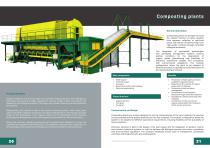
C om pos t ing pl a n t s General description Composting plants are designed to treat the organic fraction of waste, whether from separate collection or agri-food waste, with the aim of transforming it into high-quality compost through controlled biological processes. The integration of specialised technologies and automated management systems ensures optimal conditions for the degradation of organic matter, guaranteeing high standards of efficiency, operational stability and compliance with environmental regulations. The modular configuration allows the plant to be adapted to different production...
Open the catalog to page 11All Angelo Quidacciolu Costruzioni Meccaniche catalogs and technical brochures
 PRODUCTS CATALOGUE
21 Pages
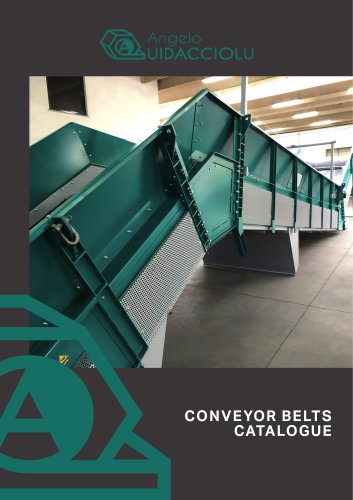 CONVEYOR BELTS CATALOGUE
15 Pages
- Transport rail conveyor
- Belt conveyor
- Horizontal conveyor
- Conveying belt
- Screening unit
- Conveyor for the food industry
- Bulk material screening machine
- Plastic conveyor belt
- Inclined conveyor
- Chain conveyor
- Work conveyor
- Industrial conveyor belt
- Flush grid conveyor belt
- Stainless steel conveyor
- Food conveyor
- Modular conveyor
- Modular conveyor belt