
- Catalogs
- Andor Technology
- Confocal Laser Microscopy System for Ultimate speed and sensitivity

Confocal Laser Microscopy System for Ultimate speed and sensitivity

Confocal Laser Microscopy System for Ultimate speed and sensitivity
The document provides a detailed overview of Andor's Revolution® laser microscopy systems, highlighting their speed and sensitivity. These systems integrate various components to deliver high-performance solutions for live cell imaging.
- Andor Revolution® Framework: Incorporates spinning disk confocal, TIRFM, and photobleach/activation modalities, combining Andor’s iXonEM+ EMCCD cameras, solid-state laser combiner, and Yokogawa CSU-X1 confocal scanner.
- Microscope Platform Compatibility: Compatible with infinity corrected microscopes from Leica, Nikon, Olympus, TILL, or Zeiss.
- iQ Multi-Dimensional Imaging Software: Synchronizes system components for minimal photon loss and offers comprehensive processing and visualization.
- Laser Confocal Spinning Disk: Provides high contrast imaging with enhanced laser throughput and optimized optics.
- iXonEM+ EMCCD Technology: Offers ultra-sensitive detection with reduced photobleaching and phototoxicity.
- Precision Controller Unit: Synchronizes all components and minimizes specimen exposure.
- Andor Laser Combiner: Allows selection and modulation of lasers with minimal exposure and cross-talk.
- FRAPPA: Enables photo-bleaching and activation with precision and speed.
- Piezo Nano Positioning: Provides high-resolution positioning for stage and objectives.
- Imaging Workstation: Optimized for handling large datasets with high-performance computing capabilities.
The systems are suitable for various applications, including cell motility, live cell confocal imaging, TIRF, FRET imaging, ion signaling, and more.
- Confocal Dual Spinning Disk: Offers high-speed, high SNR imaging with low phototoxicity.
- TIRF: Provides high contrast, low background images ideal for studying cellular membrane dynamics.
Andor's Revolution® systems offer a flexible, high-performance solution for advanced microscopy applications, supported by a range of compatible hardware and software components.
- Integral AOTF provides microsecond wavelength, shuttering, and intensity control.
- Active blanking offers precise synchronization with over 80 dB isolation.
Fluorescence Recovery After Photobleach (FRAP) and Photo Activation (PA) are techniques used for controlled application of laser beams to initiate photo-effects, providing qualitative and quantitative data about cellular structures and their environment.
- Photo-activated fluorescent proteins highlight small numbers of activated molecules.
- UV uncaging delivers agonists to specific cell compartments.
- Photoactivation is used in drug discovery to study effects of photo-sensitive compounds.
FRAPPA techniques measure molecular recruitment rates, trafficking, and turnover in cells and organelles, with applications in membrane and protein binding, mitosis, and cytoskeleton function.
FRAP is increasingly used in analytical devices for diffusion analysis, understanding cellular transduction, and identifying ligand binding sites.
A composite triple color image of a microtubule protein (EB1-GFP) was imaged using objective-type TIRFM, revealing microtubule dynamics over time, conducted by Dr. Derek Toomre at the CINEMA laboratory, Yale University School of Medicine.
Andor Technology plc has offices in Northern Ireland, North America, Japan, and China. They are ISO9001:2008 and ISO14001:2004 certified.
Catalog excerpts
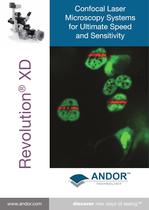
Confocal Laser Microscopy Systems for Ultimate Speed and Sensitivity Revolution® XD www.andor.com discover new ways of seeing™
Open the catalog to page 1
Laser Microscopy Andor Revolution® Andor Revolution® provides a framework for our range of laser-illuminated microscopy solutions, including spinning disk confocal, TIRFM and photobleach and activation modalities. Our spinning disk, live cell confocal instrument, illustrated below, combines Andor’s award winning iXonEM+ EMCCD cameras, solid-state laser combiner and the renowned Yokogawa CSU-X1 confocal scanner “inside”. Andor has established a global distribution agreement with Yokogawa Electric Corporation and harnessed our optoelectronics engineering and manufacturing knowledge to create powerful...
Open the catalog to page 2
Microscopy Systems Products iXonEM+ Single Photon Sensitivity discover new ways of seeing™ Features • Single photon sensitivity & Back Illuminated sensors • UltraVac™ cooling to -100°C • Minimized dark current from unparalleled –90°C TE cooling; especially critical for confocal imaging where experimental backgrounds are minimal • Industry fastest vertical shift rates (< 2ìs/row) - Minimizes clock-induced charge (CIC) • DU-897 - The ultimate combination of sensitivity and frame rate • DU-888 - 1MP resolution and exceptional sensitivity combined • DU-885 - 35 MHz readout, high resolution intra-cellular...
Open the catalog to page 3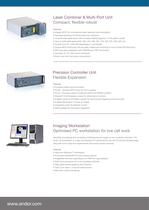
Laser Combiner & Multi-Port Unit Compact, flexible robust Imaging Workstation Optimised PC workstation for live cell work Handling, processing and visualising multidimensional images is very computer intensive. The Andor IQ workstation is a high end Desktop PC optimised for use with IQ and for handling large data sets which arise from experiments that employ Andor cameras. Precision Controller Unit Flexible Expansion www.andor.com Features • Integral AOTF for microsecond laser selection and modulation • Hardware blanking minimizes specimen exposure • Long life solid state lasers with excellent...
Open the catalog to page 4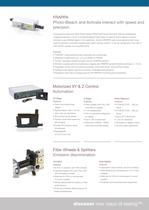
www.andor.com FRAPPA Photo-Bleach and Activate interact with speed and precision Fluorescence Recovery After Photo-bleach (FRAP) and Photo Activation (PA) are established imaging protocols in which a computer-steered laser beam is used to photo-bleach or photo-activate a user-defined region in the specimen. Andor’s FRAPPA uses a dual galvanometer scan head to provide a computer-steered laser beam delivery system. It can be configured in-line with a CSU and/or camera or on another ports. Motorized XY & Z Control Automation Filter Wheels & Splitters Emission discrimination discover new ways of...
Open the catalog to page 5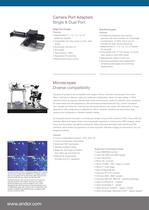
Camera Port Adapters Single & Dual Port Microscopes Diverse compatibility Revolution® products are compatible with modern infinity corrected microscopes from Leica, Nikon, Olympus or Zeiss to meet your preferred configuration. Note: For laser safety, a 100% side port switch is required. Microscopes need environmental control to maintain living conditions for mammalian live cell preparations. We recommend temperature and CO2 control incubators from Okolab and Tokai Hit. Thermal and mechanical factors can impact the observation of living specimens when image focus is affected by drift or vibration,...
Open the catalog to page 6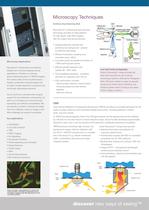
discover new ways of seeing™ Microscopy Techniques Microscopy Applications Revolution® components and systems benefit from common features across applications. Whether in confocal, photo-bleach/activation or TIRFM imaging this means state of the art performance, flexible component-oriented supply and an open-minded approach to systems and technically demanding solutions. As we continue to provide wide-ranging support for key hardware components, we also try to increase your choice through expanding our software compatibility. We are actively involved in making the bridge from iQ to MatLab, Imaris...
Open the catalog to page 7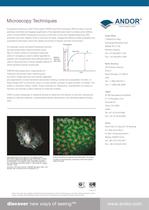
MXDB 0110 Microscopy Techniques Fluorescence Recovery After Photo bleach (FRAP) and Photo Activation (PA) provides a tool for precisely controlled and targeted application of the selected laser beam to initiate photo-effects, which include (FRAP) fluorescence recovery, (FLIP) rate of loss with repeated bleaching, (PA) activation and even ablation (with Q-switched UV laser). Imaging the effects reveals qualitative and quantitative information about the cellular structures of interest and their environment. For example, photo-activated fluorescent proteins are becoming widely used to provide a...
Open the catalog to page 8All Andor Technology catalogs and technical brochures
 Marana sCMOS
9 Pages
 MicroPoint 4
9 Pages
 ZL41 Cell sCMOS
7 Pages
 Sona sCMOS
9 Pages
 Optistat
11 Pages
 Multi-Wavelength Imaging
11 Pages
 BC43
BC4313 Pages
 andor-kymera-193-specifications
15 Pages
 andor-dragonfly-specifications
14 Pages
 Solis-Brochure
6 Pages
 Spectroscopy-Solutions-Brochure
24 Pages
 iKon-M/L SO Series
10 Pages
 iStar CCD and sCMOS
8 Pages
 Neo 5.5 sCMOS
6 Pages
 Mechelle 5000
5 Pages
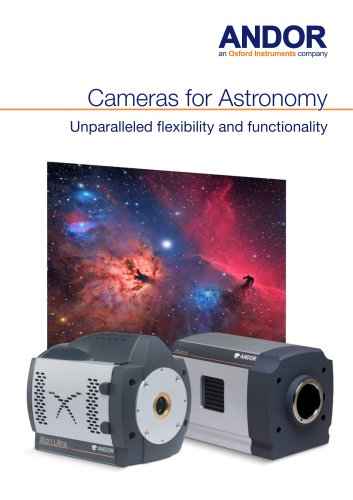
 Cameras for Astronomy
8 Pages
 Microspectroscopy Gatefold
8 Pages
 Spectroscopy Brochure
25 Pages
 iXon EMCCD
13 Pages
 Zyla for Physical Sciences sCMOS
12 Pages
 iVac OEM 2
2 Pages
 iKon-M OEM 2-page PV
2 Pages
 iKon-M X-Ray 2
2 Pages
 Newton EMCCD
16 Pages
 sCMOS
sCMOS16 Pages
 Darkcurrent
3 Pages
 iXon Back-illuminated
6 Pages
 High Energy Detection_2014
28 Pages
 PRODUCT PORTFOLIO 2013
51 Pages
 Active Illumination Solutions
25 Pages
 Neo and Zyla sCMOS
27 Pages
 iXon
iXon33 Pages


Archived catalogs
 Intensified Camera Series
9 Pages
 Clara Interline CCD Series
2 Pages
 Andor Revolution XD brochure
23 Pages
 Revolution DSD
11 Pages
 Clara Flyer
2 Pages
 Revolution
23 Pages
 Low Light Imaging
8 Pages
 iQ Software
12 Pages
 Luca vs Interline CCD
6 Pages
 ApogeeAspen CG9000
5 Pages
 Apogee Aspen CG6
5 Pages
 Apogee Aspen CG47
5 Pages
 Apogee Aspen CG230
5 Pages
 Apogee Alta F9000
5 Pages
 High Energy Detection_2019
8 Pages
 Astronomy Brochure_2014
19 Pages
 Astronomy Brochure
19 Pages
 iKon-M USB X-Ray Brochure
2 Pages

- Digital imager
- Visible imager
- CMOS camera module
- Industrial camera module
- Management software solution
- Automation software solution
- Analysis software solution
- Infrared imager
- Full-color camera system
- Process software
- Monitoring camera system
- Real-time software
- Windows software
- Cloud-based software
- Control software
- USB camera module
- Spectrometer
- Detection camera system
- Optical microscope