
- Catalogs
- Anderson-Negele | Negele Messtechnik GmbH
- NSS-157_50032_5.0

NSS-157_50032_5.0

NSS-157_50032_5.0
Catalog excerpts
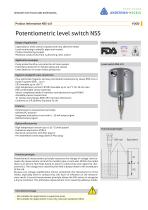
SENSORS FOR FOOD AND BIOPHARMA. Potentiometric level switch NSS Range of application · · · · Especially for level control of pastes and very adhesive media Level monitoring in metallic pipes and vessels Product monitoring in pipes Minimum conductivity from 1 µS/cm (e.g. dest. water) Application examples · Pump protection/dry run protection of mono pumps · Full/empty detection in metallic pipes and vessels · Level detection in cream cheese production Hygienic design/Process connection · Flow optimized, hygienic and easy sterilizable installation by sleeve EMZ-132 or build-in system EHG-.../1/2". · CIP cleanable up to 100 °C · High temperature version CIP/SIP cleanable up to 143 °C for 30 min max. · FDA conformable sensor materials · Sensor completely made of stainless steel (protection type IP69K) · Available process connections: Tri-Clamp, diary fl ange, DRD, APV, Varivent, BioControl · Conforms to 3-A Sanitary Standard 74-06 Features · · · · Potentiometric measurement principle Defined PG-position Integrated evaluation circuit with 4...20 mA output signal Defined empty signal Options/Accessories High temperature version up to 143 °C (with spacer) Evaluation electronics VGW-E Electrical connection with M12 plug-in Pre-assembled connecting cable for M12-plug Functional principle Function principle Potentiometric measurement principle measures the change of voltage ratio between the measurement rod and the metallic pipe or tank wall. Within the media there is an electric flow field, based on electric conductivity and capacitive characteristics. The voltage ratio caused by this field is proportional to the wetted part of the rod. Because just voltage amplification will be considered, the characteristics of the media, especially electric conductivity, will have no influence on the measurement result. A second measurement principle allows the NSL sensor to recognize a dryrun condition. This eliminates measurement error caused by adhesive media. Conventional usage · Not suitable for applications in explosive areas. · Not suitable for applications in security-relevant equipment (
Open the catalog to page 1
Specification | Dimensional Drawings Specification Dimensional drawing NSS-157 Dimensional drawing NSS-157 / ... / H
Open the catalog to page 2
Mechanical Installation | Electrical Connection | InstallationMechanical installation ■ Attention: Do not shorten the rod of the level probe! ■ To guarantee a trouble-free function of the measurement point give attention to a good electrical contacting of the process connection of the level probe to the pipe or vessel. ■ Do not use any isolating sealing materials like Teflon or similar! ■ When installing into a pipe the level probe has to be mounted from the bottom side! In this case use the Negele build-in system type EHG. The length of the rod is optimized for these build-in systems. ■ When...
Open the catalog to page 3
Product Information NSS-157 Conditions for a measuring point according to 3-A Sanitary Standard 74-06 ■ The sensors NSS-157 conforming to the 3-A Sanitary Standard. ■ The sensors are designed for CIP/SIP cleaning. Maximum 143 °C for 30 minutes. ■ Only with the build-in system CLEANadapt (EMZ, EMK, Adapter AMC and AMV) allowed. ■ Using the weld in sleeve EMZ, EMK the weld must comply to the requirements of the current 3-A Sanitary Standard. ■ Mounting position, self draining and the position of the leackage hole must be in accordance to current 3-A Sanitary Standard. ■ Sensors shall be clean and...
Open the catalog to page 4All Anderson-Negele | Negele Messtechnik GmbH catalogs and technical brochures
 Pt100-Simulator
1 Page
 Temperature Controller VTR-2
4 Pages
 ITM-51, ITM-51R
8 Pages
 LAR-361, LAR-761
8 Pages
 SX
SX4 Pages
 DPM
DPM8 Pages
 NSL-F-02
4 Pages
 HMP-E Flow Sensors
8 Pages
 ILM-4 Conductivity Sensors
8 Pages
 ITM-3 Turbidity Sensors
8 Pages
 ITM-4 Turbidity Sensors
8 Pages
 ITM-4DW Turbidity Sensors
8 Pages
 Anderson-Negele Product Overview
28 Pages
 Conductive Multilevel Sensor
8 Pages
 NVS-141...186
8 Pages
 VNV-ZNV_50064_4.0
8 Pages
 NSL-F-00-01_50060_1.4
12 Pages
 L3_50093_1.0
8 Pages
 Product info NSL-M
8 Pages


- Fitting
- Flowmeter
- Hydraulic fitting
- Screw-in fitting
- Temperature probe
- Volume flow monitor
- Liquid flow monitor
- Stainless fitting
- Resistance temperature sensor
- Pressure transmitter
- Pressure gauge
- Analog pressure transmitter
- Liquid level detector
- Level probe
- Stainless steel flow monitor
- Digital pyrometer
- Liquid level sensor
- Digital indicator
- Analog pressure gauge