
- Catalogs
- AnchorZ Inc.
- Two-Dimensional Dynamic Fusion for Continuous Authentication


- Company
- Products
- Catalogs
- News & Trends
- Exhibitions
Two-Dimensional Dynamic Fusion for Continuous Authentication
Two-Dimensional Dynamic Fusion for Continuous Authentication
Continuous authentication is essential for mobile devices due to their storage of sensitive data and frequent use in insecure environments. Traditional methods are impractical for frequent use, necessitating continuous authentication systems utilizing biometric data.
The document introduces a two-dimensional dynamic fusion approach for continuous authentication. This method calculates matching scores over classifiers and time, dynamically selecting classifiers based on context to optimize resource usage and accuracy, thereby improving usability compared to existing methods.
- Introduction of a two-dimensional dynamic fusion method for continuous authentication, selecting classifiers based on context to maximize accuracy with limited resources.
- Experimental results demonstrate an improved balance between resource usage and accuracy, with the multi-sample strategy proving effective.
Previous studies have explored multibiometric fusion for continuous authentication, often without considering context. The proposed method addresses this by using context-aware classifier scheduling and stateful fusion.
The framework includes a classifier scheduling algorithm and a fusion algorithm, implementing context-aware dynamic multibiometric fusion. Classifiers are activated based on their probability of successful authentication in a given context, minimizing resource usage while maintaining security.
The proposed two-dimensional dynamic fusion approach offers a more efficient and accurate method for continuous authentication on mobile devices, addressing the limitations of existing methods by optimizing resource use and improving security.
The document describes an algorithm for scheduling classifiers to authenticate users on mobile devices, focusing on minimizing resource costs while ensuring successful authentication within a critical time window.
The algorithm evaluates classifiers based on resource cost and probability of successful authentication, ensuring all classifiers are activated at least once before a device lock occurs. It selects the candidate set with the lowest resource cost that meets the probability threshold.
This section introduces an authentication window derived from the current context, within which a user must be authenticated. The fusion algorithm calculates an overall confidence score from individual classifier scores obtained within this window.
The loop continuously updates the device state based on the fused score, retrieves context, updates classifier score history, and determines the critical time for device locking.
The document evaluates the algorithm using real-world datasets, comparing its performance against existing fusion approaches, demonstrating high accuracy with fewer score calculations.
The experiments show that the proposed approach can outperform traditional methods by running at a higher frequency without additional resource use, providing detailed error rates and detection error trade-off curves.
The study involves selecting subject IDs with samples matching specific contexts and using genuine image and speech samples for analysis. Three classifiers are used to obtain scores, and the approach is compared to max and sum fusion rules, as well as CWMA.
The proposed approach performs comparably to CWMA and sum fusion rules at medium frequency and shows a clear advantage at high frequency, achieving higher accuracy with the same number of score calculations.
The context-aware two-dimensional dynamic fusion approach demonstrates superior performance compared to existing methods, achieving similar accuracy with fewer score calculations.
The proposed approach offers a better balance between accuracy and the number of score calculations, supported by various grants and research initiatives.
Catalog excerpts
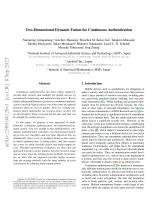
Two-Dimensional Dynamic Fusion for Continuous Authentication Nuttapong Attrapadung*, Goichiro Hanaoka*, Haochen M. Kotoi-Xie†, Takahiro Matsuda*, Takumi Moriyama†, Takao Murakami‡, Hidenori Nakamura†, Jacob C. N. Schuldt*, Masaaki Tokuyama†, Jing Zhang† Institute of Advanced Industrial Science and Technology (AIST), Japan { n.attrapadung, hanaoka-goichiro, t-matsuda, jacob.schuldt }@aist.go.jp † { kotoi, moriyama, nakamura, tokuyama, j-zhang }@anchorz.co.jp ‡ Institute of Statistical Mathematics (ISM), Japan [email protected] Abstract Continuous authentication has been widely studied to provide high security and usability for mobile devices by continuously monitoring and authenticating users. Recent studies adopt multibiometric fusion for continuous authentication to provide high accuracy even when some of captured biometric data are of a low quality. However, existing continuous fusion approaches are resource-heavy as they rely on all classifiers being activated all the time and may not be suitable for mobile devices. In this paper, we propose a new approach to multibiometric continuous authentication: two-dimensional dynamic fusion. Our key insight is that multibiometric continuous authentication calculates two-dimensional matching scores over classifiers and over time. Based on this, we dynamically select a set of classifiers based on the context in which authentication is taking place, and fuse matching scores by multi-classifier fusion and multi-sample fusion. Through experimental evaluation, we show that our approach provides a better balance between resource usage and accuracy than the existing fusion methods. In particular, we show that our approach provides higher accuracy than the existing methods with the same number of score calculations by adopting multi-sample fusion. Copyright © 2023 IEEE. Personal use of this material is permitted. Permission from IEEE must be obtained for all other uses, in any current or future media, including reprinting/republishing this material for advertising or promotional purposes, creating new collective works, for resale or redistribution to servers or lists, or reuse of any copyrighted component of this work in other works. 1. Introduction Mobile devices such as smartphones are ubiquitous in today’s society, and with their increased use, these devices store a large amount of sensitive user data, including photos, passwords, purchase history, banking, and even payment information [1]. While banking and payment information must be protected for obvious reasons, the exposure of other types of personal information can likewise have serious consequences; an IDG Research survey [3] estimated that in the past, a significant fraction of smartphone thefts led to identity theft. This has made malicious smartphone access a significant security risk. However, at the same time, secure user authentication remains a challenging task; the average smartphone user checks his smartphone 96 times a day [2], which makes it impractical to enter highentropy passwords or use a different device for two-factor authentication. Thus, any smartphone authentication mechanism must be efficient and unobtrusive. Moreover, smartphone users frequently unlock their phones in potentially malicious environments, and might leave the smartphone unguarded, e.g., on a table or in a bag from which the phone can easily be stolen. Thus, an authentication model developed for desktop users (i.e., unlock once at the beginning of a session, and lock once the session is done) leaves smartphones vulnerable to attacks while in an unlocked state. Continuous authentication [11] is based on a fundamentally different authentication model in which the user is continuously authenticated via physical and behavioral traits, including direct biometric authentication mechanisms such as facial and voice recognition, but also soft biometrics such as touch patterns, gait, motion, and location information. Modern smartphones feature a wide range of sensors that allow the capture of such input a
Open the catalog to page 1
more become sufficiently powerful to process this input. This raises the prospect of restructuring user authentication on smartphones based on continuous authentication, potentially bringing both usability and security advantages. The ideal continuous authentication system seamlessly and automatically authenticates the user once he starts using the device, but immediately locks the device once a different user attempts to interact with this. However, realizing a system coming close to this is a challenging task. When the user is not explicitly engaging with an authentication mechanism, the captured...
Open the catalog to page 2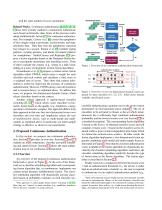
with the same number of score calculations. Related Works. Continuous authentication [6, 8, 9, 10, 14, 15] has been recently studied to continuously authenticate users based on biometric data. Some of the previous works adopt multibiometric fusion [12] for continuous authentication. For example, Crouse et al. [6] correct the uprightness of face images using a gyroscope, accelerometer, and magnetometer data. Then they fuse the uprightness-corrected face images in a session. Kumar et al. [9] combine typing patterns, swiping gestures, and phone movement patterns for smartphones. Smith-Creasey and...
Open the catalog to page 3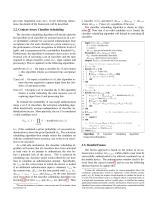
pin code, fingerprint scan, etc.). In the following subsections, the details of the framework will be described. 2.2. Context-Aware Classifier Scheduling The classifier scheduling algorithm will decide upon the best possible set of classifiers to activate based on an a priori probability estimate for successful authentication (true acceptance rate) for each classifier in a given context (e.g., the performance of facial recognition in different levels of light), and is parameterized by a probability threshold thp . Furthermore, the algorithm is assumed to have access to the resource cost of activating...
Open the catalog to page 4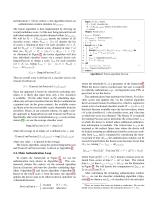
AuthWindow(c) Given context c, this algorithm returns an authentication window duration ∆twindow . The fusion algorithm is then implemented by deriving an overall confidence score β of the user being present from all individual authentication results obtained within ∆twindow . We will let H = {Hcid }cid∈S denote the history of all classifier scores, where Hcid = {(α, t)} denotes the list of scores α obtained at time t for each classifier cid ∈ S, and let Hcid [t > t′ ] denote scores obtained at time t′ or later (i.e., Hcid [t > t′ ] = {(α, t) ∈ Hcid : t > t′ }). As illustrated in Figure 2, the...
Open the catalog to page 5All AnchorZ Inc. catalogs and technical brochures
 DZSecurity
17 Pages
 会社案内
会社案内2 Pages
 DZS-Passport&Player&IAP
2 Pages
 DZ Security総合
2 Pages
- Management software solution
- Real-time software
- Windows software
- Monitoring software solution
- Industrial software
- Development software
- High-performance software
- Centralized software
- Mobile app
- Android software
- All-in-one software
- Android mobile app
- IOS software
- Off-line software
- IOS mobile app
- Management mobile app
- Cloud App
- Real-time mobile app
- Smartphone mobile app
- Tablet computer mobile app