
- Catalogs
- Analog Devices
- Zero-Drift Amplifiers


- Products
- Catalogs
- News & Trends
- Exhibitions
Zero-Drift Amplifiers

Zero-Drift Amplifiers
Zero-drift amplifiers are designed to maintain a very low offset voltage and drift over time and temperature, making them ideal for high-gain applications. Unlike traditional amplifiers, zero-drift amplifiers self-correct, ensuring precision in various conditions.
Applications
- Temperature sensors
- Thermopiles/thermocouples
- Pressure sensors
- Precision current sensing
- Strain gage amplifiers
- Medical instrumentation
- Precision references
- Automotive sensors
- Electronic weigh scales
- Photodiode amplifiers
Key Features of Zero-Drift Amplifiers
- Eliminate offset voltage changes over time and temperature
- Reduce low-frequency noise (1/f noise)
- Self-correcting capabilities
- Low offset voltage (VOS = 5μV max at 25°C)
- Low temperature coefficient of offset voltage (TCVOS = 0.005μV/°C up to 125°C)
Performance Comparison
A graph comparing voltage noise density across different frequencies shows that Analog Devices' zero-drift amplifiers outperform competitors in terms of noise reduction.
Product Specifications
Various zero-drift amplifiers are available with different specifications, including supply voltage, rail-to-rail capabilities, maximum offset voltage, typical temperature coefficient, gain bandwidth, slew rate, noise levels, and chopping frequency. Some notable models include:
- AD8628/29/30: Low voltage, high precision
- AD8551/52/54: Low noise, suitable for precision applications
- AD8571/72/74: Balanced performance for various applications
- ADA4051-1/2: Micropower, suitable for low-power applications
- AD8230/31: High voltage, zero-drift instrumentation amplifiers
Contact Information
Analog Devices, Inc. provides contact details for their headquarters in the USA, Europe, Japan, and Southeast Asia for further inquiries and support.
Conclusion
Zero-drift amplifiers from Analog Devices offer superior performance in precision applications by minimizing offset voltage drift and noise, making them suitable for a wide range of industrial and consumer applications.
Catalog excerpts
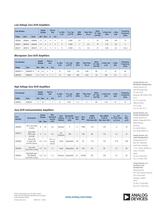
Low Voltage Zero-Drift Amplifiers Part Number Supply Voltage Rail-to- Rail VOS Max (..V) TCVOS Typ (..V/·C) GBW (MHz) Slew Rate (V/..s) Noise @ 1 kHz (nV/ãHz) IS/Amp Typ (mA) IB Max (pA) Chopping Frequency (kHz) Single Dual Quad Min Max In Out AD8628 AD8629 AD8630 2.7 6 • • 5 0.002 2.5 1 22 0.85 100 15 AD8551 AD8552 AD8554 2.7 6 • • 5 0.005 1 0.5 75 0.75 50 4 AD8571 AD8572 AD8574 2.7 6 • • 5 0.005 1.5 0.4 51 0.85 50 2 to 4 Part Number Supply Voltage Rail-to- Rail VOS Max (..V) TCVOS Typ (..V/·C) GBW (kHz) Slew Rate (V/..s) Noise @ 1 kHz (nV/ãHz) IS/Amp Typ (..A) IB Max (pA) Chopping Frequency...
Open the catalog to page 2All Analog Devices catalogs and technical brochures
 HMC722LP3E
8 Pages
 Isolated Sigma-Delta Modulator
17 Pages
 HMC853 Data Sheet
10 Pages
 AN-1084
8 Pages
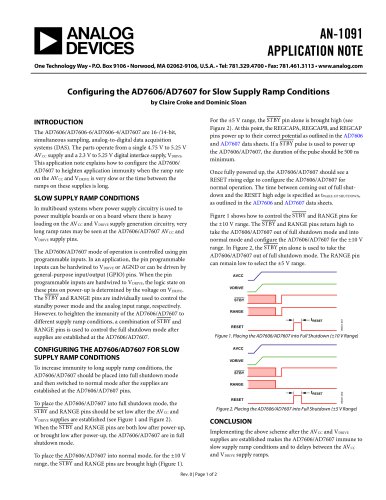 AN-1091
2 Pages
 AN_737
8 Pages
 AN-0982
4 Pages
 ADF7024
24 Pages
 AD9915
48 Pages
 AD9914
48 Pages
 ADRF6612
59 Pages
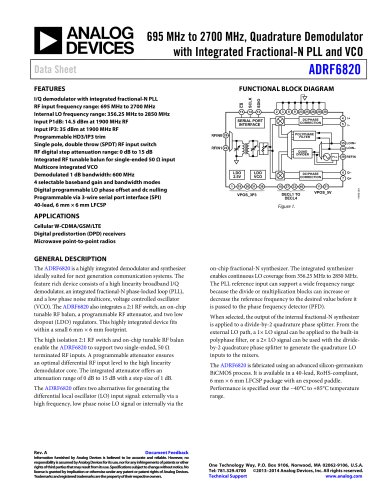 ADRF6820
48 Pages
 ADL5246
32 Pages
 ADA4961
22 Pages
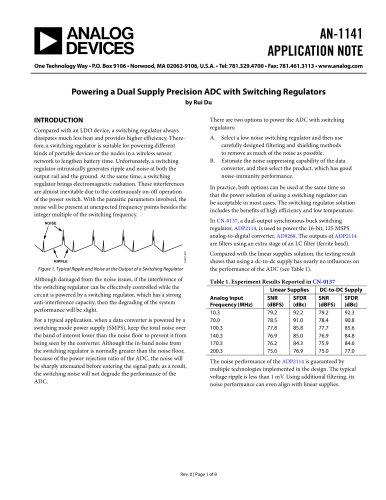 AN-1141
8 Pages
 AN-698
36 Pages
 Temperature Sensors
2 Pages
 Reference Circuits
8 Pages
 Precision ADCs
16 Pages
 ADR02ACHIPS: ADR02ACHIPS
8 Pages
 AD9364 RF Agile Transceiver
32 Pages
 Digital Temperature Sensors
2 Pages
 Digital to Analog Converter ICs
12 Pages
 AD1836A: Multichannel 96 kHz Codec
24 Pages




























Archived catalogs
 Powering ADI Components
8 Pages




- Ethernet switch
- Industrial network switch
- Acceleration sensor
- Unmanaged switch
- Analog Devices motor controller
- Transceiver module
- Triaxial acceleration sensor
- DC motor controller
- Data acquisition unit
- Analog Devices stepper motor controller
- Industrial converter
- Ethernet transceiver
- Processor
- High-voltage amplifier
- Low-noise amplifier
- Multiplexer
- Compact motor controller
- Digital converter
- Closed-loop motor controller
- Digital motor controller