
- Catalogs
- Analog Devices
- OPERATIONAL AMPLIFIERS SELECTION GUIDE 2011-2012


- Products
- Catalogs
- News & Trends
- Exhibitions
OPERATIONAL AMPLIFIERS SELECTION GUIDE 2011-2012
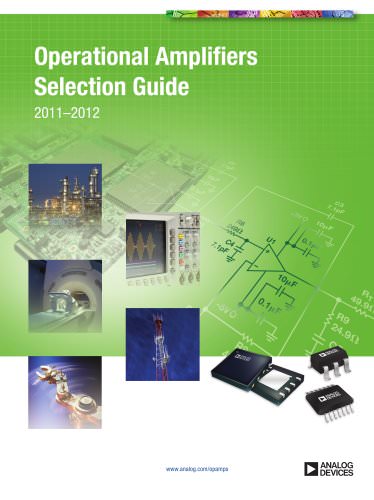
OPERATIONAL AMPLIFIERS SELECTION GUIDE 2011-2012
Analog Devices provides a comprehensive range of operational amplifiers (op amps) tailored for various applications. This guide aids in selecting the right op amp by offering terminology, selection tables, application guides, and design tools.
Key terms such as Common-Mode Voltage Range (CMVR), Common-Mode Rejection Ratio (CMRR), Gain Bandwidth Product (GBW), Input Bias Current, Offset Voltage (VOS), and Slew Rate are defined to help understand op amp specifications and performance.
Discusses various amplifier technologies like Clamp Amplifiers, Common-Mode Linearized Amplifiers, Current Feedback Amplifiers, Differential Amplifiers, and Zero-Drift Amplifiers, each offering unique benefits such as improved linearity, high speed, low distortion, and overvoltage protection.
Trimming technologies such as Laser Trim, Zener Zapping, and DigiTrim are used to achieve precise resistor values and high accuracy in op amps, enhancing performance and reliability.
Includes quick selection guides for high-speed and precision amplifiers, categorized by specifications like bandwidth, offset voltage, power consumption, and noise levels. Application-specific guides are also provided for sectors like energy, healthcare, communications, and automotive.
Offers tools, evaluation boards, and design equations to assist in developing and implementing amplifier circuits. Packaging information ensures compatibility with various applications.
Details on process technologies such as Bipolar Technology, XFCB 1.5, XFCB3, 36 V iPolar, and 16 V iCMOS, highlighting their features like high output current drive, high voltage operation, and low noise.
Describes various amplifier types including High Speed Op Amps, Rail-to-Rail Amplifiers, Low Cost Amplifiers, FastFET Amplifiers, Current Feedback Amplifiers, Zero Drift Amplifiers, Zero Input Crossover Distortion Amplifiers, Overvoltage Protection Amplifiers, and Ultralow Offset Voltage Amplifiers, each with specific features and applications.
Highlights applications for these amplifiers, including precision instrumentation, medical instrumentation, audio preamplifiers, and more.
Provides detailed specifications for a range of amplifiers, including supply voltage, bandwidth, slew rate, offset voltage, noise, and packaging options.
Emphasizes checking data sheets for test conditions and actual product specifications, and understanding specific application requirements for optimal performance.
Amplifiers are categorized based on process type (CMOS, Bipolar, JFET) and rail-to-rail capabilities (RRIO, RRO, SS) to identify suitable amplifier types for different designs.
Includes tables and graphs for comparative analysis of different amplifier models, highlighting key data points like bandwidth, noise levels, and supply current.
Details exigencies, parameters, and limitations for amplifiers, emphasizing adherence to specifications to avoid performance degradation and maintain signal integrity.
Recommends selecting amplifiers based on features like low noise, low distortion, and rail-to-rail output capabilities to match application requirements.
Provides tools like Multisim, ADI DiffAmpCalc, Analog Filter Wizard, Op Amp Stability Tool, Vrms/dBm/dBu/dBV Calculator, and Power Dissipation vs. Die Temperature Calculator to assist in design and evaluation.
Offers evaluation boards for high-speed and precision amplifiers to test and evaluate different configurations and applications.
Details various packaging types, including SOIC, TSSOP, MSOP, SOT-23, with dimensions and characteristics for each type.
Includes reference circuits, application notes, and an online support community (EngineerZone) for engineers to collaborate and find solutions to design challenges.
Catalog excerpts
Operational Amplifiers Selection Guide 2011–2012 www.analog.com/opamps www.analog.com/opamps | 1
Open the catalog to page 1
2 | Operational Amplifier Selection Guide
Open the catalog to page 2
Op Amp Glossary Common-Mode Voltage Range (CMVR) Open- Loop Gain (AVO) Also known as input voltage range, CMVR is the allowable input voltage range at both inputs before clipping or excessive nonlinearity is seen at the output. The ratio of the output voltage to the input offset voltage between the two input pins. The result is expressed in dB. Gain is usually specified only at dc (AO), but for many applications, such as high speed amplifiers for video and RF, the frequency dependence of gain is also important. For this reason the open loop gain and phase response is published for each amplifier....
Open the catalog to page 4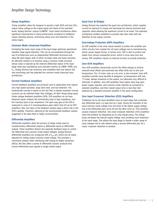
Amplifier Design Technology Clamp Amplifiers Quad Core (H Bridge) Clamp amplifiers allow the designer to specify a high (VCH) and low (VCL) output clamp voltage so the output signal will clamp at the specified levels. Analog Devices’ unique CLAMPIN™ input clamp architecture offers significant improvement in clamp performance compared to traditional output clamping devices, minimizing clamp error and distortion in the clamp region. Analog Devices has patented the quad core architecture, which supplies current on-demand to charge and discharge the internal dominant pole capacitor, while allowing...
Open the catalog to page 5
Amplifier Process and Trimming Technology Process Technology JFET Input Amplifiers Bipolar JFET input amplifiers have the advantage over bipolar devices by having an extremely high input impedance along with low noise performance, making them very useful in amplifier circuits using very small signals such as high source impedance sensors and photodiodes. A typical JFET has a voltage noise slightly larger than a BJT, but its current noise is significantly lower. Bipolar technology delivers the best overall performance amplifiers. It offers high output current drive, high voltage operation, and...
Open the catalog to page 6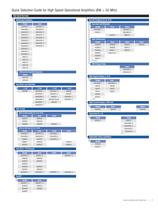
Quick Selection Guide for High Speed Operational Amplifiers (BW > 50 MHz) Single I Dual I Triple High Speed Op Amps Differential Amplifiers High Performance High Supply Voltage (±15 V) High Current Output (>300 mA) Adjustable Clamp Amplifiers
Open the catalog to page 7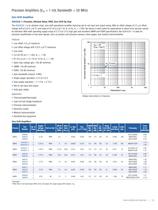
Precision Amplifiers (Vos < 1 mV, Bandwidth < 50 MHz) Zero-Drift Amplifiers ADA4528-1: Precision, Ultralow Noise, RRIO, Zero-Drift Op Amp The ADA4528-1 is an ultralow noise, zero-drift operational amplifier featuring rail-to-rail input and output swing. With an offset voltage of 2.5 |xV, offset voltage drift of 0.015 \iM/°C, and noise of 97 nV p-p (0.1 Hz to 10 Hz, Av = +100), the device is well suited for applications in which error sources cannot be tolerated. With wide operating supply range of 2.2 V to 5.5 V, high gain and excellent CMRR and PSRR specifications, the ADA4528-1 is ideal for...
Open the catalog to page 8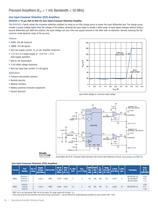
Precision Amplifiers (Vos < 1 mV, Bandwidth < 50 MHz) Zero Input Crossover Distortion (ZCO) Amplifiers ADA4505-2:10 |LA, Rail-to-Rail I/O, Zero Input Crossover Distortion Amplifier The ADA4505-X family solves the crossover distortion problem by using an on-chip charge pump to power the input differential pair. The charge pump creates a supply voltage higher than the voltage of the battery, allowing the input stage to handle a wide range of input signal voltages without using a second differential pair. With this solution, the input voltage can vary from one supply extreme to the other with no...
Open the catalog to page 9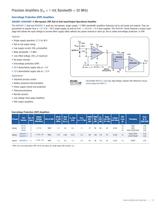
Precision Amplifiers (Vos < 1 mV, Bandwidth < 50 MHz) Overvoltage Protection (OVP) Amplifiers ADA4091-2/ADA4091-4: Micropower, OVP, Rail-to-Rail Input/Output Operational Amplifier The ADA4091 -2 dual and ADA4091 -4 quad are micropower, single-supply, 1.2 MHz bandwidth amplifiers featuring rail-to-rail inputs and outputs. They are guaranteed to operate from a +2.7 V to +30 V single supply, as well as from ±1.35 V to ±15 V dual supplies. The ADA4091 family features a unique input stage that allows the input voltage to exceed either supply safely without any phase reversal or latch-up; this is called...
Open the catalog to page 10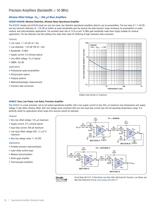
Precision Amplifiers (Bandwidth < 50 MHz) Ultralow Offset Voltage (Vos < 250 JLV Max) Amplifiers AD8597/AD8599: Ultralow Distortion, Ultralow Noise Operational Amplifier The AD8597 (single) and AD8599 (dual) are very low noise, low distortion operational amplifiers ideal for use as preamplifiers. The low noise of 1.1 nV/VHz and low harmonic distortion of -120 dB (or better) at audio bandwidths give the devices the wide dynamic range necessary for preamplifiers in audio, medical, and instrumentation applications. The excellent slew rate of 14 V/jxs and 10 MHz gain bandwidth make them highly suitable...
Open the catalog to page 11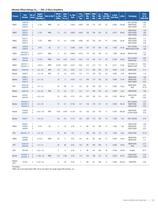
Ultralow Offset Voltage (V^ < 250 |iV Max) Amplifiers 1 RRIO: rail-to-rail input/output, RRO: rail-to-rail output, SS: single supply (IVR includes -VSY).
Open the catalog to page 12
Precision Amplifiers (Vos < 1 mV, Bandwidth < 50 MHz) AD8657: Precision, Micropower, 18 V CMOS RRIO Op Amplifier The AD8657 is a dual, precision, micropower, rail-to-rail input/output (RRIO) amplifier optimized for low power and wide operating supply voltage range applications. The device operates from 2.7 V up to 18 V with a typical quiescent supply current of 18 jxA and achieves low offset voltage thanks to Analog Devices' patented DigiTrim trimming technique. The AD8657 also has high immunity to electromagnetic interference. The combination of low supply cur- rent, low offset voltage, very...
Open the catalog to page 13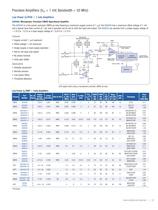
Precision Amplifiers (Vos < 1 mV, Bandwidth < 50 MHz) Low Power (ls/Amp < 1 mA) Amplifiers AD8500: Micorpower, Precision CMOS Operational Amplifier The AD8500 is a low power, precision CMOS op amp featuring a maximum supply current of 1 LIA. The AD8500 has a maximum offset voltage of 1 mV and a typical input bias current of 1 pA, and it operates rail-to-rail on both the input and output. The AD8500 can operate from a single-supply voltage of • Supply current: 1 LIA maximum • Offset voltage: 1 mV maximum • Single-supply or dual-supply operation • Rail-to-rail input and output • Unity-gain stable...
Open the catalog to page 14All Analog Devices catalogs and technical brochures
 HMC722LP3E
8 Pages
 Isolated Sigma-Delta Modulator
17 Pages
 HMC853 Data Sheet
10 Pages
 AN-1084
8 Pages
 AN-1091
2 Pages
 AN_737
8 Pages
 AN-0982
4 Pages
 ADF7024
24 Pages
 AD9915
48 Pages
 AD9914
48 Pages
 ADRF6612
59 Pages
 ADRF6820
48 Pages
 ADL5246
32 Pages
 ADA4961
22 Pages
 AN-1141
8 Pages
 AN-698
36 Pages
 Temperature Sensors
2 Pages
 Reference Circuits
8 Pages
 Precision ADCs
16 Pages
 ADR02ACHIPS: ADR02ACHIPS
8 Pages
 AD9364 RF Agile Transceiver
32 Pages
 Digital Temperature Sensors
2 Pages
 Digital to Analog Converter ICs
12 Pages
 AD1836A: Multichannel 96 kHz Codec
24 Pages


























Archived catalogs
 Zero-Drift Amplifiers
2 Pages
 Powering ADI Components
8 Pages




- Ethernet switch
- Industrial network switch
- Acceleration sensor
- Unmanaged switch
- Analog Devices motor controller
- Transceiver module
- Triaxial acceleration sensor
- DC motor controller
- Data acquisition unit
- Analog Devices stepper motor controller
- Industrial converter
- Ethernet transceiver
- Processor
- High-voltage amplifier
- Low-noise amplifier
- Multiplexer
- Compact motor controller
- Digital converter
- Closed-loop motor controller
- Digital motor controller