
- Catalogs
- Analog Devices
- AD9856 CMOS 200 MHz Quadrature Digital Upconverter


- Products
- Catalogs
- News & Trends
- Exhibitions
AD9856 CMOS 200 MHz Quadrature Digital Upconverter

AD9856 CMOS 200 MHz Quadrature Digital Upconverter
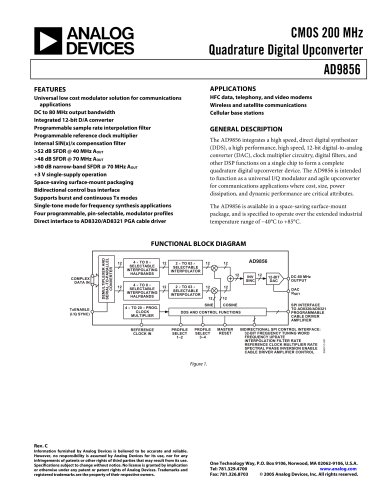
Overview: The AD9856 is a CMOS 200 MHz Quadrature Digital Upconverter by Analog Devices, integrating a high-speed DDS, a 12-bit DAC, clock multiplier circuitry, digital filters, and DSP functions on a single chip. It is designed for communications applications prioritizing cost, size, power dissipation, and dynamic performance.
Features: The AD9856 offers a low-cost modulator solution with a DC to 80 MHz output bandwidth, integrated 12-bit DAC, programmable sample rate interpolation filter, and reference clock multiplier. It supports burst and continuous transmission modes, single-tone mode for frequency synthesis, and has four programmable modulator profiles. It operates on a +3 V single supply and is available in a compact surface-mount package.
Applications: Suitable for HFC data, telephony, video modems, wireless and satellite communications, and cellular base stations.
Specifications: Operates with a reference clock input frequency range of 5 MHz to 200 MHz, depending on the REFCLK multiplier setting. Features a 12-bit resolution DAC with a full-scale output current range of 5 to 20 mA. Offers wideband and narrow-band SFDR performance, with specific values depending on the output frequency.
Functional Description: Supports complex quadrature modulator mode and single-tone output mode, accepts programmable input data formats, and operates with an input sample rate of up to 50 Msamples/sec. Includes programmable internal reference clock multiplier and interpolating half-band filters.
Pin Configuration: Includes various pins for data input, control, and output, including digital and analog supply voltage pins, ground pins, and specific pins for functions like cable driver amp enable and clock input.
Power and Thermal Considerations: Operates with a +3 V supply, with specific current consumption values for different modes. Includes ESD protection but requires careful handling to avoid performance degradation.
Specifications and Functional Overview: Supports various modulation modes, accepts 12-bit data words, and features a TxENABLE function for data sampling synchronization. Includes an inverse SINC filter for DAC precompensation, I/Q channel inversion, and a full sleep mode to reduce power consumption.
Performance Characteristics: Provides spectral plots for different modulation schemes like QPSK, 64-QAM, 16-QAM, and 256-QAM, highlighting performance at various frequencies and data rates. Includes single-tone output spectral plots and narrow-band SFDR spectral plots.
Power Consumption: Analyzed against clock speed, CIC rate, and burst duty cycle, showing variations in power usage under different conditions. Operates efficiently with reduced power dissipation in full sleep mode.
Control and Configuration: Configured via a serial control bus with registers managing functions like REFCLK multiplier, CIC gain, continuous mode, and single-tone mode. Details register layout and bit definitions for device configuration.
Theory of Operation: Involves data assembly, filtering, and modulation using half-band filters and a CIC filter for upsampling and low-pass filtering, followed by a digital quadrature modulator for frequency shifting.
Half-Band Filters (HBFs): Includes three HBFs that increase the sampling rate and maintain signal integrity. HBF 1 and 2 provide a factor-of-four increase, while HBF 3 adds an additional factor of two.
Recommendations: Ensure REFCLK and fW maintain an integer ratio relationship. Limit fundamental output frequency to 40% of SYSCLK to avoid aliasing. Oversample baseband data by at least a factor of two to maintain signal integrity.
Inverse SINC Filter (ISF) and Frequency Response: ISF corrects SINC envelope distortion, effective up to the Nyquist frequency, introducing a 3.1 dB insertion loss.
Direct Digital Synthesizer (DDS) Function: Generates sine/cosine carrier signals modulated by I/Q data paths, allowing precise tuning of the output carrier frequency using a 32-bit tuning word.
D/A Converter: Uses a 12-bit DAC to convert digital waveforms to analog signals, maintaining a spurious-free dynamic range (SFDR) of -60 dBc up to 42 MHz.
Reference Clock Multiplier: Includes an on-chip programmable clock multiplier to reduce the need for high-frequency reference clocks, supporting a range from 4x to 20x.
Throughput and Latency: Data latency described in terms of SYSCLK cycles, affected by CIC interpolation rate and engagement of the third half-band filter.
Control Interface: Features a flexible synchronous serial communications port compatible with various protocols, supporting both single and multibyte transfers.
Configuration and Synchronization: Requires careful handling of configuration changes, especially during multibyte transfers. Synchronization is crucial; loss can be corrected using the SYNC I/O pin.
Timing Specifications: Provides detailed timing specifications for data write and read operations, essential for ensuring proper communication.
Programming the AD8320/AD8321: Gain control managed through the AD9856 serial port, with data transfer requiring 136 SYSCLK clock cycles.
Modulator Profiles: Can store four modulation profiles, each defining output frequency, interpolation rate, spectral inversion status, and gain control.
Power Dissipation Considerations: Influenced by digital switching currents, clock rate, and configuration settings. Methods to optimize power usage include using sleep mode and bypassing the REFCLK multiplier.
Evaluation Board: Available for facilitating analysis and control via a PC, includes a low-pass filter and supports the AD8320/AD8321 amplifier.
PCB Layout: Includes detailed PCB layout patterns for a four-layer board, highlighting signal routing, ground planes, and power planes.
Implementation in HFC Return-Path Application: Provides technical details on implementing the AD9856 and AD8320/AD8321 in a 5 MHz to 65 MHz HFC Return-Path Application, including diagrams, package dimensions, and ordering information.
Compliance and Standards: Package compliant with JEDEC standards, ensuring reliability and standardization across applications.
Catalog excerpts

Parameter Temp Test Level Min Typ Max Unit REF CLOCK INPUT CHARACTERISTICS Frequency Range REFCLK Multiplier Disabled Full VI 5 200 > 1 MHz REFCLK Multiplier Enabled at 4 ח Full VI 5 50 MHz REFCLK Multiplier Enabled at 20 Full VI 5 10 MHz Duty Cycle 25װC V 50 % Input Capacitance 25C V 3 pF Input Impedance 25аC V 100 MΩ DAC OUTPUT CHARACTERISTICS Resolution 12 Bits Full-Scale Output Current 5 10 20 mA Gain Error 25C I ТȒ10 +10 %FS Output Offset 25C I 10 е A Differential Nonlinearity 25C V 0.5 LSB Integral Nonlinearity 25аC V 1 LSB Output Capacitance 25C V 5 pF Phase Noise @ 1 kHz Offset, 40 MHz...
Open the catalog to page 3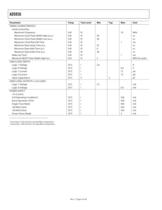
Parameter Temp Test Level Min Typ Max Unit TIMING CHARACTERISTICS Serial Control Bus Maximum Frequency Full IV 10 MHz Minimum Clock Pulse Width High (t > PWH ) Full IV 30 ns Minimum Clock Pulse Width Low (t > PWL ) Full IV 30 ns Maximum Clock Rise/Fall Time Full IV 1 ms Minimum Data Setup Time (t > DS ) Full IV 25 ns Minimum Data Hold Time (t > DH ) Full IV 0 ns Maximum Data Valid Time (t > DV ) Full IV 30 ns Wake-Up Time > 2 Full IV 1 ms Minimum RESET Pulse Width High (t > RH ) Full IV 5 REFCLK cycles CMOS LOGIC INPUTS Logic 1 Voltage 25C I 2.6 V Logic 0 Voltage 25аC I 0.4 V Logic 1 Current...
Open the catalog to page 4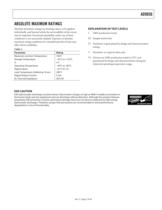
Parameter Rating Maximum Junction Temperature 150аC Storage Temperature −65C to +150аC V > S 4 V Operating Temperature −40C to +85аC Digital Inputs −0.7 V to +V > s Lead Temperature (Soldering 10 sec) 300C Digital Output Current 5 mA Ў > JA Thermal Impedance 38ذC/W > ESD (electrostatic discharge) sensitive device. Electrostatic charges as high as 4000 V readily accumulate on the human body and test equipment and can discharge without detection. Although this product features proprietary ESD protection circuitry, permanent damage may occur on devices subjected to high energy electrostatic discharges....
Open the catalog to page 5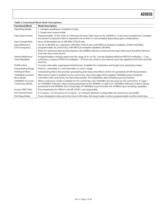
Functional Block Mode Description Operating Modes 1. Complex quadrature modulator mode. 2. Single-tone output mode. Input Data Format Programmable: 12-bit, 6-bit, or 3-bit input formats. Data input to the AD9856 is 12-bit, twos complement. Complex I/Q symbol component data is required to be at least 2 oversampled, depending upon configuration. Input Sample Rate Up to 50 Msamples/sec @ 200 MHz SYSCLK rate. Input Reference Clock Frequency For DC to 80 MHz A > OUT operation (200 MHz SYSCLK rate) with REFCLK multiplier enabled: 10 MHz to50 MHz, programmable via control bus; with REFCLK multiplier...
Open the catalog to page 7
S = +3VCIC = 2+25C +V > S = +3VCIC = 2200 MHz +25аC HB3 = OFFHB3 = ON +V > POWER CONSUMPTION (mW) POWER CONSUMPTION (mW) 800100012001400 1600 CLOCK SPEED (MHz) 10501150 125013501450 Tx ENABLE DUTY CYCLE 140120160180200 257550100 > 00637-C-020 S = +3VCIC = 2200 MHz+25C 64 HB3 = OFFHB3 = ON +V > POWER CONSUMPTION (mW) 12001300 140015001600 CIC RATE 1603248 > 00637-C-021
Open the catalog to page 12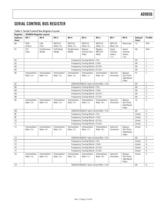
Register AD9856 Register Layout Address (hex) Bit 7 Bit 6 Bit 5 Bit 4 Bit 3 Bit 2 Bit 1 Bit 0 Default (hex) Profile 00 SDO Active LSB First REFCLK Mult.<4> REFCLK Mult.<3> REFCLK Mult.<2> REFCLK Mult.<1> REFCLK Mult.<0> Reserved 15 N/A 01 CIC Gain Continuous Mode Full Sleep Mode Single-tone Mode Bypass Inverse Sinc Filter Bypass REFCLK Mult. Input Format Select <1> Input Format Select <0> 06 N/A 02 Frequency Tuning Word <7:0> 04 1 03 Frequency Tuning Word <15:8> 00 1 04 Frequency Tuning Word <23:16> 00 1 05 Frequency Tuning Word <31:24> 00 1 06 Interpolator Rate <5> Interpolator Rate <4> Interpolator...
Open the catalog to page 13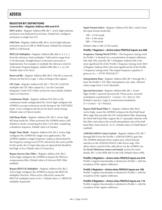
Input Format Select Register Address 01h, Bits 1 and 0, form the input format mode bits. 10b = 12-bit mode 01b = 6-bit mode 00b = 3-bit mode Default value is 10b (12-bit mode). > SDO Active Register Address 00h, Bit 7. Active high indicates serial port uses dedicated in/out lines. Default low configures serial port as single-line I/O. LSB Firstח Register Address 00h, Bit 6. Active high indicates serial port access is LSB-to-MSB format. Default low indicates MSB-to-LSB format. > REFCLK Multiplierח Register Address 00h, Bits 5, 4, 3, 2, 1 form the reference clock multiplier. Valid entries range...
Open the catalog to page 14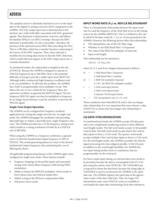
The sampled carrier is ultimately destined to serve as the input data to the digital-to-analog converter (DAC) integrated on the AD9856. The DAC output spectrum is distorted due to the intrinsic zero-order hold effect associated with DAC-generated signals. This distortion is deterministic, however, and follows the familiar SIN(x)/x (or SINC) envelope. Because the SINC distortion is predictable, it is also correctabletherefore, the presence of the optional inverse SINC filter preceding the DAC. This is a FIR filter, which has a transfer function conforming to the inverse of the SINC response....
Open the catalog to page 16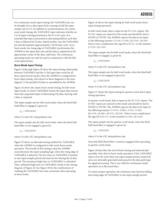
For continuous-mode input timing, the TxENABLE pin can be thought of as a data input clock running at half the input sample rate (f > W /2). In addition to synchronization, for contin-uous mode timing, the TxENABLE input indicates whether an I or Q input is being presented to the D<11:0> pins. It is intended that data is presented in alternating fashion such that I data is followed by Q data. Stated another way, the TxENABLE pin should maintain approximately a 50/50 duty cycle. As in burst mode, the rising edge of TxENABLE synchronizes the AD9856 to the input data rate and the data is registered...
Open the catalog to page 17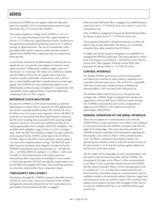
load that the AD9856 sees for signals within the filter pass band. For example, a 50 Ω terminated input/output low-pass filter looks like a 25 Ω load to the AD9856. The output compliance voltage of the AD9856 is −0.5 V to +1.5 V. Any signal developed at the DAC output should not exceed +1.5 V, otherwise, signal distortion results. Furthermore, the signal may extend below ground as much as 0.5 V without damage or signal distortion. The use of a transformer with a grounded center tap for common-mode rejection results in signals at the AD9856 DAC output pins that are symmetrical about ground. As...
Open the catalog to page 26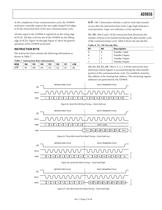
INSTRUCTION CYCLEDATA TRANSFER CYCLESCLKCSI SDIO I > 7 6 I > 5 I > 4 I > 3 I > 2 I > 1 I > D > 7 D > 6 D > 5 D > 4 D > 3 D > 2 D > 1 D > > 00637-C-044 INSTRUCTION CYCLEDATA TRANSFER CYCLESCL CSI K SDIO I > 7 6 I > 5 I > 4 I > 3 I > 2 I > 1 I > D > O7 D > O6 D > O5 D > O4 D > O3 D > O2 D > O1 D > O0 00637-C-047
Open the catalog to page 27All Analog Devices catalogs and technical brochures
 HMC722LP3E
8 Pages
 Isolated Sigma-Delta Modulator
17 Pages
 HMC853 Data Sheet
10 Pages
 AN-1084
8 Pages
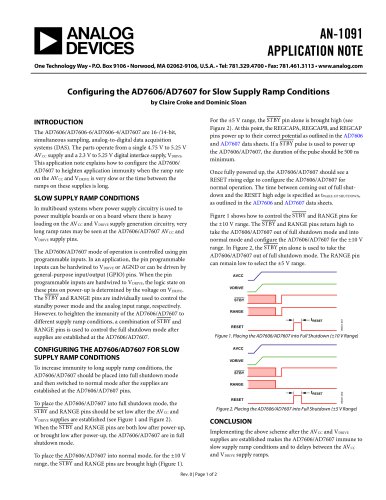 AN-1091
2 Pages
 AN_737
8 Pages
 AN-0982
4 Pages
 ADF7024
24 Pages
 AD9915
48 Pages
 AD9914
48 Pages
 ADRF6612
59 Pages
 ADRF6820
48 Pages
 ADL5246
32 Pages
 ADA4961
22 Pages
 AN-1141
8 Pages
 AN-698
36 Pages
 Temperature Sensors
2 Pages
 Reference Circuits
8 Pages
 Precision ADCs
16 Pages
 ADR02ACHIPS: ADR02ACHIPS
8 Pages
 AD9364 RF Agile Transceiver
32 Pages
 Digital Temperature Sensors
2 Pages
 Digital to Analog Converter ICs
12 Pages
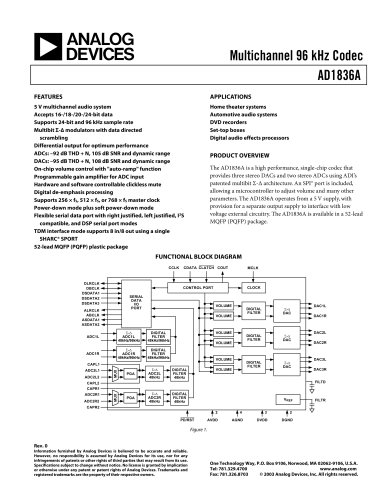 AD1836A: Multichannel 96 kHz Codec
24 Pages
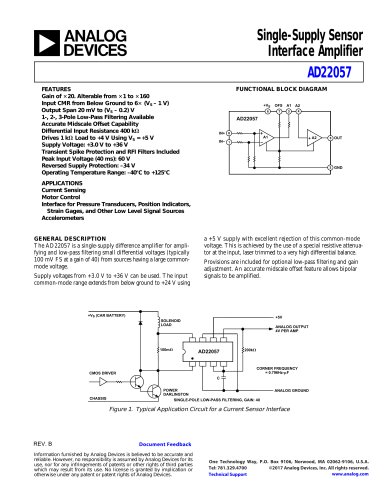

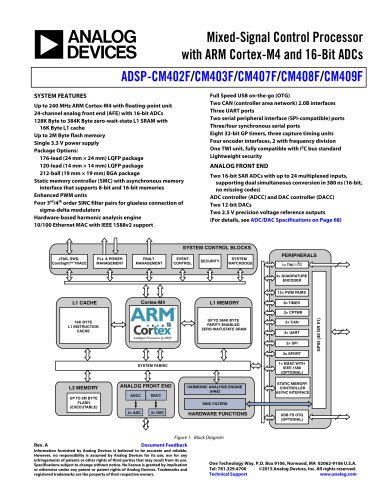

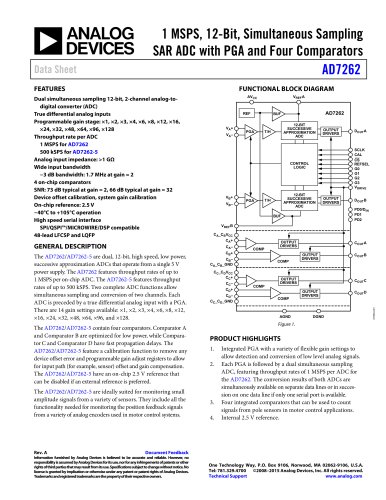


























Archived catalogs
 Zero-Drift Amplifiers
2 Pages
 Powering ADI Components
8 Pages



- Ethernet switch
- Industrial network switch
- Acceleration sensor
- Unmanaged switch
- Analog Devices motor controller
- Transceiver module
- Triaxial acceleration sensor
- DC motor controller
- Data acquisition unit
- Analog Devices stepper motor controller
- Industrial converter
- Ethernet transceiver
- Processor
- High-voltage amplifier
- Low-noise amplifier
- Multiplexer
- Compact motor controller
- Digital converter
- Closed-loop motor controller
- Digital motor controller