- Catalogs
- ams Sensors Germany GmbH
- Application Report - Improved LED systems with true color sensors


Application Report - Improved LED systems with true color sensors

Application Report - Improved LED systems with true color sensors
LEDs are favored for their technical, economic, ecological, and design benefits over traditional lighting. However, they face challenges such as color and intensity changes due to aging, current, and temperature variations. These changes can be managed using color sensors.
Functionality of Color Sensors
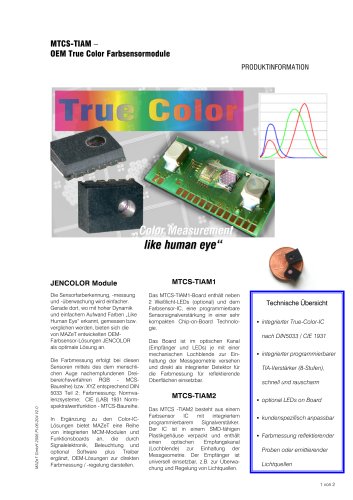
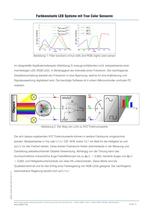
Color sensors typically use the three-range method with RGB or other spectral filters. MAZeT's sensors mimic the CIE 1931 standard spectral value function of the human eye, offering a cost-effective alternative to spectrometers for light measurement and regulation. Key characteristics of absorption and interference filters are detailed in tables.
Calibration
Calibration of color sensors involves a correction matrix and is sufficient with the primary colors of a multicolor LED, though adding white improves regulation. The process includes measuring target colors with both a color sensor and a spectrometer.
Color Sensors in LED Systems
An example with an MTCSiCS True Color Sensor and RGB LEDs highlights the integration requirements for LED systems, such as focusing on a homogeneously illuminated surface and adjusting sensor voltages to the temperature range. The MTCSiCS sensor, paired with the MTI04 amplifier, supports both PWM and constant current control methods.
Conclusion
True Color Sensors ensure consistent color in LED systems despite temperature, aging, and current variations. Successful integration requires attention to system requirements and calibration.
This section discusses compensating for color changes in RGB LEDs due to temperature fluctuations using a color sensor. An RGB LED backlight system is enhanced with the MTCS-C2 Colorimeter board, featuring a True Color Sensor, amplifier, and microcontroller. Tests involve cooling and heating the LED's heatsink from 0°C to 70°C across three runs: without regulation, with RGB sensor regulation, and with True Color Sensor regulation.
Test Results
- Run 1 (No Regulation): Significant color shift with a 7.5% brightness change and a color shift of 0.0332.
- Run 2 (RGB Sensor Regulation): Reduced color shift with a 1.0% brightness change and a color shift of 0.0227.
- Run 3 (True Color Sensor Regulation): Minimal color shift with a 0.3% brightness change and a color shift of 0.0028, within the human eye's indistinguishable range.
Summary
Regulation of multi-colored LEDs is crucial for applications requiring consistent color. Unregulated systems show unacceptable color changes with temperature variations. RGB sensors reduce changes but remain above acceptable thresholds. True Color Sensors provide successful regulation, achieving results indistinguishable to the human eye.
Name: Dipl.-Ing. (FH) Fredrik Hailer
Education: Mechatronics (Karlsruhe University of Applied Sciences)
Employer: MAZeT GmbH (Jena) since April 2007 as a Field Application Engineer in Color and Spectral Sensor Technology.
Catalog excerpts
U > x MAZeT R I > y I > In U > Out U > y sensor I > z VREF MTI04 U > z Օ Օ Օ size="-3">
Open the catalog to page 3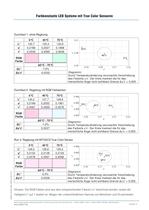
0C 40аC 70C L* 132,7 125,4 122,6 u' 0,2186 0,2027 0,1868 v' 0,4549 0,4595 0,4646 RGB Farbe 0аC - 70C L* -7,5% u'v' 0,0332 Diagramm: Durch TemperaturФnderung verursachte Verschiebung des Farborts uvҒ. Der Kreis markiert die fr das menschliche Auge nicht sichtbare Grenze uv쒒 = 0,005. 0C 40аC 70C L* 130,2 127,7 128,9 u' 0,2188 0,2052 0,1961 v' 0,4567 0,4569 0,4578 RGB Farbe 0аC - 70C Diagramm: L* -1,0% Durch TemperaturФnderung verursachte Verschiebung des Farborts uvҒ. Der Kreis markiert die fr das menschliche Auge nicht sichtbare Grenze u'v' 0,0227 uv쒒 = 0,005. 0C 40аC 70C L* 129,0 128,6 129,4...
Open the catalog to page 10All Ams Sensors Germany GmbH catalogs and technical brochures
 Company Brochure
20 Pages
 EMS Services incl. Design
2 Pages
 MTCS-C3
2 Pages
 ASIC Design Service Guide
4 Pages
 JENCOLOR
2 Pages
 Redesign of obsolete ASICs
2 Pages
 MAZeT Flyer
2 Pages
 JENCOLOR Flyer
2 Pages
 JENCOLOR- True Color Sensors
2 Pages
 MAZeT GmbH company facts
20 Pages


Archived catalogs
 MRGBiCS
9 Pages
 MRGBiCT
7 Pages
 Data Sheet - MTCSiCS
8 Pages
 Data Sheet - MTCS-ME1
25 Pages
 Software Description MTCS-ME1
20 Pages
 Data Sheet - MTI04
12 Pages
 Product information - MCS3
2 Pages
 Data sheet - MCS3AS
7 Pages
 Data Sheet - MCS3AT/BT
7 Pages
 MAZeT flyer
2 Pages