
- Catalogs
- AMETEK MOCON
- Comparing ASTM F1115 vs F2467


Comparing ASTM F1115 vs F2467

Comparing ASTM F1115 vs F2467
This white paper compares two major test methods for assessing CO2 barrier properties in the food and beverage industry: ASTM F1115 and ASTM F2476. It evaluates their application in different stages of CO2 barrier packaging design, particularly with MOCON® permeation analyzers.
Introduction
The Zahm-Nagel method, dating back to the early 1900s, is widely used for measuring air and CO2 content in beverage containers. It involves sensitive pressure and temperature monitoring to determine CO2 loss from polymer beverage containers. Factors affecting pressure loss include volume expansion and gas transport characteristics.
Zahm-Nagel Method Procedures
The Zahm-Nagel method includes two procedures: Procedure A for package development and Procedure B for quality control in beverage filling operations. Procedure A requires a minimum of 5 bottles, while Procedure B requires at least 50 bottles due to its destructive nature.
MOCON Comparison Study: IR Method vs Zahm-Nagel
The MOCON IR Sensor Method, represented by the PERMATRAN-C® 4/30, uses an infrared sensor to measure CO2 loss, offering faster and more accurate results than the Zahm-Nagel method. A comparison study showed that the IR method provides results comparable to the Zahm-Nagel method but in a much shorter time frame.
Permeation Test Results
Various permeation tests were conducted using the MOCON method, including tests on empty bottles, partially filled bottles, and fully filled bottles. Results showed that the IR method could accurately measure CO2 transmission rates, with equilibrium times significantly shorter than those required by the Zahm-Nagel method.
Conclusions
The MOCON IR Sensor Method provides comparable results to the Zahm-Nagel method but in a shorter time, making it more suitable for R&D and QA/QC processes. It allows for testing of various sample forms, including films and pre-filled bottles. The method is effective for estimating the shelf life of carbonated drinks.
Recommendations
- The Zahm-Nagel method is suitable for monitoring real-time shelf life but is time-consuming.
- The MOCON IR Sensor Method is recommended for faster, accurate CO2TR measurements, aiding in new design and QA/QC tasks.
- Further reading on using CO2TR results for shelf life estimation is suggested.
Catalog excerpts
WHITE PAPER A COMPARISON OF THE ASTM F1115 AND F2476 TEST METHODS FOR CO₂TR MEASUREMENT AMETEK MOCON April 2024 Content: Abstract . . . . . . . . . . . . . . . . . . . . . . . . . . . . . . . . . . . . . . . . . . . . . . . . . . . . . . . . . . 2 Introduction . . . . . . . . . . . . . . . . . . . . . . . . . . . . . . . . . . . . . . . . . . . . . . . . . . . . . 2 Zahm-Nagel Method Procedures . . . . . . . . . . . . . . . . . . . . . . . . . . . . . . . . 3 MOCON Comparison Study: IR Method vs Zahm-Nagel . . . . . . . . . . 4 Permeation Test Results . . . . . . . . . . . . . . . . . . . . . . . . . . . . . . . . . . . . . . . . . . 5 Conclusions . . . . . . . . . . . . . . . . . . . . . . . . . . . . . . . . . . . . . . . . . . . . . . . . . . . . . . 6
Open the catalog to page 1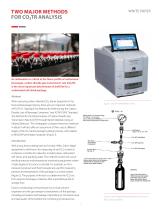
TWO MAJOR METHODS FOR CO₂TR ANALYSIS WHITE PAPER As carbonation is critical to the flavor profile of carbonated beverages, carbon dioxide gas transmission rate (CO₂TR) is the most important determinant of shelf life for a carbonated soft drink package. Abstract When assessing carbon dioxide (CO2) barrier properties in the food and beverage industry, there are two major test methods: ASTM F1115 “Standard Test Method for Determining the Carbon Dioxide Loss of Beverage Containers,” and ASTM F2476 “Standard Test Method for the Determination of Carbon Dioxide Gas Transmission Rate (CO2TR) Through...
Open the catalog to page 2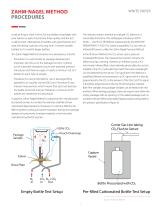
ZAHM-NAGEL METHOD PROCEDURES WHITE PAPER could be long or short in time. For any bottles or packages with poor barriers or seals, the pressure drops quickly, and the test could be short. Alternatively, for bottles with good barriers and seals, the testing could be very long, from 2 months (smaller bottles) to 4-5 months (larger bottles). The industry needs a method to evaluate CO2 barriers in a reasonably short time. This whitepaper introduces ASTM F2476 — the IR CO2TR Method, represented by the MOCON® PERMATRAN-C® 4/30. This method quantifies CO2 loss with an Infrared (IR) sensor, unlike the...
Open the catalog to page 3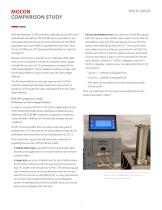
MOCON COMPARISON STUDY WHITE PAPER • Closure permeation tests were done on a set of the special MOCON closures. Glass bottles were used to ensure that the permeation came only from the special closures. First the bottles were carefully flushed with CO2. The closures were then added, and the bottle was pressurized to 60 PSIG. The bottles were then put into the capture volumes and tested. Closures took about 5 days to come to equilibrium. Results are as follows. Closure A = 0.3926 cc/pkg•day, closure B = 0.3745 cc/pkg•day. Results when normalized for PSIA of CO2 are as follows: With the obtained...
Open the catalog to page 4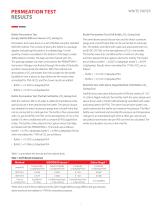
PERMEATION TEST RESULTS WHITE PAPER Bottle Permeation Test (Empty Bottle Without Closure, CO2 Going In) Bottle Permeation Test (Full Bottle, CO2 Going Out) The same above special closure was used to attach a pressure gauge and a shutoff valve that can be connected to a tank gas line. The bottles were filled with water and pressurized with CO2 to 60 PSIG (75 PSIA, or five atmospheres of CO2 in the bottle). The bottles were then conditioned for a minimum of 6 days and then placed into the capture volume for testing. The results are as follows: bottle 1 = 8.2027 cc/(pkg•day), bottle 2 = 8.1879 cc/(pkg•day)....
Open the catalog to page 5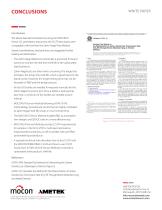
WHITE PAPER Conclusions The above data demonstrates that using the MOCON IR Sensor CO2 permeation instrument, the CO2TR test results were comparable with that from the Zahm-Nagel Test Method. Several considerations, best practices, and suggested further reading are listed below. • The Zahm-Nagel Method is historically a good tool for brand owners to monitor the real-time shelf life of the carbonated liquid products. • Zahm-Nagel tests are often time consuming. The longer the test takes, the longer the shelf life, which is good news for the brand owner. However, the longer testing time may not...
Open the catalog to page 6All AMETEK MOCON catalogs and technical brochures
 Dansensor ISM-3
2 Pages
 PERMATRAN-W Model 101 K
4 Pages
 AQUATRAN 3/40
4 Pages
 Dansensor MAP Check 3 Vacuum
2 Pages
 Dansensor LeakMatic II
2 Pages
 The ProSpect Advantage
2 Pages
 Optimize Butter Production
3 Pages
 Dansensor LeakPointer H20
2 Pages
 PERMATRAN-C 4/30 Analyzer
4 Pages
 OX-TRAN 2/48 Series
4 Pages
 Dansensor Lippke VC1400
2 Pages
 Toxic Gas Monitoring
4 Pages
 Trace Gases In Ambient Air
4 Pages
 Surface Logging
4 Pages
 Impurities In Specialty Gas
4 Pages
 Baseline VOC-TRAQ II
4 Pages
 OX-TRAN 2/28 H
4 Pages
 AQUATRAN 3/38 H
4 Pages
 PERMATRAN-W® Model 101K
4 Pages
 MOCON® BASELINE® PRODUCTS
2 Pages
 PERMATRAN-C® Model 4/41
2 Pages
 OX-TRAN Model 2/12 Series
2 Pages
 OX-TRAN® Model 2/40 Series
4 Pages
 OX-TRAN Model 2/22 Series
2 Pages
 Oxygen and Water Vapor
4 Pages
 MAP Gas Mixtures Poster
1 Page
 Dansensor ISM 3
2 Pages
 PERMATRAN-W Model 3/34
2 Pages
 BevAlert®
6 Pages
 AQUATRAN® Model 3
2 Pages


Archived catalogs
 MultiCheck Series
4 Pages
 OX-TRAN Model 2/10
2 Pages
 OX-TRAN® Model 2/61
4 Pages
 PERMATRAN-W Model 3/61
4 Pages
 OX-TRAN Model 702
4 Pages
 OX-TRAN Model 2/61
4 Pages
 PERMATRAN-W® Model 700
4 Pages
 PERMATRAN-W® Model 398
2 Pages
 piD-TECH® eVx
4 Pages
 CheckPoint 3
2 Pages


- Mocon gas analyzer
- Mocon concentration analyzer
- Mocon monitoring analyzer
- Analysis software solution
- Liquids analyzer
- Mocon automatic analyzer
- Mocon benchtop analyzer
- Mocon solids analyzer
- Stainless steel vessel
- Monitoring software solution
- Mocon process analyzer
- Gas detector
- Portable analyzer
- Continuous analyzer
- Digital tester
- Mocon real-time analyzer
- Water analyzer
- Mocon automatic tester
- Gas sensor