
- Catalogs
- AMETEK Factory Automation
- Motogard Series

Motogard Series

Motogard Series
The Motogard™ Over-Temperature Protection System is designed to provide immediate protection against overheating for motors, equipment enclosures, semiconductor heatsinks, sleeve bearings, and other machinery. It uses Positive Temperature Coefficient (PTC) Thermistors to monitor temperature and ensure equipment does not exceed pre-selected limits.
Specifications
- Model Series: 115, 120, 135, 150
- Input Rating: 120VAC± 10%, Single Phase, 50/60 Cycles
- Output Rating: 120/240 Volts AC, varying amp continuous depending on the series
- Input Resistance Control: Varies by series, with specific ohm thresholds for ON/OFF states
- Isolation: Electrical isolation varies by series
- Reset: Automatic
- Dimensions: Vary by series
- Enclosure: Varies by series, including NEMA 12 steel and polyester cases
Key Features
- Solid state logic circuitry for rapid, noiseless operation
- Fail-safe operation against sensor lead breakage or power loss
- Protection against sensor lead short circuit (Series 135 and 150)
- Solid state or electro-mechanical outputs
Applications
- Motor protection against overloads, voltage unbalance, and other failures
- Bearing protection for machine tools, compressors, and pumps
- Over-temperature protection for process vats, furnaces, and ovens
- Fire protection for equipment enclosures
- Insulation protection for electromagnets and transformer windings
- Protection of semiconductor heatsinks
Operation
The system uses PTC Thermistors that act as switches, increasing resistance sharply at the switch point temperature. This change in resistance triggers the controller to alter the state of the contacts, providing an indication of over-temperature conditions.
PTC Thermistors
These thermistors are designed for high-speed over-temperature sensing with no drift or aging. They are encapsulated in epoxy for durability and thermal conductivity. Various designs are available, including spring-loaded bearing probes.
Ordering Information
Part numbers and switching temperatures are provided, with specific wire color identifications for each temperature range. Special orders and non-stocked temperatures require consultation with the factory.
Catalog excerpts

Motogard Relay Models Model No. Operating Characteristics 6 Inputs 2 Triac Outputs 1 N.O.* 1 N.C.* 3 Inputs Single Triac Output N.C.* 3 Inputs Form C Relay Output 1 Input Form C Relay Output Input Rating Output Rating 120VAC± 10%, Single Phase, 50/60 Cycles 120/240 Volts AC 5 amp continuous 120/240 Volts AC or 28 Volts DC 5 amp continuous Input Resistance Control Controller ON with 500 ohms or less - OFF with approx. 1500 ohms or more Controller ON with 500 ohms or less - OFF with approx. 1500 ohms or more Controller ON with 150 to 500 ohms - OFF with approx. 1500 ohms or more Controller ON with 150 to 500 ohms - OFF with approx. 3500 ohms or more Controller output, excitation, and sesor input electrically isolated from each other Controller excitation only isolated from output and sensors Controller output, excitation, and sesor input electrically isolated from each other Controller output, excitation, and sesor input electrically isolated from each other Potted in "NEMA" 12 steel case Potted in polyester case Mounted in welded steel case Potted in polyester case * eries 115 and 120 Motogard Controllers use output S Triacs that have been specifically selected to operate directly in series with main line contactors. If a small interposing relay must be used, the sealed VA rating of the interposing relay should be greater than 10VA. Other Products Copyright 2015 by AMETEK FACTORY AUTOMATION. All Rights Reserved. Made in the USA. 1080 North Crooks Road, Clawson, MI 48017 Phone: 248-435-0700 Toll Free: 800-635-0289 Fax: 248-435-8120 www.ametekfactoryautomation.com Motogard™ Over – Temperature Protection System Ordering Guide and Technical Informati
Open the catalog to page 1
General Information Motogard Over-Temperature Protection Systems provide immediate overheating protection for: motors, equipment enclosures, semiconductor heatsinks, sleeve bearings, and other related machinery. All Motogard systems fully conform to the NEC requirements for integral motor thermal protection. The temperature inside of the motor is monitored at all times. Using Positive Temperature Coefficient (PTC) Thermistors embedded in or in contact with the surface, the Motogard system is able to continually sense when the equipment exceeds the pre-selected temperature limits. Motogard systems...
Open the catalog to page 2
On Motogard series 115, 120, and 135 thermistors are placed in parallel allowing independent monitoring of 3-6 points in the equipment. On series 150, the three thermistors are wired in series reacting as a single switching point. Although there is a higher resistance switching point on the series 150, each separate thermistor will pass 3500 ohms on over-temperature. PTC Thermistors Motogard controllers are designed for use with positive temperature coefficient thermistors. PTC’s are unlike other thermistors as they increase their resistance sharply when reaching their switch point temperature....
Open the catalog to page 3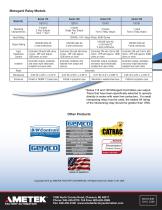
Motogard Relay Models interposing relay must be used, the sealed VA rating of the interposing relay should be greater than 10VA. Other Products UeMEU LINEAR DISPLACEMENT TRANSDUCERS ROTARY POSITION PRODUCTS PROGRAMMABLE LIMIT SWITCHES EXTREME DUTY CABLE REEL PRODUCTS ROTARY LIMIT SWITCHES MILL DUTY ENCLOSURES Copyright 2015 by AMETEK FACTORY AUTOMATION. All Rights Reserved. Made in the USA. VMETEK FACTORY AUTOMATION 1080 North Crooks Road, Clawson, MI 48017 Phone: 248-435-0700 Toll Free: 800-635-0289 Fax: 248-435-8120 www.ametekfactoryautomation.com
Open the catalog to page 4All AMETEK Factory Automation catalogs and technical brochures
 956 eBlok
8 Pages
 958A
958A6 Pages
 7330X Series
2 Pages
 7330 V Series
2 Pages
 7330 S & F Series
2 Pages
 7330 EX/ED Series
2 Pages
 Industrial Brakes
2 Pages
 957
9576 Pages
 Linear Displacement Transducers
86 Pages
 950IS
950IS3 Pages
 CATRAC & SnapTrac Catalog
32 Pages
 B/W Controls Catalog
56 Pages




Archived catalogs
 1980 Rotating Cam Limit Switch
20 Pages
 953A/D/SSI VMAX Gemco LDT
6 Pages
 950MD Gemco LDT
1 Page
 955S Smart BRIK
2 Pages
 952 BlueOx Gemco LDT
9 Pages
 955LC Brik
2 Pages
 1986DN - DeviceNet Resolver
2 Pages
 955D BRIK Gen III Gemco LDT
2 Pages
 955A Brik Gemco LDT
2 Pages
 925 Cable Reel Sensor
8 Pages
 Linear Cable Reel Sensor
8 Pages
 RESOLVER CATALOG
20 Pages


- LED monitor
- Level probe
- Liquid level sensor
- Protection relay
- AMETEK position sensor
- Friction brake
- Analog level sensor
- AMETEK linear position sensor
- Control pedal
- AMETEK displacement sensor
- Rugged monitor
- Single pedal pedal
- AMETEK linear displacement sensor
- Electronic pedal
- Vessel level sensor
- Analog position transducer
- Spring brake
- Disc brake
- Electromagnetic brake