
- Catalogs
- AMETEK Dynamic Fluid Solutions
- Electroplating Blowers

- Company
- Products
- Catalogs
- News & Trends
- Exhibitions
Electroplating Blowers

Electroplating Blowers
This document discusses the use of regenerative blowers in electroplating processes, highlighting their benefits in terms of cost savings, improved plating quality, and increased productivity. It provides detailed guidelines on the selection and use of blowers for various applications within electroplating.
Operating Cost Savings
Using low-pressure air agitation with regenerative blowers significantly reduces operating costs compared to traditional compressors. The document provides a detailed calculation of potential savings, showing that regenerative blowers can save thousands of dollars annually due to their lower energy consumption.
Financial Benefits
Regenerative blowers offer several financial advantages, including lower capital expenses, a quick payback period on electrical use, enhanced plating quality, increased production, and reduced maintenance costs. They are oil-free, reducing the need for oil filters and minimizing contamination risks.
System Design Considerations
The document outlines considerations for designing a system with regenerative blowers, including the choice between single and multiple blowers, sparger selection, and layout. It emphasizes the importance of proper pipe sizing to minimize friction loss and ensure effective air distribution.
Guidelines for Maximum Agitation Efficiency
To achieve maximum agitation efficiency, the document provides rules for sparger hole selection and layout. It advises against throttling unwanted blower air and recommends using relief valves to prevent overpressure.
Improving Electroplating Quality
Low-pressure air agitation enhances plating quality by efficiently removing cathode films and reducing polarization. It also increases production by dislodging dirt particles and improving rinsing efficiency, which reduces water consumption and waste treatment demands.
Technical Superiority and Reliability
Rotron blowers are highlighted for their technical superiority, reliability, and safety. They are designed with fewer moving parts, reducing wear and maintenance needs. The document also emphasizes the clean, oil-free air provided by these blowers, eliminating the need for high-maintenance filters.
Blower Sizing Tools
The document includes tools for sizing blowers for various applications, such as tank aeration, push air ventilation, and parts blow-off and drying. It provides detailed criteria and examples to guide users in selecting the appropriate blower model for their specific needs.
Conclusion
Overall, the document positions Rotron regenerative blowers as a cost-effective, reliable, and efficient solution for improving electroplating processes, offering significant operational and financial benefits.
Catalog excerpts
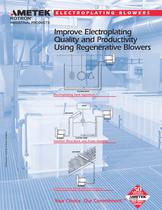
Improve Electroplating Quality and Productivity Using Regenerative Blowers Photograph courtesy of Goad Company Electroplating Tank Agitation Solution Blow-Back and Fume Guiding General Parts Blow-Off and Drying Your Choice. Our Commitment.TM
Open the catalog to page 1
Financial Benefits of Low-Pressure Air Blowers Rotron regenerative blowers result in a cost savings in a number of ways: you’ll experience lower capital expense, a six-month payback on electrical use, enhanced plating quality through aeration, increased production utilizing a consistent continuous plating process, oil-free regeneratives not needing oil filters, and a more reliable, no/low maintenance design. Lower Capital Expense. When you compare the cost of a compressor in a small plating shop against a 5-hp regenerative blower, a compressor can initially cost 4 to 6 times more than the Rotron...
Open the catalog to page 2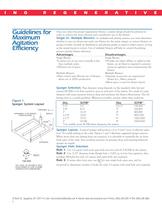
Guidelines for Maximum Agitation Efficiency Once you select the proper regenerative blower, a system design should be planned in order to achieve the most efficient and cost-effective use of the blower. Single Vs. Multiple Blowers. In multiple-tank plating systems, you must determine whether to use one blower per tank, one blower for the entire system, or various blowers on groups of tanks. In-tank air distribution and plating quality is equal in either option, as long as the system layout is correct. Use of multiple blowers will help to control the plating process and the blower efficiency....
Open the catalog to page 3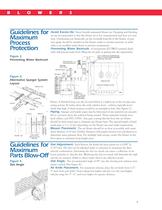
Preventing Water Backrush Alternative Sparger System SPARGER MANIFOLD Avoid Excess Air. Never throttle unwanted blower air. Dumping and bleeding air are recommended so that the blower air is not overpressured and does not over- heat. Overheating can drastically cut the normally long life of the blower. A pres- sure gauge should be installed at the blower outlet to monitor pressure. A relief valve is an excellent safety device to prevent overpressure. Preventing Water Backrush. A low-pressure (0-5 IWG) actuated check valve will prevent water from filling the air path or getting into the regenerative...
Open the catalog to page 4
Rotron Capabilities Technical superiority. Innovative thinking. A proven commitment to quality. Since it’s inception, in 1949, the name Rotron has been synonymous with reliability, quality, innovation and technical leadership in the field of electromechanical devices designed for the specialized movement of air and gas media. Over the years, Rotron products have become significant contributors within the industrial manufacturing, instrumentation, environmental, processing, air and water pollution control, material handling and medical markets. Rotron’s commitment to supply customized and standard...
Open the catalog to page 5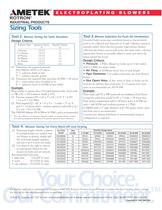
Sizing Tools Tool 2. Blower Sizing for Tank Aeration. Tool 3. Blower Selection for Push Air Ventilation. Design Criteria. Chemical baths in process contribute fumes to the air which need to be collected and disposed of. A side collection system is typically added. Since the low-vacuum, high-volume blowers collecting the fumes cannot pull across the entire bath, a Rotron regenerative blower is normally added to push and direct the fumes toward the hood. Solution Type Cleaning Cu Plating Al Plating Ni Plating Cr Plating Rinse Design Criteria. • Pressure. 1 PSIG. (Based on tanks up to 6 feet wide)....
Open the catalog to page 6All AMETEK Dynamic Fluid Solutions catalogs and technical brochures
 Windjammer pro
6 Pages
 Minijammer Blower
2 Pages
 Microjammer Blower
2 Pages
 AMETEK Nautilair Blower
2 Pages
 ROTRON TDS
2 Pages
 Windjammer Brushless Blowers
136 Pages
 ROTRON Regenerative Blowers
196 Pages
 rotron transportation catalog
54 Pages
 Water Aeration Blowers
2 Pages

Archived catalogs
 Precision Cleaning
2 Pages
 Packaging Blowers
2 Pages
 Textile Blowers
2 Pages
 Materials Handling
2 Pages
 AMETEK Blowers
133 Pages
 AMETEK Transportation
39 Pages
 fuel cell advantage sheet
2 Pages
 Nautilair Combustion Blowers
22 Pages
 Pittman Motors
104 Pages
 Blowers
128 Pages
 Regenerative Blowers
196 Pages


- Electromotor
- DC electromotor
- Synchronous motor
- Alternating current motor
- Multipole motor
- Electromotor for industrial applications
- 24 V motor
- Compact electromotor
- 2-pole motor
- 220 V motor
- Small motor
- Low-voltage motor
- Squirrel cage motor
- High-voltage motor
- Single-pole motor
- 240 V motor
- Standard motor
- Universal motor
- Double motor
- Lightweight motor