
- Catalogs
- Ametek Calibration
- RTCt Temperature Calibrator User Manual

- Products
- Catalogs
- News & Trends
- Exhibitions
RTCt Temperature Calibrator User Manual
RTCt Temperature Calibrator User Manual
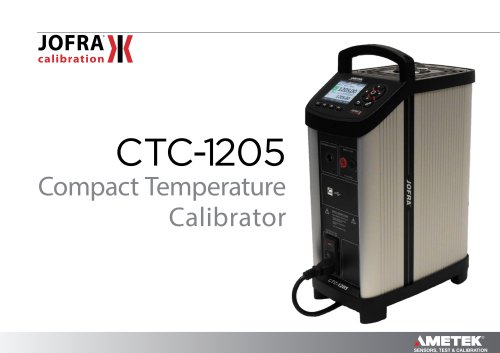
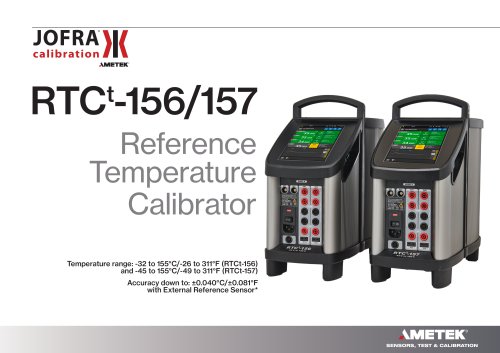
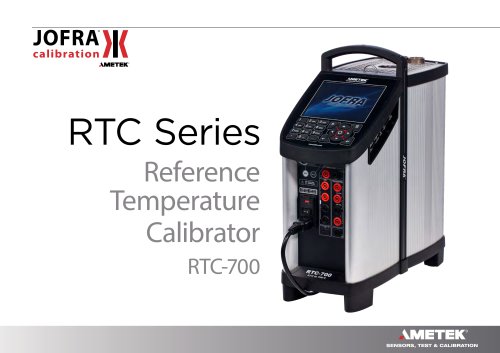
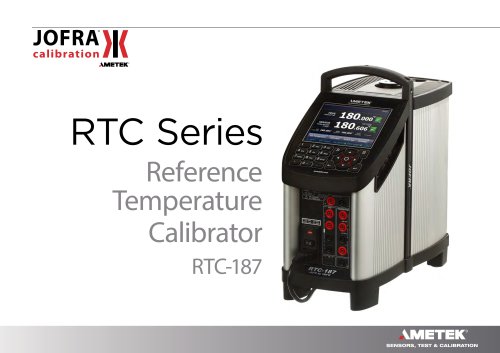
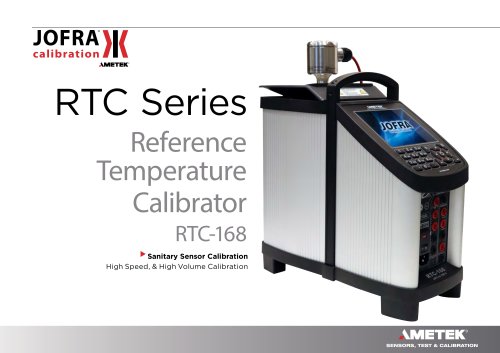
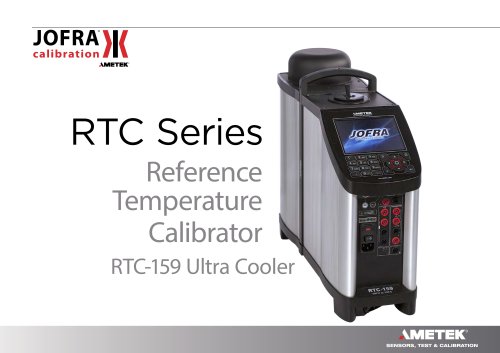
The manual provides comprehensive guidance on the JOFRA RTCt-156/157/168 A/B/C temperature calibrators, which are used for calibrating temperature sensors and thermostats. The RTCt-156/157 models are dry-block calibrators, while the RTCt-168 models can also function as liquid bath calibrators. Users are encouraged to read the manual thoroughly for safe and effective operation.
The package includes the calibrator unit, mains cable, test cables (for B models), USB memory stick with manuals and software, Wifi USB Dongle, USB cable, tool for insertion tube, calibration certificates, rubber cones, and an insulation collar. The RTCt-168 models also come with a liquid bath kit.
Safety guidelines must be followed to prevent injury or damage. The calibrator should be used indoors, away from hazardous areas, and connected to a power source with a protective earth connection. It should not be used in wet conditions or at altitudes above 2000 meters. Proper ventilation is required when using liquids in the RTCt-168 models.
Setup instructions vary depending on whether the calibrator is used as a dry-block or liquid bath. Detailed instructions are provided for each type, including the use of external reference sensors and screen configuration.
Procedures for starting the calibrator, setting temperatures, and performing calibrations are outlined. Instructions for auto calibration, auto step setup, and switch test setup are included. Users can configure temperature parameters, resolutions, and system settings.
Instructions for setting up LAN, WLAN, and remote access are provided, including the use of Wifi connections and remote communication API.
Guidelines for setting the mains voltage, replacing fuses, and storing the calibrator are included. Special instructions are provided for transporting and storing the liquid bath calibrator.
- Clean up liquid spillages immediately according to MSDS and local regulations.
- Ensure sensors are clean and dry to prevent steam explosions in liquid baths.
- Avoid pouring cold liquid into a hot well to prevent explosions.
- Only use recommended liquids in the well.
- Liquid baths should be operated by trained personnel only.
- Heat transfer liquids must not exceed specified temperatures to avoid toxic fumes.
- Remove liquid from the calibrator before transportation.
- Silicone oil is flammable above its flash point; consult safety datasheets before use.
- Do not touch hot surfaces to avoid burns.
- Wait for the calibrator to cool below 50°C/122°F before switching off or removing inserts.
- Ensure the calibrator's internal fan is operational and the area is free of flammable substances.
- The product liability is void if instructions are not followed or unauthorized parts are used.
- The calibrator is designed for indoor use only and should not be used in hazardous areas or altitudes above 2000 meters.
- Ensure proper ventilation and avoid using heat transfer liquids in dry-block calibrators.
Several functions are available during calibration, including viewing results, pausing, and navigating between steps. Completion is indicated by a green checkmark, and results can be saved or deleted.
Results can be exported in CSV format to a USB stick immediately after calibration if not deleted.
Access the AUTO CALIBRATION RESULT LIST to view detailed results. Results can be uploaded to a PC program for printing certificates or exported to a USB drive.
Allows supervision and control of calibrator settings remotely. The calibrator's IP address or host name is used to access the remote web user interface via a browser.
The document emphasizes the importance of following safety guidelines and procedural steps to ensure accurate calibration and prevent hazards. Proper handling of equipment and liquids is crucial for safe and effective operation.
Catalog excerpts
VMETEK SENSORS, TEST & CALIBRATION User manual Reference Temperature Calibrator Jofra RTCt-156/157/168 A/B/C
Open the catalog to page 1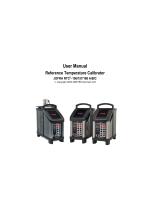
User Manual Reference Temperature Calibrator JOFRA RTCt -156/157/168 A/B/C Copyright 2025 AMETEK Denmark A/S
Open the catalog to page 2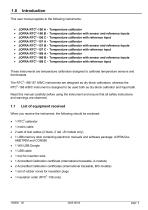
This user manual applies to the following instruments: Temperature calibrator Temperature calibrator with sensor and reference inputs Temperature calibrator with reference input Temperature calibrator Temperature calibrator with sensor and reference inputs Temperature calibrator with reference input Temperature calibrator Temperature calibrator with sensor and reference inputs Temperature calibrator with reference input These instruments are temperature calibrators designed to calibrate temperature sensors and thermostats. The RTCt -156/157 A/B/C instruments are designed as dry-block calibrators,...
Open the catalog to page 5
• RTC -168 A/B/C only (liquid bath) - OPTIONAL : • 1 liquid bath kit consisting of : - 1 sensor basket with temperature equalizer tube - 1 insulating ring for spill tray - 1 liquid drainage syringe - 1 oil material safety data sheet
Open the catalog to page 6
Read this manual carefully before using the instrument! Please follow the instructions and procedures described in this manual. They are designed to allow you to get the most out of your calibrator and avoid any personal injuries and/or damage to the instrument. The screen menus shown in this manual represent the menus displayed when using a B-model. /v-®\ These calibrators contain Electrical and Electronic circuits and must be recycled or disposed of properly (in accordance with the WEEE Directive 2012/19/EU). • Always supply the calibrator using a power circuit which is separate from essential...
Open the catalog to page 7
• When cleaning the well or the insertion tube, REMEMBER to wear goggles when using compressed air in the dry-block calibrator and cleaning oil in the liquid bath calibrator. • Remember to use appropriate protective equipment or get help when carrying the calibrator (for a longer distance) to prevent injuries from dropping the calibrator. About the front panel: • For B and C models only, the sockets on the input module must NEVER be connected to voltages exceeding 30V with reference to ground. • Thermostats connected to the switch test input must not be connected to any other voltage source during...
Open the catalog to page 8
By reducing the "Max. SET-temperature allowed”, the calibrator cannot be used outside this temperature range. Be aware of the flash point, the boiling point and other liquid properties applicable to the usage when setting the Max. SET-temperature. Read the MSDS (Material Safety Data Sheet) of the liquid before use. The Max. SET-temperature must never exceed liquid flash point –50°C. Always remove the liquid from the calibrator before transportation. Product information on the liquid must be carefully investigated before use. Do not handle hot liquid. Do not pour water or any other liquids into...
Open the catalog to page 9
Remove the insulation plug while heating up. It is very important that humidity in the well and insertion tube is removed to prevent corrosion and frost expansion damages. • Do not use the instrument if the internal fan is out of order. • Before cleaning the calibrator, you must switch it off, allow it to cool down and remove all cables. • Always place power cables and cables for attached accessories, such as sensors, in a safe way to reduce the risk of tripping. • When transporting (carrying) the calibrator, be extra careful not to drop it on other materials, equipment, and body parts. • Ensure...
Open the catalog to page 10
• The insertion tube must never be forced into the well. The well could be damaged as a result, and the insertion tube may get stuck. • The insertion tube must always be removed from the calibrator after use. The humidity in the air may cause corrosion oxidation on the insertion tube inside the instrument. There is a risk that the insertion tube may get stuck if this is allowed to happen. • If the calibrator is to be transported, the insertion tube must be removed from the well to avoid damage to the instrument. • The tip of the sensor should rest at the bottom of the sensor basket for optimum...
Open the catalog to page 11
The RTC -B-models have a precision reference input. To achieve the high precision, a set of sensor coefficients relating to the specific sensor must be present in the RTCt. Before use of the RTCt, ensure that the correct coefficients in the RTC are equal to those from the sensor’s calibration certificate. This is done with the included PC software JOFRACAL. Please read how to do in the chapter "Reference Sensors” in the JOFRACAL user manual. • The calibrator must not be used for any purposes other than those described in this manual, as it might cause a hazard. • The calibrator has been designed...
Open the catalog to page 12
About the liquid bath (RTC* -168 A/B/C only): • For liquid bath ensure that the sensor is absolutely clean and dry as a few drops of water in the well (liquid baths) might cause a steam explosion. • Do not pour cold liquid into a hot well - it might cause an explosion. • AMETEK Denmark A/S does not take any responsibility, if the well is filled with other liquids than those recommended. • Liquid baths should only be operated by trained personal. • Heat transfer liquids must only be used in calibrators prepared as a liquid bath. If these liquids are heated above specified temperature, they will...
Open the catalog to page 13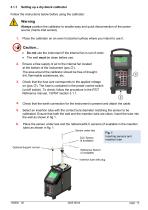
Setting up a dry-block calibrator Follow the instructions below before using the calibrator: Warning Always position the calibrator to enable easy and quick disconnection of the power source (mains inlet socket). 1. Place the calibrator on an even horizontal surface where you intend to use it. Do not use the instrument if the internal fan is out of order. The well must be clean before use. Ensure a free supply of air to the internal fan located at the bottom of the instrument (pos.). The area around the calibrator should be free of draught, dirt, flammable substances, etc. Check that the fuse...
Open the catalog to page 14All Ametek Calibration catalogs and technical brochures
 Type T Deadweight Tester
8 Pages
 ATMi Temperature Module
7 Pages
 XP2i Data Recorder
6 Pages
 Temperature Pressure Process
12 Pages
 AMETEK Calibration Brochure
12 Pages
 Maritime Brochure
8 Pages
 CPF Brochure (D)
4 Pages
 APM Advanced Pressure Module
6 Pages
 Product Overview Brochure
8 Pages
 GaugeCalHP Manual
20 Pages
 24 VDC Power Supply Manual
7 Pages
 24 VDC Power Supply
4 Pages
 FastCalXP
9 Pages



















- Management software solution
- Automation software solution
- Data logger
- AMETEK resistance temperature sensor
- Process software
- AMETEK pressure gauge
- Real-time software
- AMETEK Windows software
- Cloud-based software
- Control software
- Digital indicator
- Analog pressure gauge
- Industrial software
- AMETEK measurement software
- Interface software
- AMETEK thermocouple
- Pt100 temperature transducer
- Data-logger with screen