
- Catalogs
- Ametek Calibration
- RTCt Temperature Calibrator Reference Manual

- Products
- Catalogs
- News & Trends
- Exhibitions
RTCt Temperature Calibrator Reference Manual
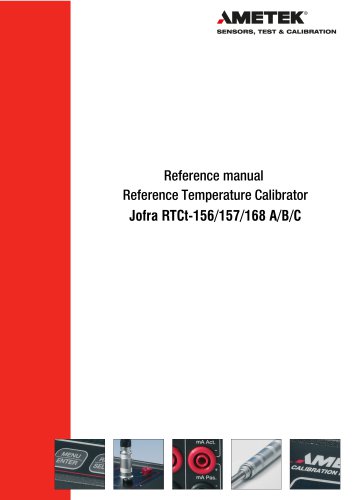
RTCt Temperature Calibrator Reference Manual
The AMETEK JOFRA RTCt Calibrator is a high-performance tool for industrial temperature calibration, featuring patented technologies for temperature uniformity and real-time calibration adjustments. It includes a touchscreen interface and intelligent recalibration alerts.
The manual is organized into 11 sections covering setup, operation, service, maintenance, technical specifications, and accessories, with safety instructions highlighted.
Safety symbols indicate potential hazards and minor risks, emphasizing the importance of following guidelines to ensure safe use.
Instructions include preparing dry-block and liquid bath calibrators, selecting insertion tubes, and handling sensors, with specific guidelines for RTCt-168 models.
Details on navigating the interface, including screens and input/output connections, are provided, with specific input sections for models B and C.
Guidelines for starting the calibrator, setting temperatures, running calibrations, and saving results are included, along with auto calibration and switch test setup procedures.
Instructions for configuring system settings, including volume, calibration intervals, language, date, time, and communication settings (LAN, WLAN, remote access) are provided.
Guidelines for storing, transporting, and maintaining the calibrator, including cleaning and replacing fuses, are included. Error messages and service return procedures are also covered.
Technical specifications and a list of available accessories are provided, along with contact information for further assistance.
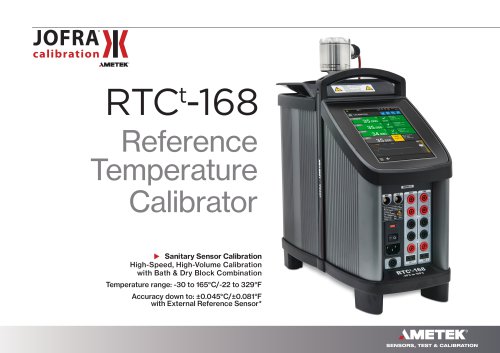
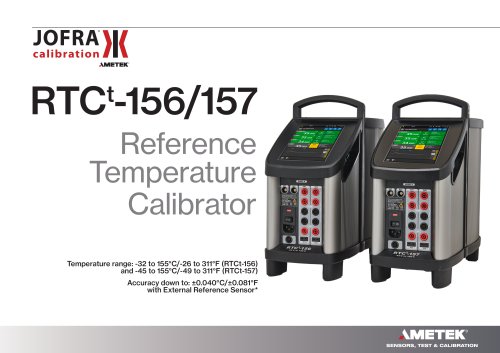
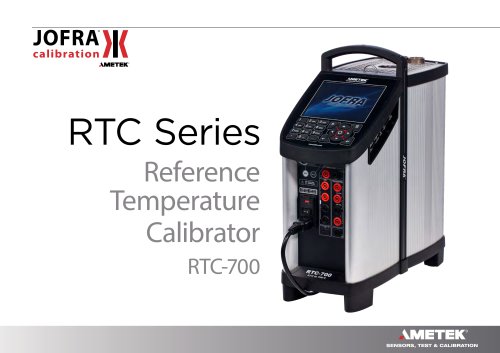
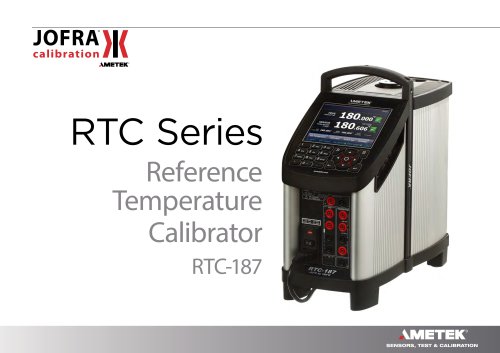
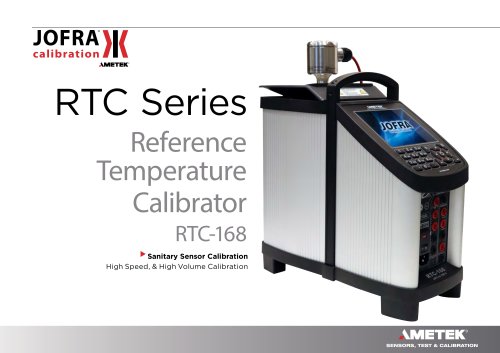
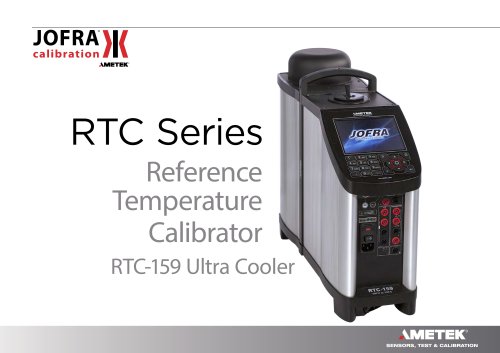
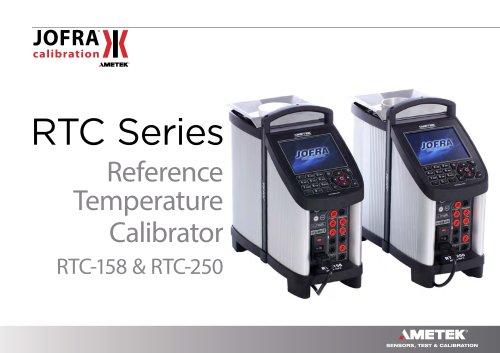
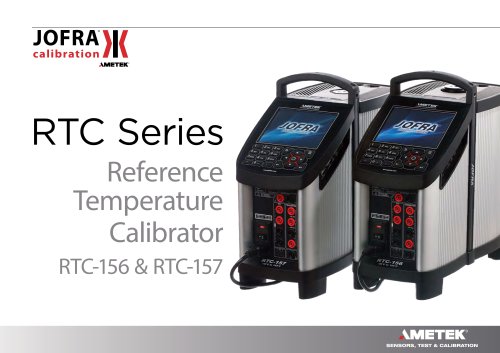
The document describes various models of JOFRA RTCt temperature calibrators, including RTCt-157 and RTCt-168 series, with different configurations.
AMETEK Denmark A/S is ISO-9001 and ISO-17025 certified, with calibrators conforming to CE standards.
The calibrators come with a two-year warranty against defects, excluding damage from tampering or corrosive conditions.
Upon receiving the calibrator, users should verify all parts against the provided list and follow specific precautions for handling liquids in RTCt-168 models.
Instructions include proper handling of surfaces, ensuring the calibrator is dry before use, and guidelines for cleaning and transporting the device.
Warnings cover the use of silicone oil and handling of hot surfaces, while cautions include ensuring the internal fan is operational and managing cables safely.
The document provides comprehensive guidelines for the safe and effective use of JOFRA RTCt temperature calibrators, emphasizing adherence to safety standards and proper handling procedures.
- Warnings: Indoor use only, not suitable for wet or hazardous areas, and must be connected to a mains outlet with a protective earth connection.
- Positioning: Ensure clearance to prevent fire hazards and avoid using heat transfer liquids in dry-block calibrators.
- Preparation: Place the calibrator on a stable surface, ensure the internal fan has a free air supply, and check the fuse size corresponds to the applied voltage.
- Selection: Insertion tubes should match the sensor diameter for optimal performance.
- Specifications: Undrilled tubes can be customized, but dimensions must be precise to avoid calibration errors.
- Procedure: Insert sensors carefully, ensuring the DLC sensor is placed in the designated hole.
- Safety: Avoid touching hot surfaces and ensure the insertion tube is cooled before removal.
- Warnings: Use only recommended liquids to avoid toxic fumes and ensure proper ventilation.
- Setup: Place the calibrator on a stable surface and assemble the sensor basket correctly.
Instructions for using a calibrator with liquids emphasize proper ventilation and handling according to MSDS and local regulations. Users are warned against pouring cold liquids into hot wells and mixing water with hot oil.
Warnings include fire hazards if used outside specified temperature ranges, and cautions include avoiding overfilling the well and ensuring the sensor is clean and dry.
Appropriate liquids should be selected for calibration tasks to avoid damage, with silicone oil recommended for specific temperature ranges.
Keeping the lid on during calibration is recommended for temperature stability, with instructions for drilling holes to accommodate different sensor sizes.
Compatible JOFRA STS Reference sensors are listed, with guidance on using configuration software to update calibration information.
The interface includes a Welcome Screen, Menu Screen, and Calibration Screen, with real-time status information.
Users are warned against handling hot liquids and advised on proper responses to liquid fires.
Key temperatures displayed include TRUE Temperature and SET Temperature, with additional temperatures for B models.
Stability is indicated by messages such as "No check for stability" and "Stable," with DLC temperature reading tolerance similarly indicated.
The calibrator graphs include a Temperature Graph and a DLC-indicator, operating in modes like New Temperature Mode and Stability Mode.
Includes USB ports, Ethernet, and a Wifi slot, with various connections for thermocouples and sensors.
Operations can be conducted directly or via a web browser, with the Menu screen providing access to all functions.
Manual calibrations can be performed by setting temperatures, with TRUE parameters adjustable for internal or external references.
Stability tolerance can be set as low as ±0.001°C, with stability time adjustable between 1 to 99 minutes.
DLC parameters are set via the calibration screen, with the DLC function enabled for active load compensation.
Available for B models, allowing semi-automatic calibration using workorders created with the "JOFRACAL" PC program.
The calibration process involves pressing "Start," configuring work order settings, and proceeding through steps, with results displayed upon completion.
Allows automatic stepping through calibration temperatures, with parameters including the number of steps and hold time.
1. Auto Step Test Results
Results are displayed and stored, showing TRUE and SENSOR temperatures for each step.
Specific to B models, this function locates switch temperatures of a thermostat.
Parameters such as Start temperature and Slope rate can be set, with results available during and after the test.
Results show temperatures when the thermostat opens and closes, with hysteresis calculated.
Allows selection of temperature units and configuration of storage temperature and dehumidification.
Includes setting volume, calibration interval, language, date, time, and time zone.
Adjustable from 0 to 100, with normal settings between 30 and 40.
Results can be saved internally or exported via USB, with memory holding up to 50 results.
Emphasizes the importance of correct setup and parameter selection for accurate calibration results.
Procedure for managing access codes, with options to bypass the code for easier access.
Instructions for setting browser access directly from the calibrator, with remote access privileges customizable.
Involves configuring LAN and WLAN settings, with DHCP as the default mode.
Details on subnet mask configurations and using Wifi connections via an external USB dongle.
Allows supervision and control of the calibrator via a web browser, with remote access privileges manageable.
Information on accessing calibrator details and navigation tips for accessing help content.
Guidelines for safely storing and transporting the calibrator, with specific warnings for handling silicone oil.
Precautions for emptying the well, including cooling the liquid to ambient temperature and cleaning the sensor basket.
Errors detected by the software will display on the screen, with most requiring reporting to the distributor or service department.
Include a completed service information form when returning the calibrator for service, ensuring the product is decontaminated if exposed to hazardous substances.
Replacing the Main Fuses: Ensure the calibrator is off before servicing, using specified fuses only.
- Insertion Tube: Must be kept clean and free of textile fibers.
- Well: Keep clean by removing dust and fibers with compressed air.
- Stirring Magnet and Sensor Basket: Clean with dry paper towels.
- Sensor-under-test: Clean thoroughly with dry paper towels.
- Annual calibration is recommended at AMETEK Denmark A/S or an accredited lab.
- Use CON050 software to update calibration information.
- Use CON050 software for calibration updates.
- Test annually by setting the maximum temperature and reducing the set temperature to ensure proper function.
- Mechanical: Dimensions, weight, and bore specifications are provided for RTCt-156 A/B/C models.
- Power Supply: Compatible with 115 VAC and 230 VAC, 50/60 Hz.
- Communication Interfaces: Includes USB, Ethernet, and Wi-Fi options.
- Environmental: Suitable for indoor use, with specified temperature and humidity ranges.
- Readout and Thermal Specifications: Detailed specifications for resolution, temperature units, and well uniformity.
- Dimensions: 362 x 171 x 363 mm
- Weight: RTC-157 A: 10.3 kg, RTC-157 B/C: 10.4 kg
- Shipping dimensions: 520 x 320 x 460 mm (cardboard box), 550 x 440 x 610 mm (carrying case)
- Shipping weight: 21.6 kg in cardboard box, 33.2 kg in carrying case
- Bore diameter/depth: ø30 mm / 150 mm
- Power supply: 115 VAC / 230 VAC, 50/60 Hz
- Power consumption: 350 VA
- Communication interfaces: USB A, USB B, RJ45, Wi-Fi 802-11ac
- Environment: Indoor use, 0-40°C operating temperature, 0-90% RH, up to 2000 m altitude
- Temperature range: Max 155°C, Min -57°C at 0°C ambient
- Axial uniformity varies with sensor load and temperature range
- Long term drift: ±0.040°C at 155°C, ±0.020°C at 23°C, ±0.040°C at -45°C
- Stability: ±0.005°C
- Accuracy: Internal reference ±0.11°C, External reference ±0.060°C
- Heating and cooling times vary with temperature range
- Dimensions: 366 x 171 x 363 mm
- Weight: RTC-168 A: 10.9 kg, RTC-168 B/C: 11.0 kg
- Shipping dimensions: 520 x 320 x 460 mm (cardboard box), 550 x 430 x 660 mm (carrying case)
- Shipping weight: 23.0 kg in cardboard box, 34.2 kg in carrying case
- Bore diameter/depth: Ø63.8 mm / 160 mm
- Power supply: 115 VAC / 230 VAC, 50/60 Hz
- Power consumption: 400 VA
- Communication interfaces: USB A, USB B, RJ45, Wi-Fi 802-11ac
- Environment: Indoor use, 0-40°C operating temperature, 0-90% RH, up to 2000 m altitude
- Temperature range: Max 165°C, Min -30°C at 0°C ambient
- Axial uniformity varies with sensor load and temperature range
- Long term drift: ±0.040°C at 165°C, ±0.020°C at 23°C, ±0.040°C at -30°C
- Stability: ±0.01°C
- Accuracy: Internal reference ±0.18°C, External reference ±0.070°C
- Heating and cooling times vary with temperature range
- Temperature Range: Maximum 165°C, Minimum -30°C at ambient temperatures of 0°C and 23°C, and -17°C at 40°C.
- Axial Uniformity: Varies by well size with uniformity ranging from ±0.010°C to ±0.050°C across different temperature ranges.
- Radial Uniformity: Consistent at 0.015°C at 165°C and -20°C, with slight variation at -30°C.
- Influence from Load: 0.10°C at 165°C and 0.04°C at -30°C, reduced with external reference.
- Long Term Drift: ±0.040°C at 165°C and -30°C, ±0.020°C at 23°C.
- Stability and Accuracy: Stability at ±0.01°C, with total accuracy varying based on calibration method.
- Temperature Range: Maximum 160°C, Minimum -30°C at ambient 0°C, -26°C at 23°C, and -13°C at 40°C.
- Axial Uniformity: Similar to liquid bath specifications, with slight variations in uniformity across different well sizes and temperature ranges.
- Radial Uniformity and Load Influence: Similar specifications as the liquid bath, with slight differences in load influence values.
- Long Term Drift and Stability: Consistent with liquid bath specifications, with a time to stability of 35 minutes.
- Input Specifications: Includes mA, voltage, thermocouple, RTD, switch test, and reference inputs with detailed signal ranges, resolutions, accuracies, and temperature coefficients.
- Accuracy: Detailed accuracy specifications for various thermocouple types and RTD types, with specific values at different temperatures.
1. Pt400(90)385: Accuracy ranges from ±0.071°C at -200°C to ±0.143°C at 850°C.
2. Pt200(90)385: Accuracy ranges from ±0.141°C at -200°C to ±0.246°C at 850°C.
3. Pt100(90)385: Accuracy ranges from ±0.011°C at -200°C to ±0.041°C at 850°C.
4. Pt50(90)385: Accuracy ranges from ±0.020°C at -200°C to ±0.055°C at 850°C.
5. Pt10(90)385: Accuracy ranges from ±0.094°C at -200°C to ±0.164°C at 850°C.
6. Pt1000(06)391: Accuracy ranges from ±0.030°C at -200°C to ±0.082°C at 850°C.
7. Pt500(06)391: Accuracy ranges from ±0.056°C at -200°C to ±0.120°C at 850°C.
8. Pt100(90)391: Accuracy ranges from ±0.272°C at -200°C to ±0.498°C at 1100°C.
9. Pt50(90)391: Accuracy ranges from ±0.019°C at -200°C to ±0.065°C at 1100°C.
10. Pt100(90)392: Accuracy ranges from ±0.010°C at -200°C to ±0.033°C at 630°C.
11. M100(90)428: Accuracy ranges from ±0.011°C at -200°C to ±0.018°C at 200°C.
12. M50(90)428: Accuracy ranges from ±0.020°C at -200°C to ±0.028°C at 200°C.
13. M100(90)426: Accuracy ranges from ±0.014°C at -50°C to ±0.019°C at 200°C.
14. M53(68)426: Accuracy ranges from ±0.022°C at -50°C to ±0.027°C at 200°C.
15. M50(90)426: Accuracy ranges from ±0.023°C at -50°C to ±0.028°C at 200°C.
16. H100(90)617: Accuracy ranges from ±0.012°C at -60°C to ±0.010°C at 180°C.
17. H120(90)672: Accuracy ranges from ±0.012°C at -60°C to ±0.010°C at 180°C.
18. Pt100 MILL: Accuracy ranges from ±0.011°C at -200°C to ±0.040°C at 850°C.
19. YSI-400: Accuracy ranges from ±0.002°C at 15°C to ±0.005°C at 50°C.
20. Pt100 Reference Input: Accuracy ranges from ±0.006°C at -200°C to ±0.023°C at 850°C.
1. EMC Directive (2014/30/EU): EN 61326-1: 2019.
2. Low Voltage Directive (2014/35/EU): EN61010-1:2019 and EN61010-2-010:2019.
1. RTCt models B and C: Patented DLC system (EP2350588/US8801271).
2. RTCt-168: Patented calibration system (EP4148405).
Includes fuses, tools, insulation collars, carrying cases, mains cables, thermocouple plugs, USB cables, software, calibration kits, and more.
AMETEK Denmark A/S and various international contacts are listed for support and inquiries.
Catalog excerpts
VMETEK SENSORS, TEST & CALIBRATION Reference manual Reference Temperature Calibrator Jofra RTCt-156/157/168 A/B/C
Open the catalog to page 1
Reference Manual Reference Temperature Calibrator JOFRA RTCt-156/157/168 A/B/C Copyright 2025 AMETEK Denmark A/S
Open the catalog to page 2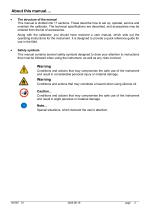
About this manual…. The structure of the manual This manual is divided into 11 sections. These describe how to set up, operate, service and maintain the calibrator. The technical specifications are described, and accessories may be ordered from the list of accessories. Along with the calibrator, you should have received a user manual, which sets out the operating instructions for the instrument. It is designed to provide a quick reference guide for use in the field. Safety symbols This manual contains several safety symbols designed to draw your attention to instructions that must be followed...
Open the catalog to page 3
Congratulations on choosing an AMETEK JOFRA RTCt Calibrator - a highly efficient and precise instrument designed to meet the highest standards in industrial temperature calibration. We are confident that this calibrator will exceed your expectations with its speed, reliability, and ease of use in on-site applications. Patented and Innovative Calibrator Technology The RTCt series features AMETEK JOFRA’s patented and patent-pending advancements, ensuring the highest accuracy and performance: Patented DLC system – Delivers exceptional temperature uniformity in the calibration zone across all models....
Open the catalog to page 6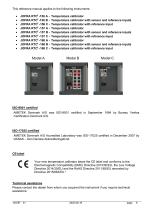
This reference manual applies to the following instruments: Temperature calibrator Temperature calibrator with sensor and reference inputs Temperature calibrator with reference input Temperature calibrator Temperature calibrator with sensor and reference inputs Temperature calibrator with reference input Temperature calibrator Temperature calibrator with sensor and reference inputs Temperature calibrator with reference input AMETEK Denmark A/S was ISO-9001 certified in September 1994 by Bureau Veritas Certification Denmark A/S. AMETEK Denmark A/S Accredited Laboratory was ISO-17025 certified...
Open the catalog to page 7
This instrument is warranted against defects in workmanship, material and design for two (2) years from date of delivery to the extent that AMETEK will, at its sole option, repair or replace the instrument or any part thereof which is defective, provided, however, that this warranty shall not apply to instruments subjected to tampering or, abuse, or exposed to highly corrosive conditions. THIS WARRANTY IS IN LIEU OF ALL OTHER WARRANTIES WHETHER EXPRESS OR IMPLIED AND AMETEK HEREBY DISCLAIMS ALL OTHER WARRANTIES, INCLUDING, WITHOUT LIMITATION, ANY WARRANTY OF FITNESS FOR A PARTICULAR PURPOSE OR...
Open the catalog to page 8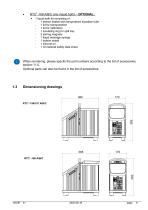
• RTC -168 A/B/C only (liquid bath) - OPTIONAL : • 1 liquid bath kit consisting of : - 1 sensor basket with temperature equalizer tube - 1 insulating ring for spill tray - 1 liquid drainage syringe - 1 oil material safety data sheet When reordering, please specify the part numbers according to the list of accessories, section 11.0. Optional parts can also be found in the list of accessories.
Open the catalog to page 9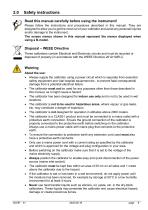
Read this manual carefully before using the instrument! Please follow the instructions and procedures described in this manual. They are designed to allow you to get the most out of your calibrator and avoid any personal injuries and/or damage to the instrument. The screen menus shown in this manual represent the menus displayed when using a B-model. /V-®\ These calibrators contain Electrical and Electronic circuits and must be recycled or disposed of properly (in accordance with the WEEE Directive 2012/19/EU). • Always supply the calibrator using a power circuit which is separate from essential...
Open the catalog to page 10
• The calibrator must be switched off before any attempt to service the instrument is made. There are no user serviceable parts inside the calibrator. • When cleaning the well or the insertion tube, REMEMBER to wear goggles when using compressed air in the dry-block calibrator and cleaning oil in the liquid bath calibrator. • Remember to use appropriate protective equipment or get help when carrying the calibrator (for a longer distance) to prevent injuries from dropping the calibrator. About the front panel: • For B and C models only, the sockets on the input module must NEVER be connected to...
Open the catalog to page 11
By reducing the "Max. SET-temperature allowed”, the calibrator cannot be used outside this temperature range. Be aware of the flash point, the boiling point and other liquid properties applicable to the usage when setting the Max. SET-temperature. Read the MSDS (Material Safety Data Sheet) of the liquid before use. The Max. SET-temperature must never exceed liquid flash point -40°C. • Always remove the liquid from the calibrator before transportation. • Product information on the liquid must be carefully investigated before use. • Do not pour water or any other liquids into a bath filled with...
Open the catalog to page 12
Remove the insulation plug while heating up. It is very important that humidity in the well and insertion tube is removed to prevent corrosion and frost expansion damages. • Do not use the instrument if the internal fan is out of order. • Before cleaning the calibrator, you must switch it off, allow it to cool down and remove all cables. • Always place power cables and cables for attached accessories, such as sensors, in a safe way to reduce the risk of tripping. • When transporting (carrying) the calibrator, be extra careful not to drop it on other materials, equipment, and body parts. • Ensure...
Open the catalog to page 13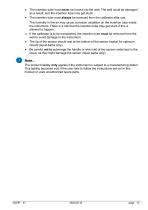
• The insertion tube must never be forced into the well. The well could be damaged as a result, and the insertion tube may get stuck. • The insertion tube must always be removed from the calibrator after use. The humidity in the air may cause corrosion oxidation on the insertion tube inside the instrument. There is a risk that the insertion tube may get stuck if this is allowed to happen. • If the calibrator is to be transported, the insertion tube must be removed from the well to avoid damage to the instrument. • The tip of the sensor should rest at the bottom of the sensor basket for optimum...
Open the catalog to page 14All Ametek Calibration catalogs and technical brochures
 Type T Deadweight Tester
8 Pages
 ATMi Temperature Module
7 Pages
 XP2i Data Recorder
6 Pages
 Temperature Pressure Process
12 Pages
 AMETEK Calibration Brochure
12 Pages
 Maritime Brochure
8 Pages
 CPF Brochure (D)
4 Pages
 APM Advanced Pressure Module
6 Pages
 Product Overview Brochure
8 Pages
 GaugeCalHP Manual
20 Pages
 24 VDC Power Supply Manual
7 Pages
 24 VDC Power Supply
4 Pages
 FastCalXP
9 Pages











- AMETEK temperature sensor
- Management software solution
- Automation software solution
- Data logger
- AMETEK resistance temperature sensor
- Process software
- AMETEK pressure gauge
- Real-time software
- AMETEK Windows software
- Cloud-based software
- Control software
- Digital indicator
- Analog pressure gauge
- Industrial software
- AMETEK measurement software
- Interface software
- Pt100 temperature transducer
- Data-logger with screen