
- Catalogs
- Ametek Calibration
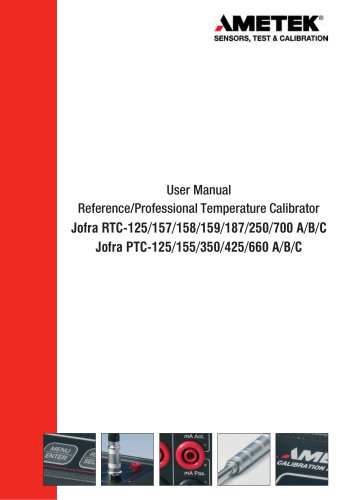
- RTC 168 Series Temperature Calibrator Datasheet

- Products
- Catalogs
- News & Trends
- Exhibitions
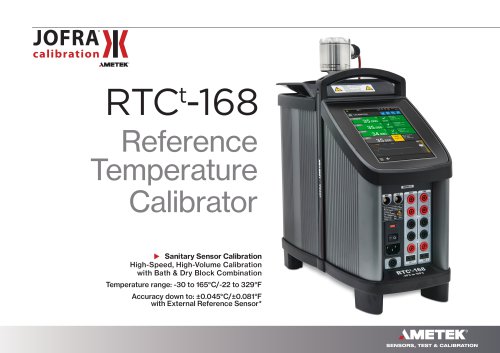
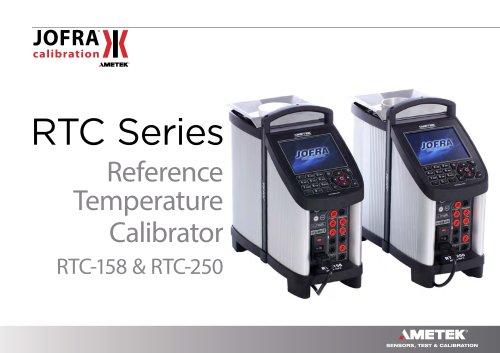
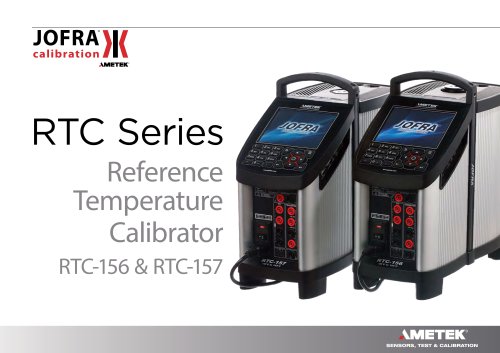
RTC 168 Series Temperature Calibrator Datasheet
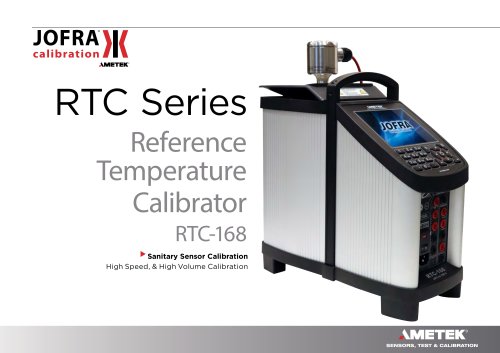
RTC 168 Series Temperature Calibrator Datasheet
- New Liquid Calibration System: Redesigned for extended temperature uniformity, suitable for shorter sanitary sensors.
- Support for Large Flanges: Calibrates sanitary sensors up to 84 mm in diameter.
- Removable Liquid Container: Facilitates easy switching between wet and dry calibration modes without cleaning.
- Quick Portability: Includes a screw-on lid with a pressure relief valve for safe transport.
- Special Sanitary Sensor Dry-Block Insert: Designed for short sensors with adapters for different models.
- Unique Airflow System: Reversed airflow protects sensors from heated exhaust air.
- New IP68 Reference Sensor: Compatible with both dry and wet applications, eliminating the need for a protection tube.
- Fast Heating Time: Heats from -22°C to 155°C over twice as fast as previous models.
The RTC-168 addresses challenges in calibrating sanitary sensors, especially in pharmaceutical and food industries, with a longer uniformity zone and special insert for accurate calibration.
Patent-pending technique isolates liquid in the main block, removing traditional error sources, and handles sensors up to 84 mm in diameter.
Features dual-zone technology and a custom insert for sanitary sensors, combining external and internal reference sensors for consistent calibration.
- Large Upper Surface: Accommodates sensor flanges up to 84 mm.
- Deep Well: 160 mm deep with a 63.5 mm diameter for calibrating multiple sensors simultaneously.
- Insert Adapter: Allows reuse of existing inserts from previous models, saving costs.
- Liquid Calibration: No need for inserts, suitable for various sensor types.
- Dry Calibration: No hazardous liquids, easier handling, and 100% repeatability.
- Combined System: Flexibility to switch between liquid and dry modes quickly.
Enhances dual-zone technology by controlling temperature homogeneity inside the insert, ensuring high accuracy calibration regardless of sensor load.
The RTC Series offers high accuracy with homogeneous zones and intelligent reference sensors. The user interface features a full-color display for ease of use.
The RTC temperature calibrator offers a user-friendly interface with large, easy-to-read digits and multilingual support. Key features include intelligent recalibration information, automatic temperature adjustment, thermoswitch testing, auto-stepping for temperature routines, customizable stability indicators, stored set-ups, and temperature limits to protect sensors.
The RTC series enhances usability with fast temperature calibration, MVI for stable temperature despite power fluctuations, automatic sensor reading, and silent operation for shared spaces.
Accessories include a specially designed carrying case, multi-hole inserts for various sensor sizes, and an integrated support rod. Supporting products like JofraCal calibration software and the JOFRA ASM scanner facilitate efficient calibration processes.
Functional Specifications: Temperature range varies with ambient conditions, with accuracy and stability specifications provided for different models and configurations.
Physical Specifications: The calibrator weighs 10.9 kg and measures 366 x 171 x 363 mm. Shipping weights and dimensions vary with packaging options.
Input Specifications: Detailed accuracy and range specifications for RTD, DLC, and thermocouple inputs are provided, along with transmitter supply and switch input details.
Mains and Communication: The calibrator supports various voltage and frequency inputs, with USB and Ethernet interfaces for data communication.
Catalog excerpts
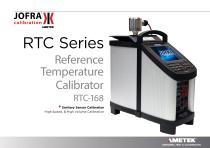
^ Sanitary Sensor Calibration High Speed, & High Volume Calibration VMETEK SENSORS, TEST & CALIBRATION
Open the catalog to page 1
Your Sanitary Sensor Solution One of the technicians' most challenging calibration jobs is the awkward sanitary sensors used predominately in the pharmaceutical and food and beverage industries. To accurately calibrate these sensors, the technician must place the sensing element in the uniform zone of the temperature calibrator. However, correctly placing the sensing element is often difficult due to the small length of the sanitary sensor or the New Liquid Calibration System: A redesigned liquid calibration system and a faster magnetic stirrer result in a longer temperature uniformity zone....
Open the catalog to page 2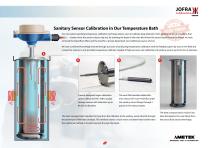
Sanitary Sensor Calibration in Our Temperature Bath Our new patent-pending temperature calibration technique allows users to calibrate large diameter, short sanitary sensors in situations that closely mirror the sensor’s day-to-day use. By isolating the liquid in the main block from the excess liquid around the flange, we have removed the liquid flow effect and the need for a precise liquid level, two traditional sources of error. We have combined knowledge learned through our years of producing temperature calibrators with the feedback given by users in the field and created the industry’s only...
Open the catalog to page 3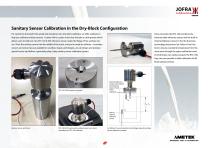
Sanitary Sensor Calibration in the Dry-Block Configuration For customers that prefer the speed and cleanliness of a dry-block calibrator, we offer solutions to Once mounted, the RTC-168 combines the help you calibrate sanitary sensors. It starts with a custom insert that includes a cable groove which external cable reference sensor and the built-in allows users to slide our new STS-102 A 035 reference sensor under the flange of the sanitary sen- internal reference sensor to fuel its dual-zone sor. Place the sanitary sensor into the middle of the insert, and you’re ready to calibrate. As sanitary...
Open the catalog to page 4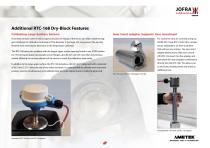
Additional RTC-168 Dry-Block Features Calibrating Large Sanitary Sensors New Insert Adapter Supports Your Investment As sanitary sensors come in many shapes and sizes, the flange of the sensor can often create the big- For customers who are currently using our gest challenge for calibration technicians. If the diameter is too large, this may prevent the sensing JOFRA ATC-156 & RTC-156 for their sanitary element from reaching the ideal zone in the temperature calibrator. sensor calibrations, we have a solution that will save you money. Our new insert The RTC-168 solves this problem with the largest...
Open the catalog to page 5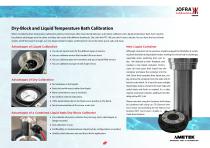
Dry-Block and Liquid Temperature Bath Calibration When considering their temperature calibration options, technicians often must decide between a dry-block calibrator and a liquid temperature bath. Each solution has distinct advantages over the other, and they also come with different drawbacks. But, with the RTC-168, you don't have to decide. You can have the best of both worlds. And if that wasn't enough, our new liquid container makes switching from one to the other quick, safe, and clean. Advantages of Liquid Calibration ■ You do not need inserts for the different types of sensors. ■ You...
Open the catalog to page 6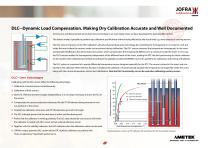
DLC—Dynamic Load Compensation. Making Dry Calibration Accurate and Well Documented DLC To bring our well documented active dual-zone technology to an even higher level, we have developed the patented DLC system. This feature makes it possible to perform top calibration specifications without being affected by the actual load, e.g. many sensors or very big sensors. The DLC sensor improves on the RTC calibrator’s already advanced dual-zone technology by controlling the homogeneity in not only the well, but inside the insert where the sensors-under-test are placed during calibration. The DLC sensor...
Open the catalog to page 7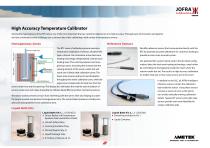
High Accuracy Temperature Calibrator Among the many features of the RTC Series, one of the most important that our customers depend on is its high accuracy. Through years of innovation and patents, we have continued to solve challenges our customers face when calibrating a wide variety of temperature sensors. Homogeneous Zones Reference Sensors Upper Zone We offer reference sensors that communicate directly with the temperature calibration of sensors, whatever the RTC to automate accurate calibrations for customers looking to type or format. Our innovative active dual-zone provide an even more...
Open the catalog to page 8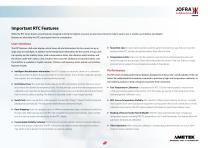
Important RTC Features While the RTC Series boasts several features designed to bring the highest accuracy, we also have strived to make it easy to use. A simple user interface and helpful features are what help the RTC stand apart from the competition. User Interface Stored Set-Ups: For users who routinely reuse the same instrument set-ups, they can store the The RTC features a full-color display, which shows all vital information for the current set-up in setting in their RTC, so they can quickly retrieve them the next time. large, easy-to-read digits. In addition to the temperature information...
Open the catalog to page 9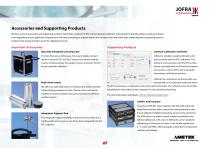
Accessories and Supporting Products We have a line of accessories and supporting products that further enhance the RTC-168 temperature calibrator. These products provide options to pick and choose from depending on your application requirements. We have something to support almost any situation, from items that make calibrating and transporting easier to products that change and document the calibration process. Important Accessories Supporting Products Specially Designed Carrying Case JofraCal Calibration Software It's more than just a rolling case. Our case includes compart- JofraCal is a highly...
Open the catalog to page 10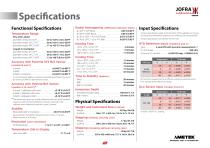
Specifications Functional Specifications Temperature Range Dry and Liquid @ ambient temp. 0°C / 32°F. . . . . . . . . . . -30 to 165°C/-22 to 329°F @ ambient temp. 23°C / 73°F . . . . . . . . . -30 to 165°C/-22 to 329°F @ ambient temp. 40°C / 104°F. . . . . . . . -17 to 165°C/1.4 to 329°F Liquid in Container @ ambient temp. 0°C / 32°F. . . . . . . . . . . -30 to 160°C/-22 to 320°F @ ambient temp. 23°C / 73°F . . . . . . . . . -26 to 160°C/-15 to 320°F @ ambient temp. 40°C / 104°F. . . . . . . . -13 to 160°C/8.6 to 320°F Accuracy with External STS Ref. Sensor (models B and C) In Insert. . . ....
Open the catalog to page 11All Ametek Calibration catalogs and technical brochures
 Type T Deadweight Tester
8 Pages
 ATMi Temperature Module
7 Pages
 XP2i Data Recorder
6 Pages
 Temperature Pressure Process
12 Pages
 AMETEK Calibration Brochure
12 Pages
 Maritime Brochure
8 Pages
 CPF Brochure (D)
4 Pages
 APM Advanced Pressure Module
6 Pages
 Product Overview Brochure
8 Pages
 GaugeCalHP Manual
20 Pages
 24 VDC Power Supply Manual
7 Pages
 24 VDC Power Supply
4 Pages
 FastCalXP
9 Pages











- Management software solution
- Automation software solution
- Data logger
- AMETEK resistance temperature sensor
- Process software
- AMETEK pressure gauge
- Real-time software
- AMETEK Windows software
- Cloud-based software
- Control software
- Digital indicator
- Analog pressure gauge
- Industrial software
- AMETEK measurement software
- Interface software
- Pt100 temperature transducer
- Data-logger with screen