
- Catalogs
- Ametek Calibration
- RTC 159 Series Temperature Calibrator Datasheet

- Products
- Catalogs
- News & Trends
- Exhibitions
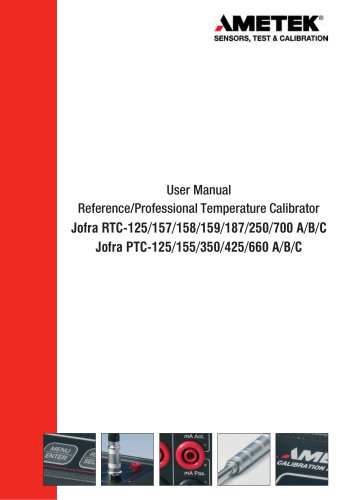
RTC 159 Series Temperature Calibrator Datasheet
RTC 159 Series Temperature Calibrator Datasheet
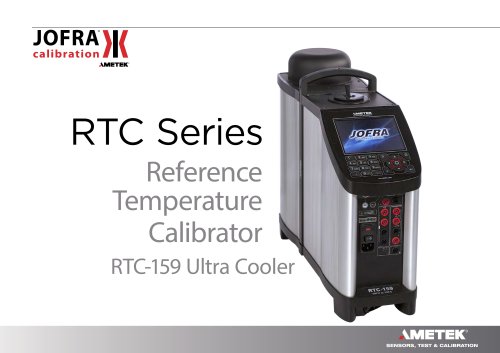
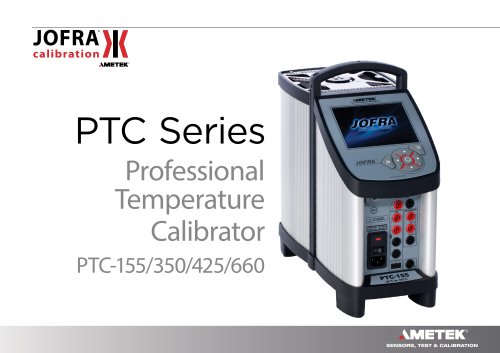
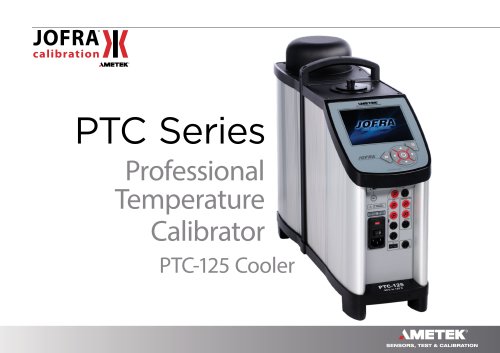
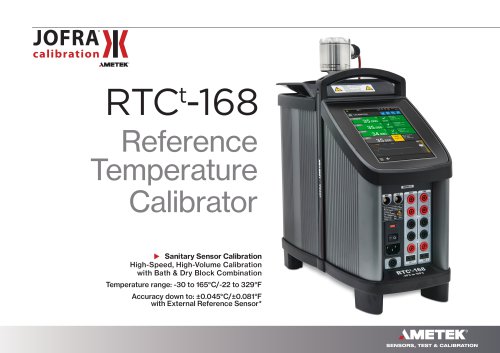
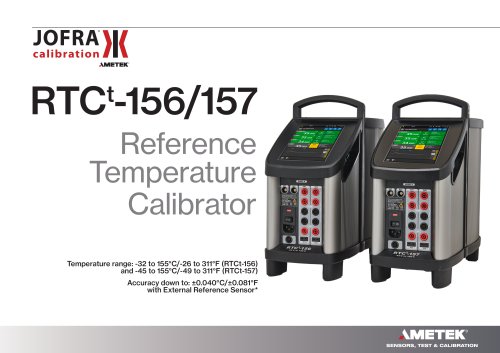
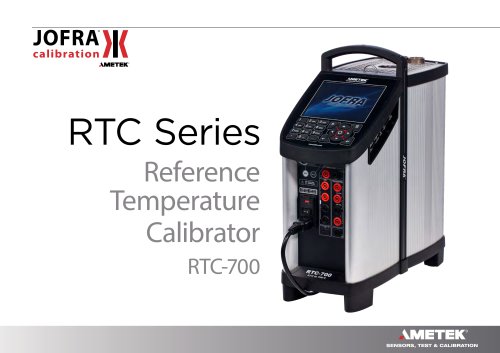
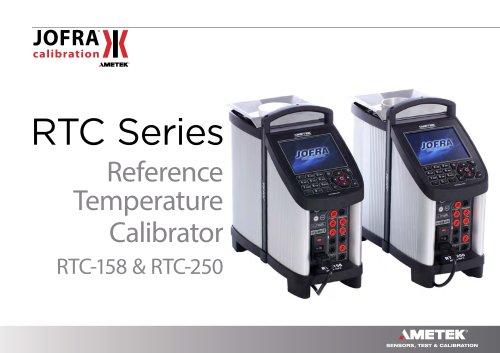
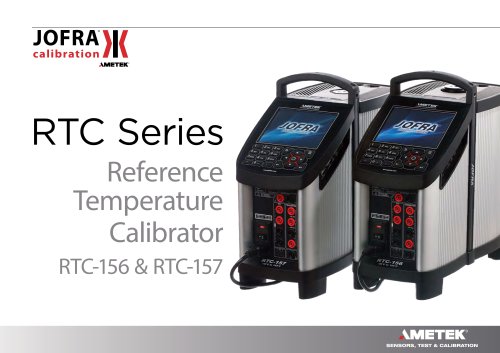
The JOFRA RTC-159 is a high-performance dry-block temperature calibrator suitable for industries like healthcare, pharmaceuticals, biotechnology, and food. It is part of the JOFRA RTC family, covering a temperature range from -100 to 700°C (-148 to 1292°F).
The RTC-159 offers a wide temperature range, user-friendly interface, ergonomic design, and mechanical stability. It is available in three models: RTC-A, RTC-B, and RTC-C, each with different sensor input capabilities.
- High accuracy and stability with ±0.06°C (±0.11°F) accuracy and ±0.03°C (±0.05°F) stability.
- Dynamic Load Compensation (DLC) for uniform temperature distribution, especially in models B and C.
- Fast calibration with Free Piston Stirling Cooler (FPSC) technology.
- Intelligent reference sensors with plug-and-play calibration.
- Lightweight design at 15.2 kg (33.5 lb) for portability.
- USB communication for easy data transfer and firmware updates.
The RTC-159 features DLC technology for enhanced temperature homogeneity, suitable for calibrating multiple or large sensors. The DLC system ensures minimal temperature differences within the insert, adhering to EURAMET guidelines.
The RTC series uses active dual-zone heating technology for precise temperature calibration, similar to laboratory liquid baths, without needing extra insulation for sensors.
Equipped with USB and LAN/Ethernet connections, the RTC-159 supports easy communication and future firmware upgrades.
The STS-200 and DLC sensors are designed for easy integration and error-free calibration, supporting a fail-safe plug-and-play system.
The RTC-159 is designed for easy transport with a special carrying case that protects all components and accessories.
Utilizes FPSC technology for efficient cooling, outperforming traditional Peltier coolers.
Increased heating and cooling speeds reduce downtime and calibration costs.
Special kits accommodate various sensor sizes, reducing the need for multiple inserts.
The 5.7" color VGA display provides clear, menu-driven navigation with essential information always visible.
- Integrated support rod for reduced weight.
- MVI for stable temperature control despite power fluctuations.
- High accuracy with external reference sensors (models B & C).
- SET-Follows-TRUE feature for precise temperature matching (models B & C).
- Auto-stepping and enhanced stability indicators for efficient calibration.
- Instrument setups for storing calibration configurations.
- Maximum and minimum temperature settings to prevent sensor damage.
- IRI for monitoring calibration certificate expiry dates.
The document outlines the calibration features of the JofraCal software and RTC calibrators, highlighting the ability to perform As Found/As Left calibrations and integration with various temperature and pressure sensors. The software allows for manual data entry and storage for later analysis and can operate independently without a PC on-site.
JofraCal is versatile software for calibrating temperature sensors, pressure gauges, and switches. It integrates with Jofra instruments and supports manual calibrations. Calibration data can be stored on a PC and exported in various formats for further processing.
The software requires a minimum of an Intel 486 processor, 32 MB RAM, and 80 MB of free disk space. A VGA compatible screen is necessary, with higher specifications recommended for optimal performance.
Temperature Range and Accuracy: The calibrators operate within a temperature range of -100 to 155°C, with varying accuracy depending on the sensor type.
Stability and Homogeneity: Stability is ±0.03°C, and radial homogeneity is 0.01°C.
Heating and Cooling Times: Detailed times are provided for various temperature transitions.
The document details input specifications for RTD and thermocouple sensors, including accuracy and full-scale ranges. It also covers transmitter supply and input specifications for voltage and current.
The calibrators have specific operating and storage temperature ranges, humidity tolerance, and protection class. Physical dimensions and weight are provided for both the instrument and shipping configurations.
Various predrilled and undrilled inserts are available, with specific codes for ordering. Accessories include sensor grips, connectors, and thermocouple plugs.
Models A, B, and C are compared based on features like dual-zone heating, USB communication, and external sensor inputs. Each model includes specific accessories and certificates.
The document outlines the specifications for a calibration device, including load compensation functionality, inputs for RTD, TC, V, mA, and a 4-20 mA transmitter input with a 24 VDC supply. All inputs are scalable to temperature, with an automatic switch test feature. The device supports downloading calibration work orders from a PC and uploading calibration results.
The device operates within a temperature range of -100 to 155°C (-148 to 311°F). It uses differential TC and PT100 as sensing elements. The dimensions for the differential TC are a diameter of 3 mm and a length of 196 mm, while the PT100 has options for diameters of 4 mm or 6.35 mm and a length of 192 mm.
The standard delivery includes a DLC-159, a plastic protection case, an accredited certificate, and a USB key with JofraCal and manual. For the STS-200 A/B Sensor, it includes a plastic protection case, an accredited certificate, a cable, and a USB key with JofraCal and manual.
The base model number is RTC159, with options for dynamic load compensation (DLC) and various power supply configurations (115 VAC, 230 VAC). Model versions include basic (A), full (B), and middle (C) models, with optional accessories like a solid protective carrying case with trolley and support rod set.
Optional STS reference sensors are available for B and C models. Calibration certificates include options for accredited certificates and full EURAMET accredited certificates, with system calibration available for B and C models.
The document provides contact details for various AMETEK locations worldwide, including the USA, India, Singapore, China, the UK, France, Germany, and Denmark.
The document is protected by copyright and cannot be reproduced or modified without permission from JOFRA.
Catalog excerpts
SENSORS, TEST & CALIBRATION
Open the catalog to page 1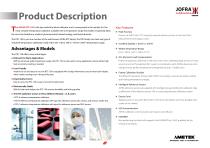
The JOFRA RTC-159 is the top model dry-block calibrator, and is unsurpassed in the market. It is the most versatile temperature calibrator available with a temperature range that makes it especially ideal for use in the healthcare, medical, pharmaceutical, biotechnology, and food industries. The RTC-159 is just one member of the well-known JOFRA RTC family. The RTC family can meet any type of industrial temperature calibration need within the -100 to 700°C (-148 to 1292°F) temperature range. The RTC-159 offers many advantages: ■ Relevant for Many Applications With its extremely wide temperature...
Open the catalog to page 2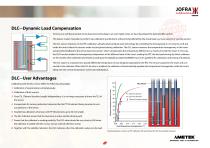
DLC–Dynamic Load Compensation DLC To bring our well documented active dual-zone technology to an even higher level, we have developed the patented DLC system. This feature makes it possible to perform top calibration specifications without being affected by the actual load, e.g. many sensors or very big sensors. The DLC sensor improves on the RTC calibrator’s already advanced dual-zone technology by controlling the homogeneity in not only the well, but inside the insert where the sensors-under-test are placed during calibration. The DLC sensor measures the temperature homogeneity in the insert...
Open the catalog to page 3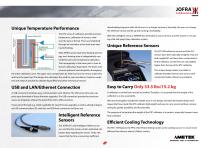
Unique Temperature Performance Upper Zone the reference sensor and be up and running immediately. The RTC series of calibrators provide precision With the intelligent sensors, AMETEK has eliminated a source of error, and the system is now giv- temperature calibration of sensors, what- ing a fail-safe plug’n’play calibration system. ever the type or format. This is accomplished Unique Reference Sensors through an innovative active dual-zone heatTemperature Difference Main Zone downloading sequence with risk of errors is no longer necessary. Secondly, the user can change With JOFRA’s active dual-zone...
Open the catalog to page 4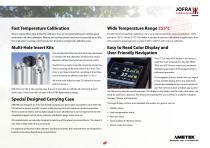
Fast Temperature Calibration Wide Temperature Range 255°C Time is money! This is why all the RTC calibrators have an increased heating and cooling speed The RTC Series can perform calibration over a very wide temperature range starting from -100°C compared to all other calibrators. Heating and cooling speeds have been increased by up to 20%. and up to 155°C (-148 to 311°F). This makes it possible to perform calibrations in applications from The implication is savings in both production downtime and general calibration costs. ultra-coolers to autoclaves over a range of 255° C (360° F) with only...
Open the catalog to page 5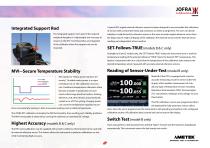
Set Temperature Calibration Switch test Autostep IMOOft'C MAX) 100*44*C MUX lOOMMtg WIKM lOOOWCj Integrated Support Rod The integrated support rod is part of the reduced weight philosophy. It is lightweight and very easy to mount on the RTC. Two fixing holes are integrated in the calibrator where the support rods can be mounted. MVI stands for ''Mains power Variance Immunity". Unstable mains power is a major contributor to on-site calibration inaccuracies. Traditional temperature calibrators often become unstable in production environments where large electrical motors, heating elements, and...
Open the catalog to page 6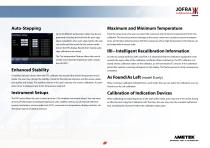
Maximum and Minimum Temperature Up to 20 different temperature steps may be pro- From the setup menu, the user can select the maximum and minimum temperature limit for the grammed including the hold time for each step. calibrator. This function prevents damage to the sensor-under-test caused by excessive tempera- Upon completion of an auto-step routine, the user tures, and it helps reducing sensor drift from exposures of too high temperatures. This feature can can easily read the results for the sensor-under- be locked with an access code. test on the RTC display. Results from twenty autostep...
Open the catalog to page 7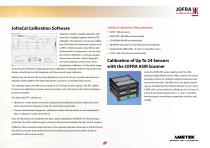
JofraCal Calibration Software JofraCal is a highly versatile calibration software that is supplied together with the RTC calibrators. The software ensures easy calibration of all kinds of temperature sensors, such as RTD's, thermocouples, transmitters, and thermoswithes. Furthermore, it can be used for pressure calibration i.e. pressure gauges and pressure switches. JofraCal integrates with Jofra calibration instruments. As for temperature calibrators, it is the whole range of temperature calibrators. Regarding pressure calibrators, it integrates with the Crystal XP2i and nVision. JofraCal also...
Open the catalog to page 8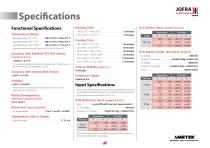
Specifications Functional Specifications Temperature Range @ ambient temp. 0°C / 32°F. . . . . . . . -100 to 155°C/-148 to 311°F @ ambient temp. 23°C / 73°F . . . . . . -100 to 155°C/-148 to 311°F Heating Time DLC Sensor Input (models B and C) Cooling Time 155 to 23°C / 311 to 73°F. . . . . . . . . . . . . . . . . . . . . . . . . . . . 40 minutes Patented heating technology: Patent No. EP2074374/US8342742 (models B and C) ± 0.06°C / ± 0.11°F 12-month period. Relative to reference standard. Specifications by use of the external JOFRA STS-200 reference sensor Immersion Depth ± 0.03°C / ± 0.054°F...
Open the catalog to page 9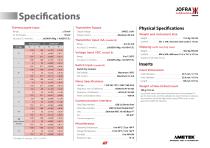
Specifications Thermocouple Input Transmitter Supply Output Current. . . . . . . . . . . . . . . . . . . . . . . . . . . . . . . Maximum 28 mA Accuracy (12 months) . . . . . . . . . . . ±(0.005% Rdg. + 0.005% F.S.) Temperature TC Type E Transmitter Input mA (model B) Range . . . . . . . . . . . . . . . . . . . . . . . . . . . . . . . . . . . . . . . . . . . . . . 0 to 24 mA Accuracy (12 months). . . . . . . . . . . . ±(0.005% Rdg. +0.010% F.S.) Voltage Input VDC (model B) Test Voltage. . . . . . . . . . . . . . . . . . . . . . . . . . . . . . . . . . . Maximum 5 VDC Test Current. . . . . . ....
Open the catalog to page 10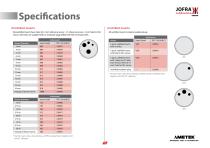
Predrilled Inserts All predrilled inserts have holes for: 4 mm reference sensor • A" reference sensor • 3 mm hole for DLC sensor. All inserts are supplied with an insulation plug drilled with the necessary holes. Undrilled Inserts All undrilled inserts include insulation plugs. * Use the insert code, when ordering a JOFRA standard undrilled insert together with the RTC calibrator. Use the insert code, when ordering a JOFRA standard insert together with the RTC calibrator. inf AMETEK* SENSORS, TEST & CALIBRATION
Open the catalog to page 11All Ametek Calibration catalogs and technical brochures
 Type T Deadweight Tester
8 Pages
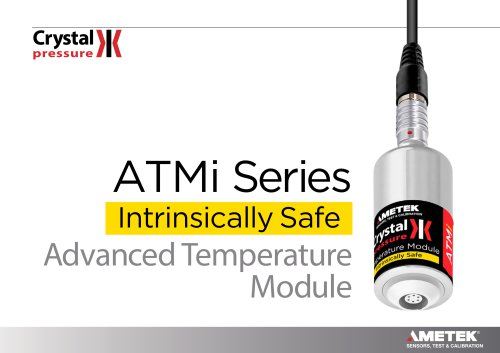 ATMi Temperature Module
7 Pages
 XP2i Data Recorder
6 Pages
 Temperature Pressure Process
12 Pages
 AMETEK Calibration Brochure
12 Pages
 Maritime Brochure
8 Pages
 CPF Brochure (D)
4 Pages
 APM Advanced Pressure Module
6 Pages
 Product Overview Brochure
8 Pages
 GaugeCalHP Manual
20 Pages
 24 VDC Power Supply Manual
7 Pages
 24 VDC Power Supply
4 Pages
 FastCalXP
9 Pages











- Management software solution
- Automation software solution
- Data logger
- AMETEK resistance temperature sensor
- Process software
- Real-time software
- AMETEK Windows software
- Cloud-based software
- Control software
- Digital indicator
- Analog pressure gauge
- Industrial software
- AMETEK measurement software
- Interface software
- Pt100 temperature transducer
- Data-logger with screen