
- Catalogs
- Ametek Calibration
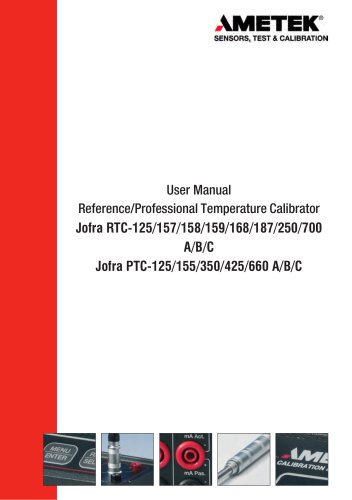
- PTC Temperature Calibrator Reference Manual

- Products
- Catalogs
- News & Trends
- Exhibitions
PTC Temperature Calibrator Reference Manual
PTC Temperature Calibrator Reference Manual
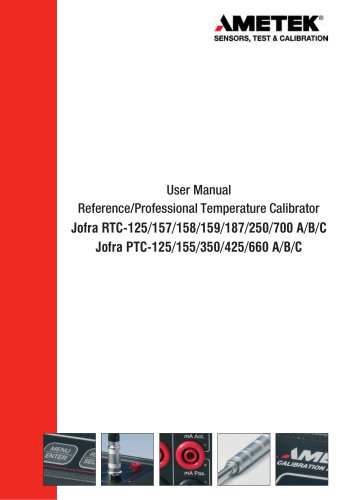
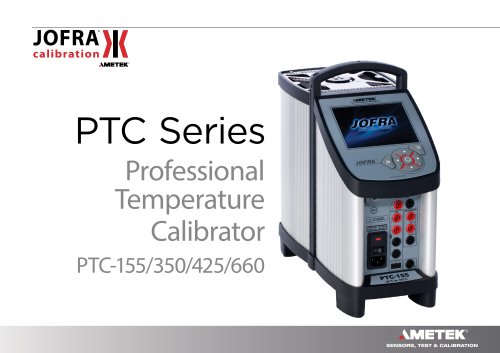
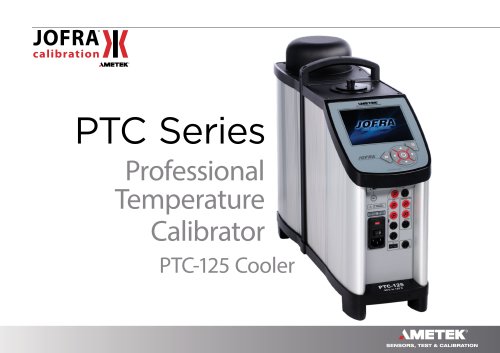
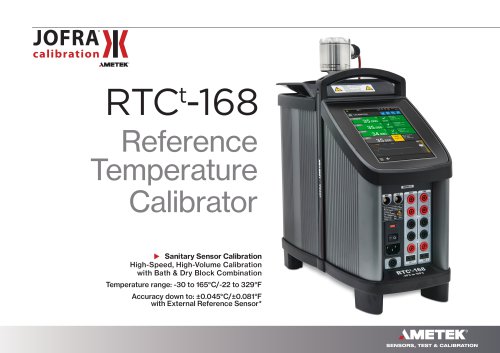
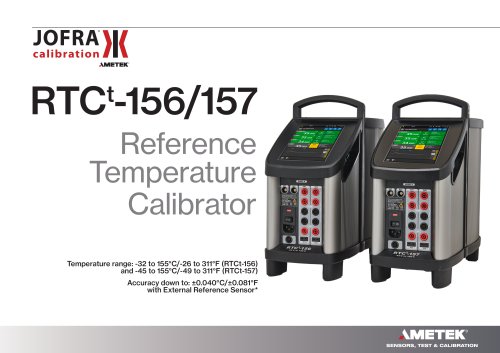
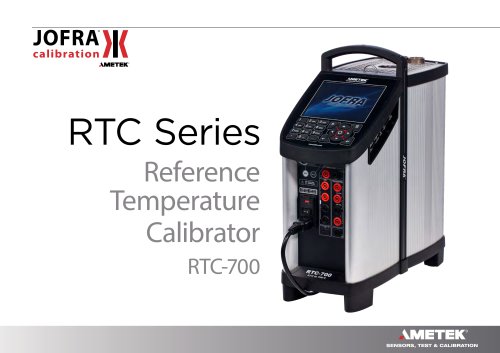
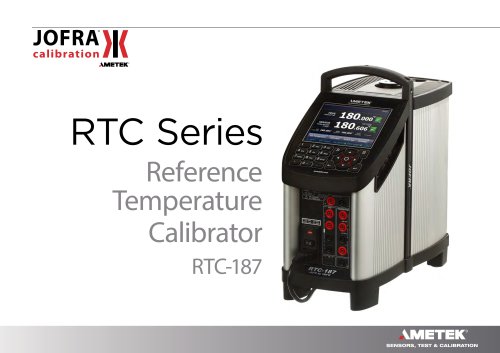
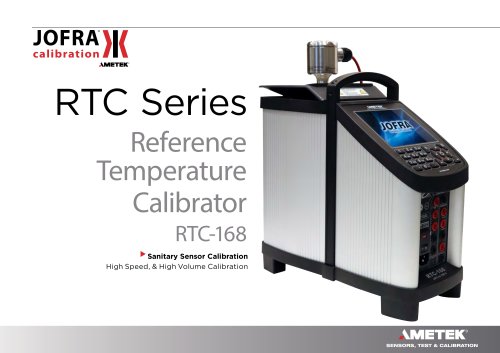
The AMETEK JOFRA PTC Calibrator is a professional temperature calibration instrument designed for industrial use, available in models PTC-125, PTC-155, PTC-350, PTC-425, and PTC-660 with configurations A, B, and C. The manual provides guidance on setup, operation, and maintenance.
The calibrator includes a two-year warranty covering defects in workmanship, material, and design, excluding damage from tampering, abuse, or corrosive conditions.
Upon receipt, verify the contents against the provided list, including the calibrator, USB memory stick, and test leads. Report discrepancies to the dealer.
Safety symbols highlight important instructions and potential risks. Adherence to these guidelines is crucial for safe operation.
Instructions cover preparing the dry-block calibrator, selecting insertion tubes, and programming sensors for accurate calibration.
Details on standard connections, input modules, and operation of the keyboard and display are provided, including menu navigation and temperature setting procedures.
Sections cover running calibrations, viewing results, and conducting switch tests, with an auto step menu for automated sequences.
Guidance on cleaning, adjusting, and calibrating the instrument, maintaining the STS-reference sensor, and testing the overtemperature function is provided.
Detailed technical specifications for each model are included to ensure effective use.
A list of available accessories and standard insertion tubes is provided to enhance functionality.
Components included with different versions of the calibrator, such as heat shields and calibration certificates, are outlined.
Drawings for various models are referenced for precise measurements and compatibility with accessories.
Key safety points include using the calibrator as described, ensuring proper electrical connections, and adhering to temperature limits.
Instructions include placing the calibrator on a stable surface, ensuring ventilation, and connecting to a grounded power source.
Guidelines emphasize using JOFRA insertion tubes, heating new tubes before use, and ensuring proper fit.
Instructions stress keeping the well and tubes clean, avoiding heat transfer fluids, and handling hot surfaces with care.
Ensure all water has evaporated before removing the insulation plug to prevent corrosion and frost damage.
Use the CON050 configuration software to program and update calibration information in intelligent sensors.
Includes standard connections, input modules, keyboard and display operation, and setting temperatures.
Run calibrations by selecting a workorder, ensuring the correct reference sensor is specified.
Details steps for storing calibration data, setting temperatures, and handling manual readings.
Results can be saved or discarded, with options to upload to a PC for printing certificates.
Describes how to view and manage workorders, including accessing notes and scenarios.
Specific to B versions, involves locating switch temperatures of a thermostat.
Automates calibration across a range of temperatures, with results stored in memory.
Allows configuration of sensor parameters, including stability time and reference sensor settings.
Includes specifications for setting stability tolerance, stability time, and sensor types.
Outlines methods for cold junction compensation using thermocouples.
Users can set minimum and maximum current and corresponding temperature span.
For RTD sensors, users can select between 2, 3, or 4 wires.
Stability checks can be performed on both the reference sensor and the sensor under test.
Calibration data for the Intelligent Reference sensor can be accessed via the Reference Info function.
Users can configure temperature units, set min/max temperatures, and protect settings with an access code.
Sound can be toggled on/off with adjustable volume for feedback.
Users can set recalibration intervals between 1 and 99 months.
The default language is English, with options for other languages.
Users can save and load up to 10 setups, with factory defaults restorable.
Network settings can be configured with DHCP or manually.
Status summaries and calibrator information are accessible.
Used for training, simulates heating/cooling without actual temperature changes.
Guidelines for safe storage and transport include cooling the calibrator below 50°C/122°F.
Instructions for replacing main fuses are provided.
A list of error messages with solutions is included.
Error codes are identified, advising users to report to service departments.
Include a completed service information form and use original packaging.
Cleaning involves switching off the calibrator and removing cables.
Annual calibration by AMETEK or an accredited lab is recommended.
Specifications for dry-block and cooling calibrators are provided.
Users must decontaminate the calibrator if exposed to hazardous substances.
Technical specifications for various PTC models are provided, including mechanical, power, communication, environmental, readout, and thermal specifications.
Dimensions, weight, and shipping details are provided for each model.
All models operate on a line voltage of 90-127VAC or 180-254VAC.
Devices are equipped with USB A, USB B, and RJ45 connections.
Operating temperature range is 0-40°C, with a storage range of -20-50°C.
Resolution for temperature readings is 0.01°C, 0.01°F, or 0.01 K.
Each model has specific maximum and minimum temperature capabilities.
Includes long-term drift, calibration accuracy, and stability.
Comprehensive specifications ensure users can select the appropriate device based on calibration needs.
Compliance with EMC Directive and Low Voltage Directive is outlined.
Patented technologies include heating and fast cooling technologies.
Details input specifications for mA, thermocouple, RTD, switch test, and reference inputs.
A comprehensive list of accessories is provided with specific part numbers.
Specifications for various reference probes are provided.
Use JOFRA insertion tubes for optimal performance.
AMETEK provides contact details for various regions.
Catalog excerpts
AMETEK SENSORS, TEST & CALIBRATION Reference Manual Professional Temperature Calibrator
Open the catalog to page 1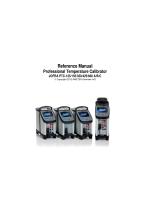
Reference Manual Professional Temperature Calibrator JOFRA PTC-125/155/350/425/660 A/B/C Copyright 2012 AMETEK Denmark A/S
Open the catalog to page 2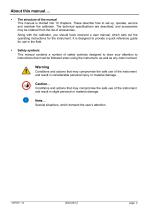
About this manual…. • The structure of the manual This manual is divided into 10 chapters. These describe how to set up, operate, service and maintain the calibrator. The technical specifications are described, and accessories may be ordered from the list of accessories. Along with the calibrator, you should have received a user manual, which sets out the operating instructions for the instrument. It is designed to provide a quick reference guide for use in the field. Safety symbols This manual contains a number of safety symbols designed to draw your attention to instructions that must be followed...
Open the catalog to page 3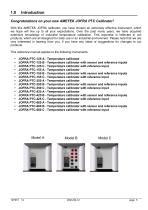
With this AMETEK JOFRA calibrator, you have chosen an extremely effective instrument, which we hope will live up to all your expectations. Over the past many years, we have acquired extensive knowledge of industrial temperature calibration. This expertise is reflected in our products, which are all designed for daily use in an industrial environment. Please note that we are very interested in hearing from you, if you have any ideas or suggestions for changes to our products. This reference manual applies to the following instruments: Temperature calibrator Temperature calibrator with sensor and...
Open the catalog to page 6
ISO-9001 certified AMETEK Denmark A/S was ISO-9001 certified in September 1994 by Bureau Veritas Certification Denmark. CE-labels Your new temperature calibrator bears the CE label and conforms to the Electromagnetic Compatibility (EMC) Directive 2014/30/EU, the Low Voltage Directive 2014/35/EU and the RoHS Directive 2011/65/EU amended by Directive 2015/863/EU.* Technical assistance Please contact the dealer from whom you acquired the instrument if you require technical assistance. * PTC-125 A / PTC-125 B / PTC-125 C from serial no. xxxxxx-00442, PTC-155 A / PTC-155 B / PTC-155 C from serial...
Open the catalog to page 7
This instrument is warranted against defects in workmanship, material and design for two (2) years from date of delivery to the extent that AMETEK will, at its sole option, repair or replace the instrument or any part thereof which is defective, provided, however, that this warranty shall not apply to instruments subjected to tampering or, abuse, or exposed to highly corrosive conditions. THIS WARRANTY IS IN LIEU OF ALL OTHER WARRANTIES WHETHER EXPRESS OR IMPLIED AND AMETEK HEREBY DISCLAIMS ALL OTHER WARRANTIES, INCLUDING, WITHOUT LIMITATION, ANY WARRANTY OF FITNESS FOR A PARTICULAR PURPOSE OR...
Open the catalog to page 8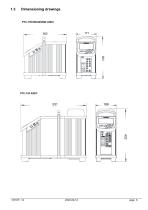
Dimensioning drawings
Open the catalog to page 9
Read this manual carefully before using the instrument! In order to avoid any personal injuries and/or damage to the instrument all safety instructions and warnings must be observed. The screen menus shown in this manual represent the menus displayed when using a B-version. Disposal - WEEE Directive These calibrators contain Electrical and Electronic circuits and must be recycled or disposed of properly (in accordance with the WEEE Directive 2012/19/EU). • Always supply the calibrator using a power circuit which is separate from essential safety equipment and vital hospital equipment etc., to...
Open the catalog to page 10
• The PTC-125 contains R-1270 and R-704 under pressure. The calibrator must under no circumstances be stored at ambient temperatures above 50°C (122°F) or operated at ambient temperatures above 40°C (104°F). Doing so may cause a hazard. • Remember to use appropriate protective equipment or get help when carrying the calibrator (for a longer distance) in order to prevent injuries from dropping the calibrator. About the front panel: • For B and C versions only, the sockets on the input module must NEVER be connected to voltages exceeding 30V with reference to ground. • Thermostats must not be connected...
Open the catalog to page 11
• If the calibrator has reached a température below 0°C/32°F, ice crystals may form on the insertion tube and on the well. This, in turn, may cause the material surfaces to oxidize. To prevent this from happening, the insertion tube and the well must be dried. This is done by heating up the calibrator to min. 100°C/212°F until all water left has evaporated. Remove the insulation plug while heating up. It is very important that humidity in the well and insertion tube is removed to prevent corrosion and frost expansion damages. • Do not use the instrument if the internal fan is out of order. •...
Open the catalog to page 12
• The calibrator must not be used for any purposes other than those described in this manual, as it might cause a hazard. • The calibrator has been designed for indoor use only and is not to be used in wet locations. • The calibrator is not to be used in hazardous areas, where vapour or gas leaks, etc. may constitute a danger of explosion. • The calibrator is not designed for operation in altitudes above 2000 meters. • The calibrator is a CLASS I product and must be connected to a mains outlet with a protective earth connection. Ensure the ground connection of the calibrator is properly connected...
Open the catalog to page 13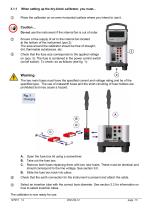
When setting up the dry-block calibrator, you must… Place the calibrator on an even horizontal surface where you intend to use it. Caution… Do not use the instrument if the internal fan is out of order. Ensure a free supply of air to the internal fan located at the bottom of the instrument (pos.2). The area around the calibrator should be free of draught, dirt, flammable substances, etc. Check that the fuse size corresponds to the applied voltage on (pos. 3). The fuse is contained in the power control switch (on/off switch). To check; do as follows (see fig. 1): Warning The two main fuses must...
Open the catalog to page 14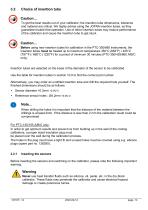
Choice of insertion tube Caution… To get the best results out of your calibrator, the insertion tube dimensions, tolerance and material are critical. We highly advise using the JOFRA insertion tubes, as they guarantee trouble free operation. Use of other insertion tubes may reduce performance of the calibrator and cause the insertion tube to get stuck. Caution… Before using new insertion tubes for calibration in the PTC-350/660 instruments, the insertion tubes must be heated up to maximum temperature 350°C (662°F) / 425°C (797°F) / 660°C (1220°F) for a period of minimum 30 minutes (PTC-350/425/660...
Open the catalog to page 15All Ametek Calibration catalogs and technical brochures
 Type T Deadweight Tester
8 Pages
 ATMi Temperature Module
7 Pages
 XP2i Data Recorder
6 Pages
 Temperature Pressure Process
12 Pages
 AMETEK Calibration Brochure
12 Pages
 Maritime Brochure
8 Pages
 CPF Brochure (D)
4 Pages
 APM Advanced Pressure Module
6 Pages
 Product Overview Brochure
8 Pages
 GaugeCalHP Manual
20 Pages
 24 VDC Power Supply Manual
7 Pages
 24 VDC Power Supply
4 Pages
 FastCalXP
9 Pages












- AMETEK temperature sensor
- Management software solution
- Automation software solution
- Data logger
- AMETEK resistance temperature sensor
- Process software
- AMETEK pressure gauge
- Real-time software
- AMETEK Windows software
- Cloud-based software
- Control software
- Digital indicator
- Analog pressure gauge
- Industrial software
- AMETEK measurement software
- Interface software
- Pt100 temperature transducer
- Data-logger with screen