
- Catalogs
- AMETEK Calibration Instruments
- Industrial Temperature Measurement

Industrial Temperature Measurement

Industrial Temperature Measurement
Temperature measurement is vital in industry and science for maintaining product quality, safety, and energy efficiency. Selecting the right sensor involves balancing user needs with sensor limitations.
The document discusses four temperature scales: Réaumur, Fahrenheit, Celsius, and Kelvin. Kelvin is used scientifically, while Celsius and Fahrenheit are common in industry. Conversion formulas and the evolution of international temperature scales are provided, along with the use of platinum thermometers and thermocouples.
Temperature is defined as the thermodynamic energy content of a medium. Accurate measurement requires thermal equilibrium between the sensor and medium.
Electrical temperature measurement relies on changes in electrical properties due to temperature variations, such as resistance and thermal voltage changes.
The document focuses on thermocouples and resistance thermometers, detailing their principles, types, and industrial applications.
Thermocouples are active sensors that measure temperature differences based on the Seebeck effect. Various types are standardized internationally, each with specific applications and limitations.
Thermocouples cover -200°C to 1800°C, with tolerances classified into three classes. The temperature-voltage relationship is complex, described by high-order polynomials.
These cables connect thermocouples to instruments without introducing errors. Compensation cables are for limited ranges, while extension cables handle broader ranges.
Each thermocouple type has specific applications and limitations based on environmental conditions.
Choosing the right thermocouple depends on measurement environment conditions.
Platinum Resistance Thermometers (PRTs) are preferred for stability and high-temperature performance. Various tolerance classes define permissible deviations. Measuring resistance types include wire-wounded and thin-film resistors, with 4-wire coupling offering the most accuracy.
Resistance thermometers are suitable for -50 to 400°C, requiring high accuracy. Selection criteria include temperature range, corrosion, mechanical influences, and response time.
Material selection depends on the medium, concentration, and temperature. Corrosion tables and alternative materials like Teflon may be used.
Sensors are subject to mechanical influences and pressure conditions, requiring appropriate protective tubes.
Accuracy is determined by norms, with specific tolerances. Calibrated sensors should be used if accuracy is insufficient.
Response time is influenced by sensor dimensions and medium type, with time constants indicating the time to reach temperature changes.
Guidelines are provided for sensor mounting to avoid errors from heat dissipation.
Errors can arise from heat conduction, radiation, and electrical conditions. Practical actions include good insulation and appropriate sensor placement.
Minimizing heat transfer errors involves good insulation and radiation corrections.
Radiation correction is crucial in high-temperature environments to minimize errors.
Accurate data transmission is essential, with methods including direct cable connections and transmitters.
Requires specific compensation cables for thermocouples and recommended configurations for resistance thermometers.
Transmitters convert values for long-distance transmission, with isolation preventing earth currents.
Includes thermal voltage tables based on the ITS 90 scale and resistance tables for Pt100 sensors.
AMETEK Calibration Instruments is a leading manufacturer of calibration instruments, with global contact information provided.
Catalog excerpts

Industrial tempera ture measurement ...because calibration is a matter of confidence AMETEK CALIBRATION INSTRUMENTS
Open the catalog to page 1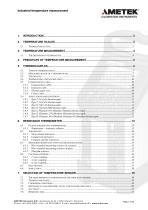
AMETEK Denmark A/S • Gydevang 32-34 • 3450 Allerod • Denmark Phone: +45 4816 8000 • Fax: +45 4816 8080 • E-mail: [email protected] • www.jofra.com
Open the catalog to page 2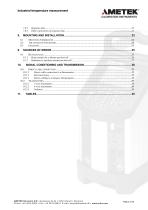
Industrial temperature measurement AMETEK Denmark A/S • Gydevang 32-34 • 3450 Allerød • Denmark Phone: +45 4816 8000 • Fax: +45 4816 8080 • E-mail: [email protected] • www.jofra.com
Open the catalog to page 3
Industrial temperature measurement AMETEK® CALIBRATION INSTRUMENTS 1. INTRODUCTION Temperature is one of the most measured parameters within industry and science. A correct measurement is of great importance to the quality of the product, as well as to security and to energy consumption. Therefore, it is very important to choose the right sensor for the actual application. However, a 100% ideal solution for a measuring job is difficult to find if not to say impossible. The choice will often be a compromise between the requirements of the user and the limitations set by the sensor types that are...
Open the catalog to page 4
Industrial temperature measurement The definition of temperature The temperature of a medium is an expression of its content of thermodynamic energy. The thermodynamic energy represents the average velocity of the unarranged molecular movement in the material. To measure a temperature is therefore different from measuring one of the other basic units. Metres for example can be measured with an inch rule without affecting or changing the length. To measure temperature is different. Actually, the content of thermodynamic energy in the medium should be measured, based on the definition. This is...
Open the catalog to page 5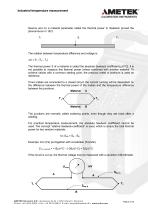
Industrial temperature measurement ference and on a material parameter called the thermal power S. Seebeck proved the phenomenon in 1821. T1 The relation between temperature difference and voltage is ΔU = S ⋅ (T2 – T1) The thermal power S of a material is called the absolute Seebeck coefficient [μV/°C]. It is not possible to measure this thermal power unless combined with another material. To achieve values with a common starting point, the precious metal of platinum is used as reference. If two metals are connected to a closed circuit, the current running will be dependent on the difference...
Open the catalog to page 6
Industrial temperature measurement The thermocouple voltage is: Umeas = ( Smat A – Smat B) ⋅ (T2 – T1) If you want to measure absolute temperature, one soldering point must be kept at a constant temperature. This soldering point is now called the cold junction point, and the other soldering point may be used as temperature sensor. As the ice point of water is fairly easy to realise, 0°C is often used as reference temperature. In tables on thermal voltages, 0°C is always used as reference. For industrial use, this method is not practical. In modern electronic instruments for temperature measuring,...
Open the catalog to page 7
Industrial temperature measurement AMETEK® CALIBRATION INSTRUMENTS 5.1 Types of thermocouples Two metals or alloys welded/joint together form a thermocouple, so the number of possibilities is infinite. It is a serious job to select the proper materials for a thermocouple. The types that for one reason or another are selected are defined very precisely as far as the composition of the alloy is concerned. This, together with the requirements to the accuracy tolerance makes it possible for different manufacturers to produce even complicated alloys completely uniform themselves. The following thermocouples...
Open the catalog to page 8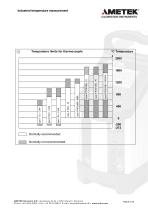
Industrial temperature measurement Temperature limits for thermocouple type N NiCroSil - NiSil type E NiCr - CuNi Normally recommended Normally not recommended AMETEK Denmark A/S • Gydevang 32-34 • 3450 Allerød • Denmark Phone: +45 4816 8000 • Fax: +45 4816 8080 • E-mail: [email protected] • www.jofra.com
Open the catalog to page 9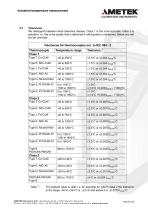
Industrial temperature measurement AMETEK® CALIBRATION INSTRUMENTS 5.3 Tolerances We distinguish between three tolerance classes. Class 1 is the most accurate. Class 2 is standard, i.e. this is the quality that is delivered if nothing else is mentioned. Below you will find an overview. Note 1) : The highest value is valid. I.e. for example for type K class 2 the tolerance AMETEK Denmark A/S • Gydevang 32-34 • 3450 Allerod • Denmark Phone: +45 4816 8000 • Fax: +45 4816 8080 • E-mail:
Open the catalog to page 10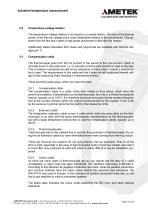
Industrial temperature measurement Temperature-voltage-relation The temperature-voltage-relation is not based on a simple relation. The size of the thermal power or the thermal voltage has a most complicated relation to the temperature. This appears from the fact that it takes a high power polynomial to describe this relation. Additionally tables calculated from these with polynomial are available with thermal voltages per °C. Compensation cable The thermocouple goes from the hot junction in the sensor to the cold junction, which is normally found in the instrument, i.e. in principle a thermo...
Open the catalog to page 11
Industrial temperature measurement AMETEK® CALIBRATION INSTRUMENTS Colour Codes for compensation cables 5.6 Applications and limitations A good knowledge of the conditions under which the measurement shall take place gives the best possibility for choosing the right type of thermocouple. For the thermocouples most often used the following should be observed as to applications and limitations: 5.6.1 Type J. Fe-CuNi thermocouple * Cannot be used below 0°C, because condensation on the Fe-conductor will cause rusting. * Most suitable for reducing atmospheres * May be used up to 500°C as a max. Above...
Open the catalog to page 12
Industrial temperature measurement ∗ In the range from 200 to 500°C a so-called hysteresis effect may occur, i.e. you do not reach the same value in heating and cooling. There may be a difference of up to 5°C. ∗ To be used in neutral or oxidizing atmospheres. ∗ Shows too low temperature after ageing. ∗ Is not recommended to be used in reducing atmospheres. In this case chromium will come out of the NiCr-conductor, the so-called migration. The thermocouple will change thermal voltage and show too low temperature. This error effect is called Green-rot. ∗ Sulphurous atmospheres are poisonous, because...
Open the catalog to page 13All AMETEK Calibration Instruments catalogs and technical brochures
 XP2i Pressure Gauge psi
5 Pages
 PTC-125 Cooler
12 Pages
 MTC 650A Spec Sheet
8 Pages
 MTC 650A - Dry-block
8 Pages
 PTC Series
13 Pages
 mACal - mA Loop Calibrator
5 Pages
 Crystal Pressure Fittings
13 Pages
 CPF
CPF4 Pages
 AMETEK Calibration Brochure
12 Pages
 Sanitary Sensors Brochure
4 Pages
 30 series
4 Pages
 JofraCloud
6 Pages
 nVision Reference Recorder
9 Pages
 DTI-1000 & STS-100/102
10 Pages
 ETC Series - Dry-block
8 Pages
 PTC-125 - Ultra Cooler
12 Pages
 RTC-156/157 Dry-block calibrator
12 Pages
 CTC Series - Dry-block
8 Pages
 RTC-159 - Ultra Cooler
12 Pages
 RTC-700 Dry-block calibrator
12 Pages


Archived catalogs
 ITC Series - Dry-block
8 Pages
 CSC201 - Signal calibrator
4 Pages
 CSC101 - Signal Calibrator
4 Pages
 AMC910 - Signal calibrator
4 Pages
 DTI050 and STS-050
4 Pages
 nVision Lab Brochure
7 Pages
 HPC40 Series
7 Pages
 m1m Data Sheet
4 Pages
 Type T - Deadweight tester
8 Pages


- Pressure gauge
- Stainless steel pressure gauge
- Digital pressure gauge
- Precision pressure gauge
- Calibration pressure gauge
- Electronic pressure gauge
- Test pressure gauge
- Explosion-proof pressure gauge
- Rugged pressure gauge
- High-accuracy pressure gauge
- Relative pressure gauge
- Pressure gauge with LCD display
- Corrosion-resistant pressure gauge
- ATEX pressure gauge
- Portable pressure gauge
- Pressure gauge for marine applications
- Intrinsically safe pressure gauge
- Data logging pressure gauge
- USB pressure gauge
- Temperature compensated pressure gauge