


- Products
- Catalogs
- News & Trends
- Exhibitions
Rearchitecting data centers for AI workloads
Rearchitecting data centers for AI workloads
- High-Throughput Data Collection: Efficient storage solutions are necessary to handle the vast data required by AI models.
- Scalable Storage Mediums: NVMe SSDs and data lakes are recommended for high-speed data retrieval and scalability.
- Compute Infrastructure Optimization: Utilizing high-core-count processors and parallelized workloads is essential for efficient data processing.
- High-Performance Networking: Smart DPUs and high-bandwidth interconnects are vital for seamless data movement.
- AI-Ready Hardware: GPUs and AI accelerators are crucial for parallel processing to alleviate computational bottlenecks.
- Energy Consumption: AI-optimized processors help reduce energy usage while maintaining performance.
- Advanced Cooling: Direct-to-chip and immersion cooling effectively manage heat output.
- Real-Time Inference: Infrastructure must support continuous, low-latency inference workloads.
- Compute Optimization: AI-optimized CPUs and edge processing are recommended for efficient inference.
- Cost-Efficient Scaling: Dynamic resource allocation and hybrid models ensure cost efficiency.
- Data Localization and Compliance: Compliance with regulatory requirements for data residency and processing is essential.
1. The Root Causes of Failure for Artificial Intelligence Projects and How They Can Succeed: Avoiding the Anti-Patterns of AI | RAND
2. Number of Parameters in GPT-4 (Latest Data)
3. How 25,000 Computers Trained ChatGPT | Towards Data Science
Catalog excerpts
WHITE PAPER Rearchitecting data centers for AI workloads According to some estimates, over 80% of AI projects1 fail to achieve all their goals. There are several common reasons for this, one of them being a lack of adequate data center infrastructure. While most IT leaders realize AI can’t happen without cutting-edge infrastructure, building and optimizing an AI-ready data center is undeniably complex. At the heart of this challenge is that AI isn’t a single process but a set of processes happening in different places, each with its own technical requirements. Before you can train an AI model, you need to collect, process and store vast amounts of data, often across a multitude of systems. Training then requires specialized hardware, such as high-end GPUs. Once trained, you need the lowlatency, high-efficiency CPUs to generate real-time insights, all while moving data seamlessly between storage, compute and edge environments. Each workload places unique demands on the data center. As such, optimizing data center infrastructure to support AI projects requires a fundamentally different approach compared with more traditional enterprise workloads, such as virtualization or delivery of cloud applications. This paper explores strategies for building an efficient data center that can accommodate the ever-growing demands of AI workloads.
Open the catalog to page 1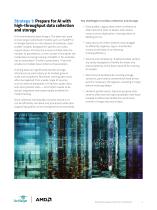
AI is tremendously data-hungry. The data sets used to train large mainstream models such as ChatGPT-4 or Google Gemini run into dozens of terabytes. Even smaller models, designed for specific use cases, require about 10 times the amount of data than the number of parameters, or the number of variables the model learns during training. ChatGPT-4, for example, has an estimated 1.8 trillion parameters.2 Even the smallest AI models have millions of parameters. Training data can significantly burden storage infrastructure, particularly as AI models grow in scale and complexity. Moreover, training...
Open the catalog to page 2
Step 1: Choose scalable, high-performance storage mediums To meet data collection and storage demands, the AI-ready data center must use modernized storage architectures that minimize bottlenecks and support high-speed data retrieval. While hard drives remain a practical choice for low-cost archival storage, they can’t meet the performance demands of real-time data access. An optimal production environment should instead use nonvolatile memory express solid state drives (NVMe SSDs). These offer lower latency and higher throughput, with data-transfer speeds up to 35 times higher than conventional...
Open the catalog to page 3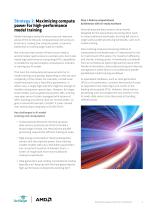
Model training is easily the most resource-intensive phase of the AI lifecycle. Computational demands are enormous, making raw compute power a common bottleneck in training large-scale AI models. Not only does data center infrastructure need to accommodate rapid access to vast data sets, but it also needs high-performance computing (HPC) capabilities to handle the myriad complex computations inherent in training any AI model. That said, the computational requirements for AI model training vary greatly, depending on the size and complexity of the model. For example, a small-scale model may have...
Open the catalog to page 4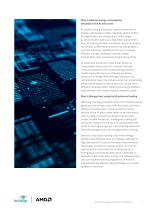
Step 2: Address energy-consumption demands in the AI data cente AI model training consumes massive amounts of energy, with larger models requiring several orders of magnitude more energy than small, singlepurpose models with just a few billion parameters. Also, AI training involves sustained, resource-hungry workloads, unlike the short bursts of computation used for inference. Standard CPUs aren’t energyefficient enough, leading to wasted energy consumption over excessively long training times. AI-optimized processors have lower power-tocomputation ratios and can maintain the high compute demands...
Open the catalog to page 5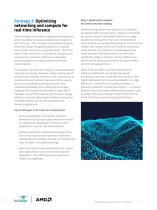
After training, an AI model is deployed in production, where its ability to analyze and generate insights is put to the test. This is known as the inference phase, where the model recognizes patterns in external data to infer conclusions and predictions. That's the heart of the value of AI, so having the infrastructure necessary for real-time inference is ultimately what translates into actual business value and model viability. Fortunately, inference isn't nearly as computationally intensive as training. However, unlike training, which is done intermittently, inference runs continuously in a...
Open the catalog to page 6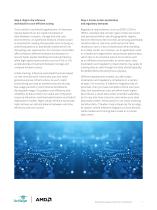
Step 2. Right-size inference workloads for cost-efficient scaling Step 3. Factor in data localization and regulatory demands To be useful in real-world applications, AI inference heavily depends on the rapid movement of data between compute, storage and end-user environments. An optimized network infrastructure is essential for making that possible and, in doing so, preventing latency or bandwidth bottlenecks from disrupting user experiences. For instance, SmartNICs offer software-defined hardware acceleration to ensure faster packet handling and reduced latency, while high-speed interconnects...
Open the catalog to page 7
AI is radically changing how businesses operate, compete and innovate, but success hinges on having a high-performance data center. As AI workloads continue to grow in scale and complexity, integrating specialized storage and compute and efficient networking are paramount for ensuring long-term sustainability and growth. Working with the right AI infrastructure partner grants you access to the expertise, hardware and software ecosystem needed to accelerate AI adoption while ensuring cost efficiency, performance and scalability. Being at the forefront of AI data center innovation, AMD delivers...
Open the catalog to page 8All AMD catalogs and technical brochures


Archived catalogs
 turion-athlon-neo-x2
2 Pages
 33358f_lx
2 Pages
 47589A_SR5690_chipset
2 Pages
 M690T
M690T2 Pages
 E2400
E24002 Pages
 E6760 Embedded GPU
2 Pages
 E6760-MXM
2 Pages
 45626B_Sempron_BGA
2 Pages
 E4690 MXM V3.0 Module
2 Pages
 AMD FirePro W7000
2 Pages
 32284a_nxfamily
2 Pages
 _Athlon_II_785E_AM3
2 Pages
 ATI FirePro? V5800 DVI
2 Pages
 46110A_High_Perf_PB
2 Pages
 AMD FirePro 2270
2 Pages
 E4690
E46902 Pages
 53738_PDS_Athlon
12 Pages
 AMD FirePro W8000
2 Pages
 Opteron_Product
12 Pages
 ATI FirePro 2460
2 Pages
 Sempron
12 Pages
 AMD FirePro W9000
2 Pages
 Socket AM3/AM2 Processors
2 Pages
 G-Series
12 Pages
 E-Series
12 Pages
 E6460
E64602 Pages
 43887C_Athlon_PB
2 Pages
 2nd Gen R series
2 Pages
 W5000
W50002 Pages
 R series
5 Pages
 V5800
V58002 Pages
 V7900
V79002 Pages
 W9100
W91002 Pages
 W600
W6002 Pages
 W4100
W41002 Pages
 E6760 PCI Express Board
2 Pages
 W2100
W21002 Pages
 W7100
W71002 Pages
 W4300
W43002 Pages
 FirePro-W7100
2 Pages
 V3900
V39002 Pages
 W8100
W81002 Pages
 G-SERIES SOC PLATFORM
5 Pages
 FirePro-W5100
2 Pages
 Radeon™ Pro WX 7100
2 Pages
 radeon-pro-ssg
3 Pages
 Radeon-Pro-WX5100
2 Pages
 Radeon™ Pro WX 4100
2 Pages


- Embedded video card
- PCI Express graphics card
- DisplayPort graphics card
- Linux graphics card
- Windows 10 graphics card
- HDMI graphics card
- ARM processor
- Mobile device processor
- Windows 11 graphics card
- Starter kit
- X64 processor
- GDDR6 graphics card
- GDDR5 graphics card
- Quad-core processor
- Dual core processor
- AMD Radeon graphics card
- Embedded processor
- Desktop computer processor
- PCIe graphics card