


- Products
- Catalogs
- News & Trends
- Exhibitions
Protecting the AI-ready data center
Protecting the AI-ready data center
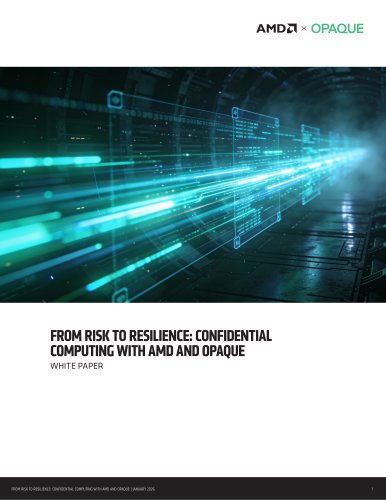
AI workloads have transformed data center security needs, introducing new complexities and vulnerabilities. Traditional security frameworks are inadequate for the dynamic and distributed nature of AI, which requires a zero-trust approach. Key challenges include monitoring systems at scale, sophisticated AI-specific attacks, and the limitations of perimeter-oriented security tools.
AI workloads require comprehensive security beyond perimeter defenses and data encryption at rest. Data is vulnerable during real-time processing, and I/O channels are often overlooked. Confidential computing and memory encryption are essential to protect data during processing and ensure end-to-end trust.
AI workloads demand a cohesive security architecture that integrates security features across every layer of the system. Challenges include fragmented toolchains, tech sprawl, and keeping pace with rapid AI advancements. Security should be built from the silicon up, with centralized observability and continuous attestation to maintain integrity and prevent configuration drift.
Modernizing data centers for AI involves reengineering trust across the tech stack. AMD offers solutions with powerful CPUs, GPUs, and AI accelerators, along with hardware-layer security features to support scalable and secure AI adoption.
Catalog excerpts

WHITE PAPER Protecting the AI-ready data center AI doesn’t happen in one place. Workloads are constantly on the move, touching myriad systems both inside the data center and beyond. Data shifts across multiple storage arrays and compute nodes, over networks, to the edge and back again. Every movement and resting point is a potential opportunity for compromise and, as AI systems grow more capable, so can the threats that target them. Modern AI workloads demand massive data throughput, distributed processing, and complex model architectures, all of which create new surfaces for adversaries to probe. From training data poisoning to model inversion attacks, adversaries don’t exploit weaknesses just in software—but also hardware and infrastructure. dynamic, spanning dozens of different environments— and rendering many older assumptions obsolete. Data center infrastructure is itself an attack surface. The problem is that many enterprises still rely primarily on locking down the perimeter. With AI, however, workloads are increasingly distributed and This paper looks at the strategies IT leaders can use to tackle the unique security challenges that come with modernizing a data center for AI workloads. We often talk about AI as a workload—or workloads. But for adversaries, it’s something more—a new attack surface to exploit. On the other hand, while AI introduces new infrastructure risks and attack vectors, it also offers new ways to guard against them. From anomaly detection to policy enforcement, AI can itself help identify and respond to threats.
Open the catalog to page 1
AI hasn't just redefined data center performance requirements—it has reshaped how infrastructure needs to be secured. While traditional data architecture focused on securing applications, users, and the perimeter, AI workloads have introduced new complexities: They don't just run on the infrastructure—they change it. AI workloads are dynamic, distributed, and highly data-intensive, making them inherently more vulnerable to novel and emerging attack vectors. As AI becomes more deeply embedded into everyday business operations, adversaries have started to target not just endpoints and networks,...
Open the catalog to page 2
Perimeter defenses and encryption of data at rest are still important parts of any comprehensive security strategy, but they are no longer sufficient alone. With AI workloads constantly ingesting, analyzing, and generating huge amounts of data across diverse infrastructure layers, data center operators must think beyond static protections. After all, every stage of the data journey—whether in motion, at rest, or in active use—represents a potential opportunity for compromise. The number of potential single points of failure is immense. This is especially true for memory channels and I/O layers,...
Open the catalog to page 3
AI workloads are fast-moving, multi-layered, and highly automated. Moreover, the technology itself is advancing at a pace that's unmatched throughout the history of computing. These characteristics have created an environment where security features need to be built in by design and default across every layer of the system. Until recently—and especially during the early days of AI experimentation and adoption-enterprises often made do with fragmented, ad-hoc security measures. But these can create blind spots and lead to operational complexity by introducing inconsistencies in how policies are...
Open the catalog to page 4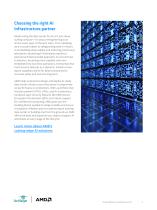
Choosing the right AI infrastructure partner Modernizing the data center for AI isn’t just about scaling compute—it’s about reengineering trust across every layer of the tech stack. From adopting zero-trust principles to safeguarding data in motion, to embedding observability and enforcing continuous attestation, protecting AI workloads requires a planned architecturewide approach. As AI continues to advance, becoming more capable and more embedded into business operations, enterprises that treat security features as a dynamic, infrastructureaware capability will be far better positioned to innovate...
Open the catalog to page 5All AMD catalogs and technical brochures
Archived catalogs
 turion-athlon-neo-x2
2 Pages
 33358f_lx
2 Pages
 47589A_SR5690_chipset
2 Pages
 M690T
M690T2 Pages
 E2400
E24002 Pages
 E6760 Embedded GPU
2 Pages
 E6760-MXM
2 Pages
 45626B_Sempron_BGA
2 Pages
 E4690 MXM V3.0 Module
2 Pages
 AMD FirePro W7000
2 Pages
 32284a_nxfamily
2 Pages
 _Athlon_II_785E_AM3
2 Pages
 ATI FirePro? V5800 DVI
2 Pages
 46110A_High_Perf_PB
2 Pages
 AMD FirePro 2270
2 Pages
 E4690
E46902 Pages
 53738_PDS_Athlon
12 Pages
 AMD FirePro W8000
2 Pages
 Opteron_Product
12 Pages
 ATI FirePro 2460
2 Pages
 Sempron
12 Pages
 AMD FirePro W9000
2 Pages
 Socket AM3/AM2 Processors
2 Pages
 G-Series
12 Pages
 E-Series
12 Pages
 E6460
E64602 Pages
 43887C_Athlon_PB
2 Pages
 2nd Gen R series
2 Pages
 W5000
W50002 Pages
 R series
5 Pages
 V5800
V58002 Pages
 V7900
V79002 Pages
 W9100
W91002 Pages
 W600
W6002 Pages
 W4100
W41002 Pages
 E6760 PCI Express Board
2 Pages
 W2100
W21002 Pages
 W7100
W71002 Pages
 W4300
W43002 Pages
 FirePro-W7100
2 Pages
 V3900
V39002 Pages
 W8100
W81002 Pages
 G-SERIES SOC PLATFORM
5 Pages
 FirePro-W5100
2 Pages
 Radeon™ Pro WX 7100
2 Pages
 radeon-pro-ssg
3 Pages
 Radeon-Pro-WX5100
2 Pages
 Radeon™ Pro WX 4100
2 Pages


- Processor
- Embedded video card
- PCI Express graphics card
- DisplayPort graphics card
- Linux graphics card
- Windows 10 graphics card
- HDMI graphics card
- ARM processor
- Mobile device processor
- Windows 11 graphics card
- Starter kit
- X64 processor
- GDDR6 graphics card
- GDDR5 graphics card
- Quad-core processor
- Dual core processor
- AMD Radeon graphics card
- Embedded processor
- Desktop computer processor
- PCIe graphics card