
- Catalogs
- AMANDUS KAHL
- Pelleting Press for Small-Scale Production


Pelleting Press for Small-Scale Production

Pelleting Press for Small-Scale Production
Catalog excerpts

Positive roller drive ¡ optional extra for products with high anti-friction properties. The pelleting press can be used for ¡ Testing the pelleting qualities of a diverse range of products, ¡ Production of test material in research laboratories, ¡ Tests to obtain optimal formulations for achieving economic pelleting, ¡ Pelleting of high quality materials in smaller quantities. The laboratory press operates on the flat die principle which has a proven value with difficult materials. The pelleting tools can be easily interchanged without the need for special equipment. Small quantities are manually fed by way of a feed hopper. For continuous operation a proportioning feed unit is fitted to the press. Pelleting press for small-scale productions The flat die pelleting presses are suitable for compacting powdery and lumpy products. Machine design: Jens Plewa vom Berg, Hamburg The pellet diameter can be selected. The range of KAHL pelleting presses comprises 12 sizes which cover laboratory requirements through to high capacity production. Press Typ 14 - 175 Pelleting Press 14 - 175
Open the catalog to page 1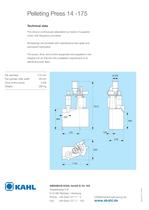
Digi-AK-07-E 03/05 AMANDUS KAHL GmbH & Co. KG Dieselstrasse 5-9 D-21465 Reinbek / Hamburg Phone: +49 (0)40 727 71 - 0 Fax: +49 (0)40 727 71 - 100 [email protected] www.akahl.de Pelleting Press 14 -175 The drive is continuously adjustable by means of a geared motor with frequency converter. All bearings are provided with maintenance-free seals and permanent lubrication. The press, drive, and control equipment are supplied in one integral unit so that the only installation requirement is an electrical power feed. Technical data Die diameter 175 mm Pan grinder roller width 29 mm Drive motor...
Open the catalog to page 2All AMANDUS KAHL catalogs and technical brochures
 PELLET MILLS
9 Pages
Archived catalogs
 AK01 KAHL ROTOSPRAY®
2 Pages
 Wood Pelleting Plants
12 Pages
 KAHL High-Speed Mixer SMW
2 Pages
 KAHL Annular gap expander
4 Pages
 Feedmills, Plants, and Machines
12 Pages
 KAHL Fabric Belt Drier
4 Pages
 Annular Gap Expander
4 Pages
 Pelleting Presses
8 Pages
 Belt driers and coolers
8 Pages
 Crown Expander OEK
2 Pages
 KAHL Batch Mixers
2 Pages
 KAHL Continuous Mixer
2 Pages
 KAHL Press O-500/390
2 Pages
 KAHL AKANA Hammer Mills
2 Pages
 Waste Tyre Recycling Plants
6 Pages
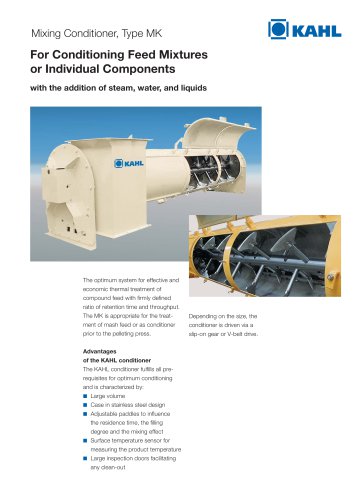


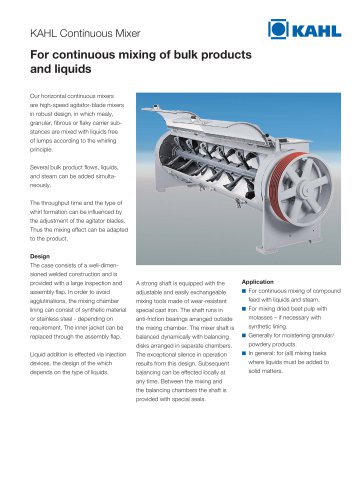








- Rail conveyor
- Dynamic agitator
- Transport rail conveyor
- Chiller
- Grinding mill
- Horizontal conveyor
- Amandus Kahl dryer
- Agitator for the food industry
- Vertical homogenizer
- Liquids dispensing system
- Stainless steel homogenizer
- Air chiller
- In-line mixer
- Inclined conveyor
- Work conveyor
- Solid/liquid agitator
- Horizontal lump breaker
- Industrial cooling system
- Continuous drying system
- Vertical pulverizer