
- Catalogs
- AMANDUS KAHL
- Granulation Presses - New Process for the Granulation of Food


Granulation Presses - New Process for the Granulation of Food

Granulation Presses - New Process for the Granulation of Food
The document discusses a new process for the granulation of food using high-performance granulation presses developed by AMANDUS KAHL GmbH & Co. KG. These machines are designed for efficient dry granulation of food additives, suitable for pilot plants and small production settings.
The granulation presses feature a flexible design with various pan grinder roller and die configurations. They are equipped with a positive drive for the pan grinder rollers, ensuring economic operation through continuous use.
The machines are designed to meet GMP (Good Manufacturing Practice) standards, ensuring food compatibility and preventing cross-contamination. They offer easy access to all parts for cleaning and maintenance, and include temperature measurement and frequency-controlled drive of the main shaft.
The granulation presses are versatile due to their easy handling and compact design. They are easy to operate and clean, minimizing the need for extensive clean room areas.
Overall, the granulation presses by AMANDUS KAHL provide a reliable and efficient solution for the granulation of food additives, adhering to GMP guidelines and ensuring high-quality production.
Catalog excerpts

AMANDUS KAHL GmbH & Co. KG Dieselstrasse 5-9 D-21465 Reinbek / Hamburg Phone: +49 (0)40 727 71 - 0 Fax: +49 (0)40 727 71 - 100 [email protected] www.akahl.de The granulation press is a high-performance laboratory machine with a very wide range of applications. The granulation presses have been designed for efficient dry granulation (agglomeration by compression) of food additives. The design of this series, which is especially appropriate for use in the pilot plant and as a small production machine, ensures an unmatched flexibility by using different pan grinder roller and die configurations as well as the positive drive of the pan grinder rollers. ¡ due to continuous operation Qualification and validation ¡ for reproducible and qualityconforming production ¡ food compatible design according to GMP Versatility ¡ thanks to facilitated handling GMP-conforming design ¡ to avoid cross-contamination ¡ to ensure good accessibility of all plant parts ¡ compact design, easy to operate ¡ temperature measurement ¡ easy and reliable cleaning ¡ frequency-controlled drive of the main shaft ¡ minimisation of clean room areas Food compatible design For application in the food industry, the flat die presses are designed according to GMP guidelines. They can be qualified and the process can be validated according to GMP requirements.
Open the catalog to page 1All AMANDUS KAHL catalogs and technical brochures
 PELLET MILLS
9 Pages
Archived catalogs
 AK01 KAHL ROTOSPRAY®
2 Pages
 Wood Pelleting Plants
12 Pages
 KAHL High-Speed Mixer SMW
2 Pages
 KAHL Annular gap expander
4 Pages
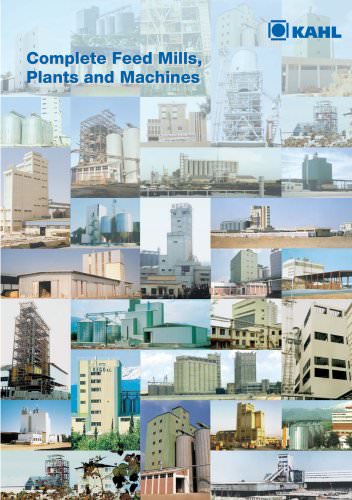 Feedmills, Plants, and Machines
12 Pages
 KAHL Fabric Belt Drier
4 Pages
 Annular Gap Expander
4 Pages
 Pelleting Presses
8 Pages
 Belt driers and coolers
8 Pages
 Crown Expander OEK
2 Pages
 KAHL Batch Mixers
2 Pages
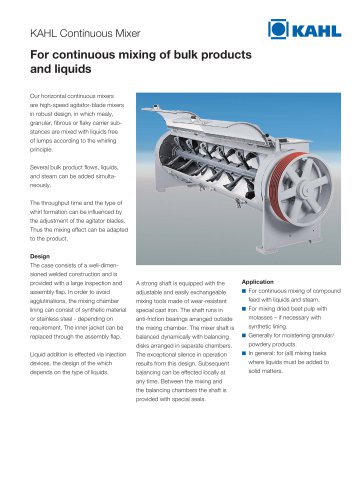
 KAHL Continuous Mixer
2 Pages
 KAHL Press O-500/390
2 Pages
 KAHL AKANA Hammer Mills
2 Pages
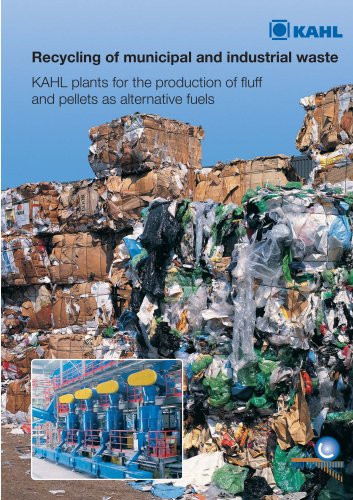
 Waste Tyre Recycling Plants
6 Pages
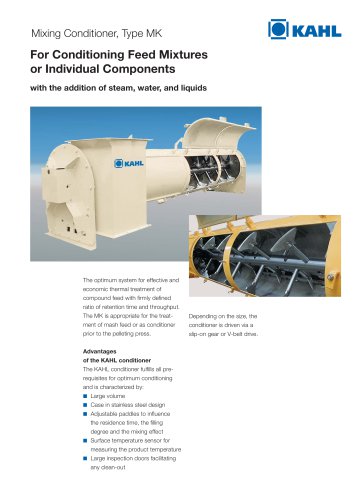










- Rail conveyor
- Dynamic agitator
- Transport rail conveyor
- Chiller
- Grinding mill
- Horizontal conveyor
- Amandus Kahl dryer
- Agitator for the food industry
- Vertical homogenizer
- Liquids dispensing system
- Stainless steel homogenizer
- Air chiller
- In-line mixer
- Inclined conveyor
- Work conveyor
- Solid/liquid agitator
- Horizontal lump breaker
- Industrial cooling system
- Continuous drying system
- Vertical pulverizer