
- Catalogs
- AMADA WELD TECH Inc.
- Thermoplane Thermodes Technical Datasheet


- Products
- Catalogs
- News & Trends
- Exhibitions
Thermoplane Thermodes Technical Datasheet

Thermoplane Thermodes Technical Datasheet
- Fast heating and forced air cooling for reduced process cycle times.
- Robust 3-dimensional design suitable for high force applications ensuring perfect bond planarity.
- Adapter block (QCB) allows easy and quick exchange of thermodes without re-adjustment.
- 3-D design prevents voltage drop on products.
The Thermode, or Hot bar, is central to each bonding system and is designed by Miyachi Europe for various applications. It offers ultra-fast heating and cooling cycles, minimizing process times. Forced air-cooling accelerates the bonding process. The design maintains co-planarity and withstands deformation from high forces. The Thermo-plane Thermode prevents voltage drop by directing current flow from front-to-back.
Specific thermode configurations are required for Wire-Soldering & Heatstake processes based on product size and shape. Miyachi provides both standard and custom designs.
Quick Connect BlockThe Thermode connects to the bonding head via a Quick Connect Block (QCB), mounted with two set screws. The QCB and Thermode are designed as a set to optimize co-planarity and enable fast thermode exchange without adjustment. Different QCB types support various thermode configurations for processes like Hot bar Reflow Soldering, ACF Bonding, or Heatstaking.
Thermode Applications- 2-D Thermode (Pulsed Heat): Suitable for wire soldering.
- 3-D Thermo-plane Thermode (Pulsed Heat): Used for leadframe soldering and flex soldering.
- Heat stake Thermode (Pulsed Heat): Applied in mobile phone heat staking.
Thermodes are available in various dimensions and configurations, specified by length and width for order purposes. Custom designs are available for specific applications.
Note: All data, images, and text are subject to change. Miyachi Europe reserves the right to modify specifications, design, and illustrations at any time.
Catalog excerpts
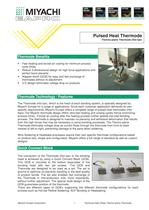
Pulsed Heat Thermode Thermode Benefits Fast heating and forced air cooling for minimum process cycle times Robust 3-dimensional design for high force applications and perfect bond planarity Adapter block (QCB) for easy and fast exchange of thermodes without re-adjustment 3-D design eliminates voltage drop on products Thermode Technology / Features The Thermode (Hot bar), which is the heart of each bonding system, is specially designed by Miyachi Europe for a range of applications. Since each customer application demands its own specific requirements, Miyachi Europe offers a complete range of pulsed heat thermodes (Hot bars).The Miyachi thermode design offers ultra-fast heating and cooling cycles hence minimizing process times. Forced air-cooling after the heating process further speeds the total bonding process. The thermode is designed to maintain co-planarity and withstand deformation that results from the high forces that may be necessary in some bonding processes. The Thermo-plane Thermode eliminates voltage drop as current flows through the thermode from front-to-back instead of left-to-right, preventing damage to the parts when soldering. Wire-Soldering & Heatstake processes require their own specific thermode configurations based on product size, shape and configuration. Miyachi offers a full range of standard as well as custom Quick Connect Block The connection of the Thermode (Hot bar) to the bonding head is achieved by using a Quick Connect Block (QCB). This QCB is mounted to the bottom base-plate of the bonding head with two set screws. The QCB and Thermode are designed to be used as a set. The set is ground to optimize co-planarity resulting in the best quality of product bonds. The set also enables fast exchange of the Thermode in mid-production and, more importantly, without further adjustment. The special shaft design of the QCB guarantees position of the thermode. There are different types of QCB's supporting the different thermode configurations for each process such as Hot bar Reflow Soldering, ACF Bonding or Heatstaking. Miyachi Europe Corporation Technical Data Sheet Thermo-plane Thermode
Open the catalog to page 1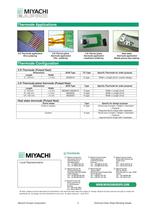
Thermode Applications 2-D Thermode application 3-D Thermo-plane 3-D Thermo-plane Heat stake Wire soldering thermode application thermode application thermode application Flex soldering Leadframe soldering Mobile phone heat staking Thermode Configuration Local Representative 16 Royal Scot Road Pride Park DE24 8AJ Derby United Kingdom O Miyachi Europe GmbH Czech Republic O Miyachi Europe GmbH Strada della Cebrosa, 86 Saint Germain en Laye, 78100 All data, images and text described and illustrated in this technical data sheet are subject to change. Miyachi Europe reserves the right to modify the...
Open the catalog to page 2All AMADA WELD TECH Inc. catalogs and technical brochures
 TC-W100A
2 Pages
 MEA-100B
2 Pages
 MIB-300A/600A
2 Pages
 CD-A125A CD-A300A CD-A1000A
2 Pages
 Rotary Dial Index Systems
2 Pages
 AMADA WELD TECH
24 Pages
 HF-2700A / HF-2500A
4 Pages
 CD-V Series
2 Pages
 MD-A10000A/ MD-B5000A
2 Pages
 ISQ Series
3 Pages
 IPB-5000A-MU
2 Pages
 MFP60 for aws3
2 Pages
 MFP25 FRO AWS3
2 Pages
 Series 320
2 Pages
 newhorizon
3 Pages
 F120, F160, FD120
4 Pages
 KN-II Series
2 Pages
 MH Weld Head Range
4 Pages
 Accessries
9 Pages
 Laser Microfabrication
2 Pages
 ML-5120A
2 Pages
 Systems
16 Pages
 ML-5120
2 Pages
 DC29-UB29-UB29A
4 Pages
 LF Series Lasers
2 Pages
 SA2200 Dual Oven
2 Pages
 Laser Tube Cutting Systems
2 Pages
 Heat Staking
2 Pages
 Seam Laser Welder - 150W
2 Pages
 Systems Datasheet
16 Pages
 AX5000 Glovebox
2 Pages
 MX2000 Glovebox
2 Pages
 Benchmark AF8500 / AF 1250
2 Pages
 Pulsed-Heat Hot-Bar
10 Pages
 Benchmark SM8500
2 Pages
 vacuum bakeout oven
2 Pages
 Interposer Module
2 Pages
 UV Laser Marking Systems
2 Pages
 CO2 Laser Marking Systems
2 Pages
 Fiber Laser Micro Welders
2 Pages
 Sigma Laser Tube Cutter
2 Pages
 Laser Marker Motion
2 Pages
 Laser Welding Gloveboxes
2 Pages
 Thermocouple Welder - TCW
2 Pages
 Laser Accessories
7 Pages
 Alpha Series
2 Pages
 MX-2000 Glovebox Technical
2 Pages
 AX-5000 Glovebox
2 Pages
 Benchmark Accessories
9 Pages
 Thin Line Weld Heads
8 Pages
 Uniflow 4
2 Pages
 Pulsar
2 Pages
 LMC1 Laser Marker Motion
2 Pages
 LW300-600A
2 Pages
 LW50A-70-150A
2 Pages
 LW5-15-25A
2 Pages
 LF Series
2 Pages
 50 Series Weld Heads
4 Pages
 MH Series Weld Heads
4 Pages
 MG3
MG312 Pages
 MG3 Hot Bar Monitoring
3 Pages
 Sarcon and Kapton Modules
2 Pages
 IS series
2 Pages
 ISB-300 A
2 Pages
 Accessoires
9 Pages
 DC25, UB25
4 Pages


Archived catalogs
 Fine Laser Cutting Datasheet
4 Pages
 laser markers and marker systems
16 Pages
 Bonding Heads
2 Pages
 Thin-line
8 Pages
 MG3 UNIQUE PROCESS MONITORING
12 Pages
 Process Calibration Tools
2 Pages
 LaserCuttingSystems_Cut
4 Pages
 Pincer Weld Head - MFP-Z
3 Pages


- Power supply unit
- Kiln
- DC power supply
- AC/DC power supply
- Welding system
- Chamber kiln
- Electric furnace
- Automatic welding machine
- Marking machine
- Welder
- Laser marking machine
- Arc welder
- Tabletop power supply
- Metal welding machine
- Arc welding machine
- Manual welding machine
- Stainless steel kiln
- Laser sealer
- Precision welding machine
- Benchtop marking machine