
- Catalogs
- AMADA WELD TECH Inc.
- Laser Accessories


- Products
- Catalogs
- News & Trends
- Exhibitions
Laser Accessories

Laser Accessories
Successful laser applications depend on proper laser selection, system integration, and the right accessories. Key accessory categories include laser diagnostics, process observation and verification, laser safety, and optomechanical components.
Laser performance is checked by measuring power or energy output using a sensor and a meter. Amada Miyachi America offers thermal sensors with broadband absorbers for various laser sources. Power meters and sensors are selected based on laser energy/power output.
Ensuring a smooth spatial beam profile is crucial. Burn paper is a low-cost tool for checking beam profiles, used with Pulsed Nd:YAG lasers.
Tools like the IVSC system and USB microscopes help verify laser processes. Magnification devices are essential for observing small laser processes.
Handheld imagers read 1D and 2D matrices, ideal for decoding low contrast symbols on various materials.
The PT-200 pull tester evaluates weld strength, configurable for tension or compression testing up to 200 lbf.
Laser safety glasses protect against harmful radiation. Fume extractors remove airborne particles and toxic fumes from laser processes.
Lab jacks and tooling plates provide height adjustment and part mounting. Water chillers cool high-powered lasers.
Starter kits simplify new laser projects, including power meters, sensors, and safety equipment.
Auto focus features adjust focal height using non-contact sensors, available for different focal lengths.
Catalog excerpts
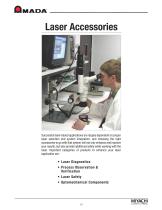
Laser Accessories Successful laser-based applications are largely dependent on proper laser selection and system integration, and choosing the right accessories to go with that system will not only enhance and improve your results, but also provide additional safety while working with the laser. Important categories of products to enhance your laser application are: • Laser Diagnostics • Process Observation & Verification • Laser Safety • Optomechanical Components
Open the catalog to page 1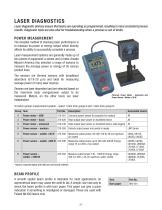
LASER DIAGNOSTICS Laser diagnostic devices ensure that lasers are operating as programmed, resulting in more consistent process results. Diagnostic tools are also vital for troubleshooting when a process is out of limits. POWER MEASUREMENT The simplest method of checking laser performance is to measure its power or energy output which directly affects its ability to successfully complete a process. Laser measurement systems are generally made up of two pieces of equipment: a sensor and a meter. Amada Miyachi America has selected a range of sensors to measure the average power or energy of its...
Open the catalog to page 2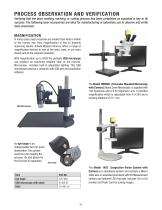
PROCESS OBSERVATION AND VERIFICATION Verifying that the laser welding, marking, or cutting process has been completed as expected is key to its success. The following laser accessories are ideal for manufacturing or laboratory use to observe and verify laser processes. MAGNIFICATION In many cases, laser processes are smaller than what is visible to the human eye, thus magnification is key to properly observing results. Amada Miyachi America offers a range of magnification devices to look at the weld, mark, or cut more closely and at the required resolution. With magnification up to 200X the portable...
Open the catalog to page 3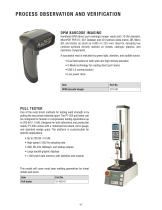
PROCESS OBSERVATION AND VERIFICATION DPM BARCODE IMAGING Handheld DPM (direct part marking)) imager reads both 1D (All standard, MicroPDF, PDF417, GS1 Databar) and 2D matrices (Data matrix, QR, Micro QR, and Aztec) as small as 0.005 in (125 mm). Ideal for decoding low contrast symbols directly marked on metals, castings, plastics, and electronic components. A successful read is indicated by green light, vibration, and audible sound. • Dual field optics for both wide and high density barcodes • X-Mode technology for reading direct part marks • USB 2.0 communication • Low power draw PULL TESTER...
Open the catalog to page 4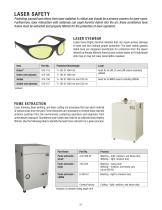
LASER SAFETY Protecting yourself and others from laser radiation is critical and should be a primary concern for laser users. Furthermore, laser interaction with materials can expel harmful debris into the air; these sometimes toxic fumes must be extracted and properly filtered for the protection of laser operators. LASER EYEWEAR Lasers have bright, harmful radiation that can cause serious damage to eyes and skin without proper protection. The laser safety glasses listed here are designed specifically for protection from the lasers offered by Amada Miyachi America and include styles to fit individuals...
Open the catalog to page 5
OPTO-MECHANICAL ACCESSORIES AND MORE Opto-mechanical components are used for quick fixturing and tooling of parts. Great for proof-of-principle testing! LAB JACKS & TOOLING PLATES Parts come in many different shapes and sizes, making it necessary to create a unique fixture for each and every part to be held in focus. Opto-mechanical components can be used as tooling, or a platform to mount tooling and parts, and provide height adjustment for quick and easy process verification before going to the expense of building a specific tool. Fine height adjustment of part Tooling plate Height adjustment...
Open the catalog to page 6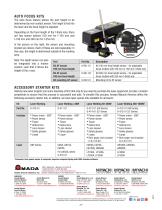
AUTO FOCUS KITS The auto focus feature allows the part height to be determined by non-contact sensor. The height is fed into the laser and the focal height is adjusted. Depending on the focal length of the f-theta lens, there are two sensor options 100 mm for f-100 mm and f-160 mm and 300 mm for f-254 mm. In the picture on the right, the sensor and mounting bracket are shown. Each of these are sold separately. In this case, the height is determined outside of the marking area. Note: The depth sensor can also be integrated into a motion system, such that it drives the height of the z-axis. Kit...
Open the catalog to page 7All AMADA WELD TECH Inc. catalogs and technical brochures
 TC-W100A
2 Pages
 MEA-100B
2 Pages
 MIB-300A/600A
2 Pages
 CD-A125A CD-A300A CD-A1000A
2 Pages
 Rotary Dial Index Systems
2 Pages
 AMADA WELD TECH
24 Pages
 HF-2700A / HF-2500A
4 Pages
 CD-V Series
2 Pages
 MD-A10000A/ MD-B5000A
2 Pages
 ISQ Series
3 Pages
 IPB-5000A-MU
2 Pages
 MFP60 for aws3
2 Pages
 MFP25 FRO AWS3
2 Pages
 Series 320
2 Pages
 newhorizon
3 Pages
 F120, F160, FD120
4 Pages
 KN-II Series
2 Pages
 MH Weld Head Range
4 Pages
 Accessries
9 Pages
 Laser Microfabrication
2 Pages
 ML-5120A
2 Pages
 Systems
16 Pages
 ML-5120
2 Pages
 DC29-UB29-UB29A
4 Pages
 LF Series Lasers
2 Pages
 SA2200 Dual Oven
2 Pages
 Laser Tube Cutting Systems
2 Pages
 Heat Staking
2 Pages
 Seam Laser Welder - 150W
2 Pages
 Systems Datasheet
16 Pages
 AX5000 Glovebox
2 Pages
 MX2000 Glovebox
2 Pages
 Benchmark AF8500 / AF 1250
2 Pages
 Pulsed-Heat Hot-Bar
10 Pages
 Benchmark SM8500
2 Pages
 vacuum bakeout oven
2 Pages
 Interposer Module
2 Pages
 UV Laser Marking Systems
2 Pages
 CO2 Laser Marking Systems
2 Pages
 Fiber Laser Micro Welders
2 Pages
 Sigma Laser Tube Cutter
2 Pages
 Laser Marker Motion
2 Pages
 Laser Welding Gloveboxes
2 Pages
 Thermocouple Welder - TCW
2 Pages
 Alpha Series
2 Pages
 MX-2000 Glovebox Technical
2 Pages
 AX-5000 Glovebox
2 Pages
 Benchmark Accessories
9 Pages
 Thin Line Weld Heads
8 Pages
 Uniflow 4
2 Pages
 Pulsar
2 Pages
 LMC1 Laser Marker Motion
2 Pages
 LW300-600A
2 Pages
 LW50A-70-150A
2 Pages
 LW5-15-25A
2 Pages
 LF Series
2 Pages
 50 Series Weld Heads
4 Pages
 MH Series Weld Heads
4 Pages
 MG3
MG312 Pages
 MG3 Hot Bar Monitoring
3 Pages
 Sarcon and Kapton Modules
2 Pages
 IS series
2 Pages
 ISB-300 A
2 Pages
 Accessoires
9 Pages
 DC25, UB25
4 Pages


Archived catalogs
 Fine Laser Cutting Datasheet
4 Pages
 laser markers and marker systems
16 Pages
 Bonding Heads
2 Pages
 Thin-line
8 Pages
 MG3 UNIQUE PROCESS MONITORING
12 Pages
 Process Calibration Tools
2 Pages
 LaserCuttingSystems_Cut
4 Pages
 Pincer Weld Head - MFP-Z
3 Pages


- Power supply unit
- Kiln
- DC power supply
- AC/DC power supply
- Welding system
- Chamber kiln
- Electric furnace
- Automatic welding machine
- Marking machine
- Welder
- Laser marking machine
- Arc welder
- Tabletop power supply
- Metal welding machine
- Arc welding machine
- Manual welding machine
- Stainless steel kiln
- Laser sealer
- Precision welding machine
- Benchtop marking machine