


solidThinking Click2Extrude ™ Metal

solidThinking Click2Extrude ™ Metal
- Validate and Correct Die Design: Simulations help improve die performance by analyzing aspects like nose cone, product quality, weld strength, and process efficiency.
- Extrude New Alloys: Capable of simulating a wide range of alloys, essential for understanding flow stress and material behavior.
- Determine Die Stresses and Failure: Identifies tool deflection, mandrel shift, stress concentrations, and potential die failure.
- Increase Productivity: Optimizes ram speed, billet preheat, and taper heating to enhance productivity and reduce costs.
- Increase Recovery and Reduce Scrap: Minimizes scrap by optimizing billet length and tracking skin material.
- Determine Product Quality: Improves quality by eliminating defects and assessing seam weld location, grain size, and yield strength.
- Analyze Quenching: Predicts cooling rate and uniformity during quenching to control grain size and mechanical properties.
- Support for All Die Types: Includes solid, semi-hollow, hollow profiles, and various extrusion processes.
- Product Quality and Defects: Predicts profile shape, surface defects, seam weld quality, and grain size.
- Thermal Management: Simulates coupled flow and thermal solutions to optimize billet preheat and taper.
- Virtual Die Trials: Visualizes material flow and identifies causes for flow imbalance and overheating.
- Tool Deflection Analysis: Simulates stress analysis to minimize tool deflection and prevent breakage.
- Super Alloy Extrusion: Simulates glass lubrication and predicts pad erosion.
- Comprehensive Material Database: Includes commonly used alloys and supports user-defined material models.
- Contact Friction: Models include viscoplastic, Coulomb, and slip velocity.
- Optimize Die Design: Features modules for bearing length correction and dimension modification.
- Extrusion System Management: Calculates optimum conditions, reduces scrap, and prepares cost estimates.
Catalog excerpts
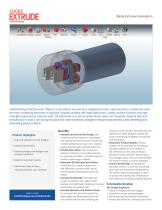
EXTRUDE solidThinkinjf Metal Extrusion Simulation Orient Model Flow Volume Organize Billet Extrusion Move Push/Pull Tools solidThinking Click2Extrude™ Metal is a simulation environment designed to help metal extrusion companies meet the ever increasing demands to produce complex profiles with tight tolerances, quality surface finishes and high strength properties at reduced cost. Click2Extrude is a virtual press where users can visualize material flow and temperature inside a die during extrusion and make necessary changes to ensure balanced flow, while identifying and eliminating product defects. Product Highlights • Test and validate new die designs • Improve productivity • Optimize/correct die designs and process conditions • Determine product quality • Automated, easy to learn, extrusion-specific user interface Benefits • Validate and Correct Die Design: Use Click2Extrude simulations to understand and improve the performance of a die from multiple perspectives (nose cone, product quality, weld strength, process efficiency). • Extrude New Alloys: Flow stress and material behavior of new alloys requires an accurate simulation. Click2Extrude can handle a wide range of alloys. • Determine Die Stresses and Failure: Click2Extrude is used to determine tool deflection, mandrel shift, stress concentrations and potential early die failure. • Increase Productivity: Click2Extrude is used to optimize ram speed, billet preheat and billet taper heating to improve productivity and reduce cost. • Increase Recovery and Reduce Scrap: To minimize front and back scrap, the weld length can be computed and the skin material of the billet entering the product can be tracked. Click2Extrude can optimize the billet length to reduce the scrap considering all aspects of extrusion and fabrication. • Determine Product Quality: Product quality can be improved by eliminating extrusion defects and the effects of die deflection on the product shape. By determination of seam weld location and strength, grain size and yield strength the product quality is further assessed. • Analyze Quenching: Quenching the extruded profile is crucial for controlling grain size and mechanical properties of the profile. Quenching analysis is used to predict the cooling rate, temperature and uniformity of cooling during the process. A Complete Solution Die Design Engineers: • Test and validate new die designs • Determine correct bearing lengths • Adjust porthole and pocket dimensions • Predict die deflection, stresses and
Open the catalog to page 1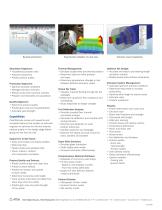
Simulation Engineers: • Troubleshoot problem dies • Improve productivity • Predict product quality Production Engineers: • Optimize process conditions • Manage extrusion inventory • Reduce scrap and maximize recovery • Prepare cost estimates and quotations Quality Engineers: • Determine product quality • Predict grain size and recrystallization • Calculate yield strength Capabilities Click2Extrude comes with powerful and complete features that enable an extrusion engineer to optimize the die and improve product quality in the design stage before going into the first die trial. Support for all...
Open the catalog to page 2All ALTAIR catalogs and technical brochures
 solidThinking Activate
2 Pages
 solidThinking
2 Pages
 HyperWorks Unlimited ®
2 Pages
 Evolve ®
2 Pages
 HyperView ®
2 Pages
 HyperMesh ®
2 Pages


- Automation software solution
- Analysis software solution
- Process software
- Computer-aided design software
- Control software
- Design software solution
- 3D software solution
- Interface software
- Visualization software solution
- Simulation software solution
- Programming software
- Development software
- Reporting software
- Engineering software
- Creation software
- Optimization software
- Modeling software
- Planning software solution
- CAM software
- Flow software