
- Catalogs
- Alpha Moisture Systems Ltd
- Trace Moisture In Welding

- Company
- Products
- Catalogs
- News & Trends
- Exhibitions
Trace Moisture In Welding
Trace Moisture In Welding
Catalog excerpts
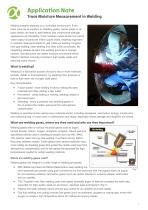
Application Note Trace Moisture Measurement in Welding Welding integrity depends on a controlled environment. Even trace amounts of moisture in shielding gases, carrier gases or on base metals can lead to weld defects that compromise strength, appearance and durability. Trace moisture measurement pin points water vapour at parts per million (ppm) levels, enabling engineers to maintain ideal parameters for gas metal arc welding, tungsten inert gas welding, laser welding and other fusion processes. By integrating reliable sensors into welding gas lines or storage vessels, manufacturers can detect moisture excursions before defects manifest, ensuring consistent, high quality welds and reducing costly rework. What is welding? Welding is a fabrication process that joins two or more materials, typically metals or thermoplastics, by applying heat, pressure or both to fuse them into a single, solid piece. Key characteristics: • Fusion based - most welding involves melting the base materials and often adding a filler metal. • Permanent - unlike bolting or riveting, welding creates a permanent joint. • Shielding - many processes use shielding gases or flux to protect the molten weld pool from atmospheric contamination. Welding is essential across nearly every industrial sector, including aerospace, automotive, energy, construction and manufacturing. It’s also used in maintenance and repair, especially where strength and durability are critical. What are welding gases, where are they used and why are they important? Welding gases refer to various industrial gases such as argon, carbon dioxide, helium, oxygen, acetylene, propane, natural gas and specialised blends used in welding processes such as MIG, MAG, TIG, plasma, laser and oxy-fuel welding, to achieve strong, defect free joints between metals. These gases have several essential roles, most notably as shielding gases that protect the molten weld pool from atmospheric contamination and as fuel gases that generate the high temperatures needed for certain welding methods. Where are welding gases used? Welding gases are integral to a wide range of welding processes: • MIG (Metal Inert Gas) and MAG (Metal Active Gas) welding are semi-automatic processes using gas to shield the arc and weld pool with inert gases (such as argon) for non-reactive protection and active gases (such as carbon dioxide) to enhance deeper weld fusion and arc stability. • TIG (Tungsten Inert Gas) welding uses inert gases (primarily argon or helium) to protect the weld area, especially for high-quality welds on aluminium, stainless steel and titanium (Fig.1). • Plasma and laser welding require precise gas control for arc stability and weld quality. • Oxy-fuel welding and cutting involves fuel gases (such as acetylene, propane or natural gas) mixed with oxygen to create a high temperature flame for melting and joini
Open the catalog to page 1
Application Note Trace Moisture Measurement in Welding Moisture problems encountered in welding applications Introduction of hydrogen from trace moisture contamination Moisture, whether from atmospheric humidity, contaminated gas lines or improperly stored consumables, introduces hydrogen into the welding environment. At the high temperatures present during welding, water vapour decomposes, releasing hydrogen atoms, which are absorbed by the molten weld pool, leading to increased hydrogen content in the weld metal. Even trace amounts of moisture in the shielding gas can substantially raise the...
Open the catalog to page 2
Application NoteTrace Moisture Measurement in WeldingSources of moisture Moisture originates from several sources throughout the welding process, each contributing to the risk of hydrogen contamination and weld defects. • Shielding gases Shielding gas supply systems are a primary source of moisture contamination. Moisture can be present as an impurity in gas cylinders, especially if the gas is not of high purity or if the cylinders are neglected. Leaks in gas lines or during cylinder changes can allow atmospheric moisture to enter the system, contaminating the shielding gas. Furthermore, the...
Open the catalog to page 3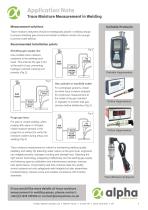
Application Note Trace Moisture Measurement in Welding Suitable Products Measurement solutions Trace moisture analysers should be strategically placed in welding setups to ensure shielding gas and environmental conditions remain dry enough to prevent weld defects. Recommended installation points Fig.2 Shielding gas supply line Use portable trace moisture analysers at the welding torch head. This ensures the gas is dry at the point of use, preventing hydrogen induced cracking and porosity (Fig.2). Fig.3 Portable Hygrometers Gas cylinder or manifold outlet For centralised systems, install an inline...
Open the catalog to page 4All Alpha Moisture Systems Ltd catalogs and technical brochures
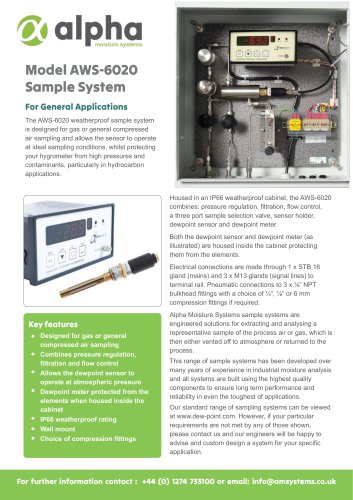 Model AWS-6020 Sample System
3 Pages
 Model 6020 User Manual
41 Pages
 SADPmini2 User Manual
57 Pages
 AMT User Manual
14 Pages
 AMT-Ex User Manual
15 Pages
 PSS User Manual
17 Pages
 SADPmini2-Ex User Manual
86 Pages
 DS1200-Exd-AMT-Ex
3 Pages
 DS1500-Exd
2 Pages
 DS4000-Exd-AMT-Ex
3 Pages
 DSP-FCI Portable Hygrometer
3 Pages
 Model 6020 Exd
4 Pages
 Model 6020
3 Pages
 DS1500
3 Pages




- Digital indicator
- 4-20 mA indicator
- Automatic sampler
- Stainless steel sampler
- Gas sampler
- Sampler for the food industry
- Sampler for the pharmaceutical industry
- Humidity hygrometer
- 4-digit indicator
- Relative humidity hygrometer
- Digital hygrometer
- Portable sampler
- Compact sampler
- Alpha Moisture Systems dew-point transmitter
- Laboratory sampler
- Industrial hygrometer
- Dew-point humidity meter
- Analog dew-point transmitter
- Dew-point meter