
- Catalogs
- Alpha Moisture Systems Ltd
- Trace Moisture in Welding - GTAW & TIG

- Company
- Products
- Catalogs
- News & Trends
- Exhibitions
Trace Moisture in Welding - GTAW & TIG
Trace Moisture in Welding - GTAW & TIG
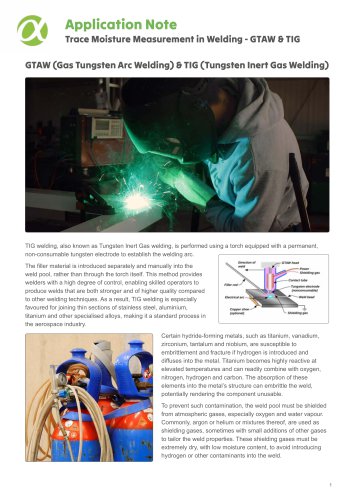
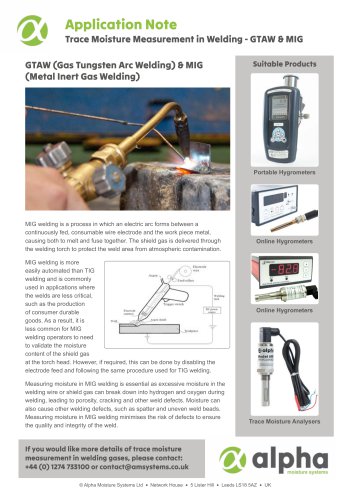
TIG welding, also known as Gas Tungsten Arc Welding (GTAW), utilizes a torch with a non-consumable tungsten electrode to create the welding arc. The filler material is manually added to the weld pool, allowing for high precision and quality welds. This method is preferred for thin sections of metals like stainless steel, aluminum, and titanium, particularly in the aerospace industry.
Metals such as titanium, vanadium, and zirconium can become brittle if hydrogen is absorbed during welding. To prevent contamination, the weld pool must be shielded from atmospheric gases using dry shielding gases like argon or helium.
The aerospace sector follows strict quality standards, often under NADCAP accreditation, which includes maintaining low moisture levels at the torch head, typically between -60 °C and -40 °C dewpoint.
To ensure compliance, moisture content at the torch head can be monitored using a portable dewpoint hygrometer, such as the SADPmini2. Proper sealing and flow rate settings are crucial for accurate measurements.
For more details on trace moisture measurement in welding gases, contact Alpha Moisture Systems Ltd at +44 (0) 1274 733100 or [email protected].
Catalog excerpts

Application Note Trace Moisture Measurement in Welding - GTAW & TIG GTAW (Gas Tungsten Arc Welding) & TIG (Tungsten Inert Gas Welding) TIG welding, also known as Tungsten Inert Gas welding, is performed using a torch equipped with a permanent, non-consumable tungsten electrode to establish the welding arc. The filler material is introduced separately and manually into the weld pool, rather than through the torch itself. This method provides welders with a high degree of control, enabling skilled operators to produce welds that are both stronger and of higher quality compared to other welding techniques. As a result, TIG welding is especially favoured for joining thin sections of stainless steel, aluminium, titanium and other specialised alloys, making it a standard process in the aerospace industry. Certain hydride-forming metals, such as titanium, vanadium, zirconium, tantalum and niobium, are susceptible to embrittlement and fracture if hydrogen is introduced and diffuses into the metal. Titanium becomes highly reactive at elevated temperatures and can readily combine with oxygen, nitrogen, hydrogen and carbon. The absorption of these elements into the metal’s structure can embrittle the weld, potentially rendering the component unusable. To prevent such contamination, the weld pool must be shielded from atmospheric gases, especially oxygen and water vapour. Commonly, argon or helium or mixtures thereof, are used as shielding gases, sometimes with small additions of other gases to tailor the weld properties. These shielding gases must be extremely dry, with low moisture content, to avoid introducing hydrogen or other contaminants into the weld.
Open the catalog to page 1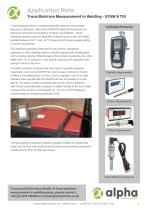
Application Note Trace Moisture Measurement in Welding - GTAW & TIG In the aerospace sector, companies typically adhere to strict quality assurance standards, often under NADCAP (National Aerospace and Defense Contractors Accreditation Program) accreditation. These standards specify maximum allowable moisture levels at the torch head, typically between -60 °C and -40 °C dewpoint and require regular testing to ensure compliance. Suitable Products TIG welding is generally employed for low volume, specialised applications. Each welding station is usually supplied with shielding gas from a nearby...
Open the catalog to page 2All Alpha Moisture Systems Ltd catalogs and technical brochures
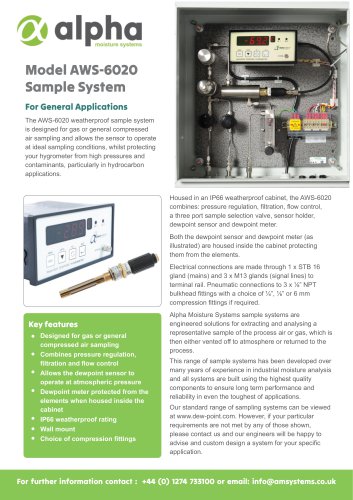
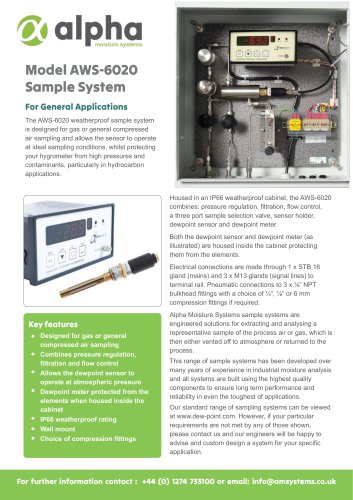 Model AWS-6020 Sample System
3 Pages
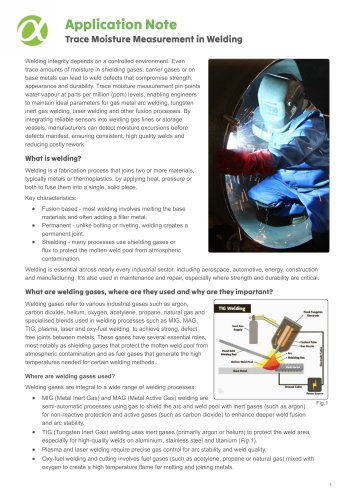 Trace Moisture In Welding
4 Pages
 Model 6020 User Manual
41 Pages
 SADPmini2 User Manual
57 Pages
 AMT User Manual
14 Pages
 AMT-Ex User Manual
15 Pages
 PSS User Manual
17 Pages
 SADPmini2-Ex User Manual
86 Pages
 DS1200-Exd-AMT-Ex
3 Pages
 DS1500-Exd
2 Pages
 DS4000-Exd-AMT-Ex
3 Pages
 DSP-FCI Portable Hygrometer
3 Pages
 Model 6020 Exd
4 Pages
 Model 6020
3 Pages
 DS1500
3 Pages




- Digital indicator
- 4-20 mA indicator
- Automatic sampler
- Stainless steel sampler
- Gas sampler
- Sampler for the food industry
- Sampler for the pharmaceutical industry
- Humidity hygrometer
- 4-digit indicator
- Relative humidity hygrometer
- Digital hygrometer
- Portable sampler
- Compact sampler
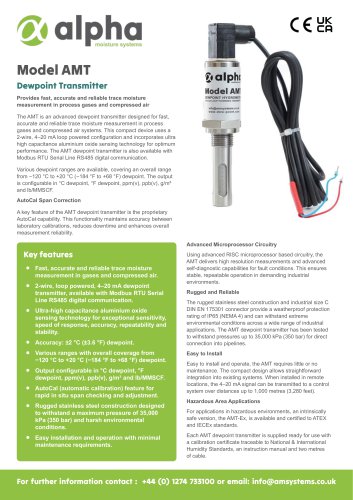
- Alpha Moisture Systems dew-point transmitter
- Laboratory sampler
- Industrial hygrometer
- Dew-point humidity meter
- Analog dew-point transmitter
- Dew-point meter