
- Catalogs
- Alpha Moisture Systems Ltd
- Trace Moisture in Pharmaceutical Manufacturing

- Company
- Products
- Catalogs
- News & Trends
- Exhibitions
Trace Moisture in Pharmaceutical Manufacturing
Trace Moisture in Pharmaceutical Manufacturing
Trace moisture measurement is crucial in pharmaceutical manufacturing to ensure product safety, equipment reliability, and regulatory compliance. Moisture in compressed air and gases can lead to microbial growth, product instability, equipment corrosion, and regulatory non-compliance.
Importance of Trace Moisture Measurement
- Preventing Microbial Growth: High moisture content in compressed air can support bacterial and fungal growth, leading to contamination and product loss.
- Product Stability and Shelf Life: Moisture can cause clumping in powders and catalyze chemical degradation, reducing drug efficacy.
- Equipment Reliability: Moisture leads to corrosion and equipment failure, introducing particulates and causing unplanned downtime.
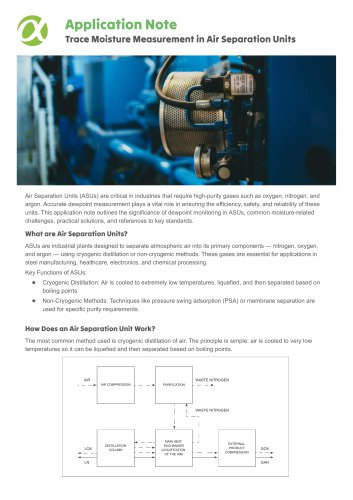
- Regulatory Compliance: Standards like ISO 8573-1 require specific air quality classes to ensure dry air, with a pressure dew point of -40°C or lower.
- Efficient Desiccant Dryer Operation: Dewpoint sensors optimize dryer operation, saving utility costs.
Applications in Pharmaceutical Manufacturing
- Lyophilization: Moisture control ensures optimal sublimation conditions and prevents product degradation.
- Aseptic Filling and Cleanroom Air Supply: Dewpoint transmitters ensure dry air to prevent microbial growth and contamination.
- Powder Handling and Tableting: Continuous moisture measurement prevents clumping and ensures quality in production.
- Nitrogen Purging and Transfer Lines: In-line analyzers prevent oxidation and maintain product integrity.
Measurement Techniques
Robust trace moisture measurement involves continuous dew point measurement, cleanroom humidity control, and periodic spot checks using portable dewpoint meters.
Standards and Compliance
Compliance with standards such as ISO 8573-1, ISO 14644, EU GMP Annex 1, and ICH Q8 is essential for maintaining product quality and patient safety.
Conclusion
Accurate trace moisture measurement is essential for GMP compliance, ensuring product quality, and maintaining equipment reliability in pharmaceutical manufacturing.
Catalog excerpts

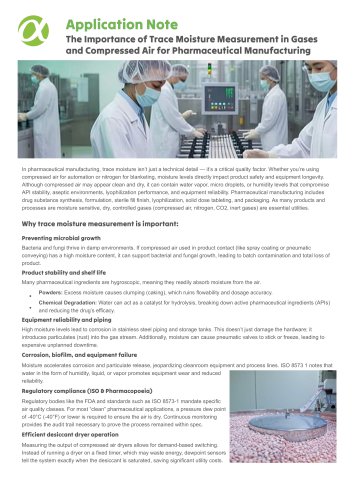
Application Note The Importance of Trace Moisture Measurement in Gases and Compressed Air for Pharmaceutical Manufacturing In pharmaceutical manufacturing, trace moisture isn’t just a technical detail — it’s a critical quality factor. Whether you’re using compressed air for automation or nitrogen for blanketing, moisture levels directly impact product safety and equipment longevity. Although compressed air may appear clean and dry, it can contain water vapor, micro droplets, or humidity levels that compromise API stability, aseptic environments, lyophilization performance, and equipment reliability. Pharmaceutical manufacturing includes drug substance synthesis, formulation, sterile ll nish, lyophilization, solid dose tableting, and packaging. As many products and processes are moisture sensitive, dry, controlled gases (compressed air, nitrogen, CO2, inert gases) are essential utilities. Why trace moisture measurement is important: Preventing microbial growth Bacteria and fungi thrive in damp environments. If compressed air used in product contact (like spray coating or pneumatic conveying) has a high moisture content, it can support bacterial and fungal growth, leading to batch contamination and total loss of product. Product stability and shelf life Many pharmaceutical ingredients are hygroscopic, meaning they readily absorb moisture from the air. Powders: Excess moisture causes clumping (caking), which ruins flowability and dosage accuracy. Chemical Degradation: Water can act as a catalyst for hydrolysis, breaking down active pharmaceutical ingredients (APIs) and reducing the drug’s e cacy. Equipment reliability and piping High moisture levels lead to corrosion in stainless steel piping and storage tanks. This doesn’t just damage the hardware; it introduces particulates (rust) into the gas stream. Additionally, moisture can cause pneumatic valves to stick or freeze, leading to expensive unplanned downtime. Corrosion, biofilm, and equipment failure Moisture accelerates corrosion and particulate release, jeopardizing cleanroom equipment and process lines. ISO 8573 1 notes that water in the form of humidity, liquid, or vapor promotes equipment wear and reduced reliability. Regulatory compliance (ISO & Pharmacopoeia) Regulatory bodies like the FDA and standards such as ISO 8573-1 mandate speci c air quality classes. For most “clean” pharmaceutical applications, a pressure dew point of -40°C (-40°F) or lower is required to ensure the air is dry. Continuous monitoring provides the audit trail necessary to prove the process remained within spec. Efficient desiccant dryer operation Measuring the output of compressed air dryers allows for demand-based switching. Instead of running a dryer on a xed timer, which may waste energy, dewpoint sensors tell the system exactly when the desiccant is saturated, saving signi
Open the catalog to page 1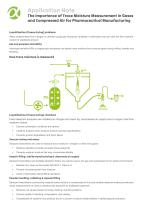
Application NoteThe Importance of Trace Moisture Measurement in Gases and Compressed Air for Pharmaceutical ManufacturingLyophilization (freeze drying) problems Water contamination from nitrogen or chamber purge gas introduces variability in sublimation and can raise the final moisture content of lyophilized product. Api and excipient instability Hydrolysis sensitive APIs or hygroscopic excipients can absorb trace moisture from process gases during milling, transfer and blending. Lyophilization (freeze drying) chambers Fixed dewpoint analysers are installed on nitrogen and clean dry compressed...
Open the catalog to page 2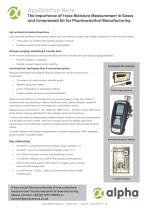
Application NoteThe Importance of Trace Moisture Measurement in Gases and Compressed Air for Pharmaceutical ManufacturingApi synthesis & chemical reactions High sensitivity aluminium oxide sensors detect ppb level moisture in argon and nitrogen necessary for critical chemical steps. • Trace water can interfere with moisture sensitive reactions • Prevents undesired hydrolysis or reagent degradation In-line moisture analyzers ensure accurate measurement of nitrogen dew point during purging operations. • Prevent oxidation or hydrolysis Suitable Products • Maintain product integrity during handling...
Open the catalog to page 3All Alpha Moisture Systems Ltd catalogs and technical brochures
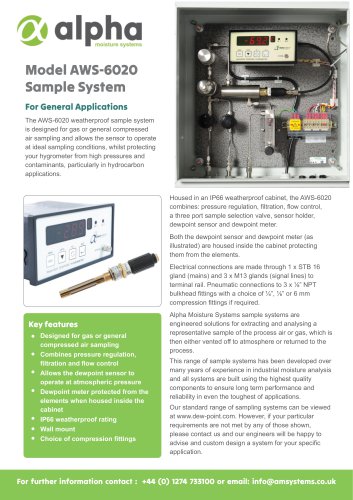
 Model AWS-6020 Sample System
3 Pages
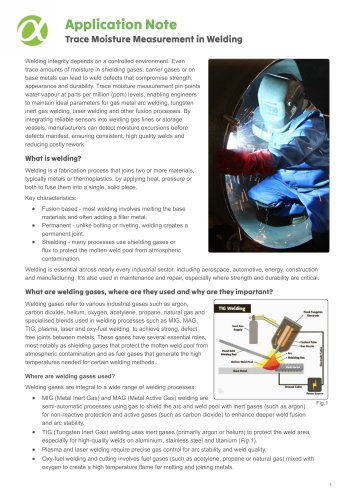 Trace Moisture In Welding
4 Pages
 Model 6020 User Manual
41 Pages
 SADPmini2 User Manual
57 Pages
 AMT User Manual
14 Pages
 AMT-Ex User Manual
15 Pages
 PSS User Manual
17 Pages
 SADPmini2-Ex User Manual
86 Pages
 DS1200-Exd-AMT-Ex
3 Pages
 DS1500-Exd
2 Pages
 DS4000-Exd-AMT-Ex
3 Pages
 DSP-FCI Portable Hygrometer
3 Pages
 Model 6020 Exd
4 Pages
 Model 6020
3 Pages
 DS1500
3 Pages





- Digital indicator
- 4-20 mA indicator
- Automatic sampler
- Stainless steel sampler
- Gas sampler
- Humidity meter
- Sampler for the food industry
- Sampler for the pharmaceutical industry
- Humidity hygrometer
- 4-digit indicator
- Relative humidity hygrometer
- Digital hygrometer
- Portable sampler
- Compact sampler
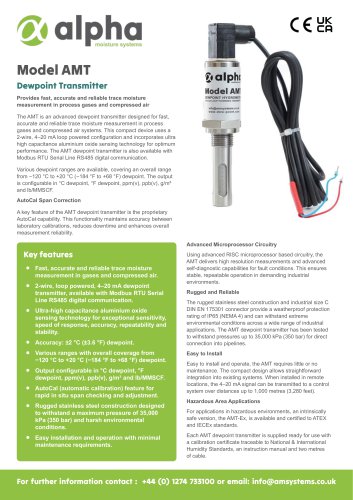
- Alpha Moisture Systems dew-point transmitter
- Laboratory sampler
- Industrial hygrometer
- Dew-point humidity meter
- Analog dew-point transmitter
- Dew-point meter